
The CEO Hot Seat – ResponsibleTrading.com Interview Series
INTRODUCTION (written by ResponsibleTrading.com)
The prop trading industry paid out over $1 billion to traders in 2025. It also saw 80+ firms shut down, leaving thousands of traders with frozen accounts and unpaid profits.
In between those two headlines is a space where trust is everything and information is scarce. Traders spend hundreds of dollars on challenges based on marketing pages, Trustpilot scores, and forum opinions rarely hearing directly from the people running the firms.
The ResponsibleTrading.com CEO Hot Seat changes that.
We ask the questions traders post on Reddit at 2am when their payout gets denied. We ask the questions forums debate for weeks without an answer. And we publish the responses, unedited, so traders can judge for themselves.
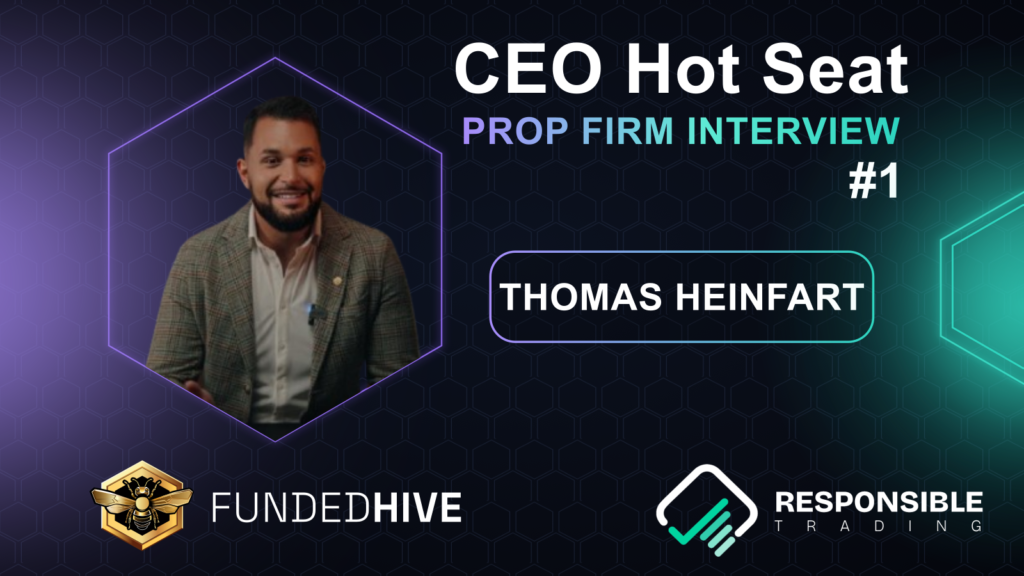
Our first guest is Thomas Heinfart, founder and CEO of FundedHive.
PART 1: THE BUSINESS
Q1. Give us the one-sentence pitch for FundedHive but not the one from your website. The one you’d say to a skeptical trader who’s been burned by a firm before.
FundedHive is built for traders who are tired of trusting promises, because our system is designed around transparent rules, real execution logic, and automated smart-contract payouts that remove the need to “hope” someone approves what you earned.
Q2. How does FundedHive actually make money? Walk us through the business model honestly because traders increasingly understand that challenge fees fund payouts, and they want to know if the math works.
FundedHive makes money through challenge purchases, account-related fees, and a carefully managed hybrid A-book and B-book execution model. The key difference is that we built AADS, our automated A-book dealing system, which allows us to mirror funded traders’ positions into our licensed brokerage accounts when they demonstrate profitable market behavior and meet the required A-book conditions. This means that strong traders are not just a cost to the company. Their real market performance can also create positive cash flow for the ecosystem.
Q3. 80+ prop firms shut down in 2024. What did those firms do wrong, and what specifically does FundedHive do differently to ensure it’s still operating in five years?
The biggest mistake many failed firms made was that they were not built as risk-management businesses. They were built as marketing machines. They sold aggressive account sizes, relied too heavily on traders failing, had no serious A-book infrastructure, had weak platform dependency, and when payouts, regulation, payment pressure, or real profitable traders arrived, the model broke.
Q4. What does your risk management infrastructure actually look like behind the scenes? Most traders have no idea what happens on your end when they open a trade. Give us a real answer.
The real answer is this: FundedHive is not just a dashboard with accounts attached to it. It is a risk infrastructure. Every trade is evaluated from the trader side and from the company side at the same time. We ask: is the trader following the rules, is the exposure sustainable, should this be mirrored to market, is the account still within its allowed risk profile, and can the ecosystem safely continue supporting this trader?
That is also why we are transparent about being hybrid A-book and B-book. We do not believe the future of prop trading is pretending that every trade is always sent to market, and we do not believe the future is hidden B-book models that only survive when traders lose. The future is controlled automation, transparent rules, real execution logic, and risk management that protects both serious traders and the company.
PART 2: THE HARD QUESTIONS
Q5. Industry data from FPFX Technology shows only 7% of traders who buy a challenge ever receive a payout. Does that figure surprise you? And what is FundedHive’s actual payout rate the percentage of challenge buyers who ever withdraw money?
No, the 7% figure does not surprise us. For traditional two-step challenge models, that is actually a realistic industry-level number, because most traders are not yet consistent enough to pass both phases, reach funded status, trade profitably, and complete a withdrawal. But FundedHive is not built around one single model, so the payout rate depends heavily on the account type.
For our Classic two-step model, a number around that range can make sense because the structure is designed to filter for discipline and consistency. But we also offer one-step and instant funding style models, where the path to funded trading is shorter. On these fast-track models, the withdrawal ratio is significantly higher, generally around the 20% to 30% range, depending on the cohort and period measured.
Q6. Has FundedHive ever changed rules on traders who already had funded accounts? If yes, what were the circumstances and how did you handle it? If no, what would it take for you to consider doing so?
No, FundedHive has never changed rules retroactively on traders who already had funded accounts. This is one of the most important trust principles in our company. If a trader joins under a certain rule structure, passes under that structure, and receives a funded account under that structure, we do not believe it is fair or ethical to change the conditions afterward in a way that damages that trader.
Q7. “Vague terms give prop firms unlimited discretion to deny payouts” that’s a direct quote from a trader forum. When you look at your own terms and conditions, are there clauses that a reasonable trader could interpret as giving you an escape route to avoid paying?
FundedHive does not have a manual payout denial process. Once a trader meets the payout conditions, the withdrawal is executed directly from the smart contract, usually in under 60 seconds. So the question is not whether we can “decide” to deny a payout after eligibility. We cannot. The only real question is whether the trader met the rules before the smart contract unlocks the withdrawal.
Q8. Some traders believe the prop firm model is fundamentally structured for most people to fail that the challenge rules are designed as friction to generate fee revenue rather than to genuinely test trading ability. What’s your response to that argument?
The honest answer is that prop firm challenges are supposed to be difficult, because real capital exposure cannot be given to traders without proof of risk control. The problem is not that rules exist. The problem is when rules are hidden, vague, changed retroactively, or used manually to avoid paying traders. FundedHive was built to remove that part.
Q9. What is the single rule in your funded accounts that generates the most disputes or complaints from traders? And why do you keep it?
The most disputed rule is our hybrid A-book and B-book risk switch logic, especially when traders do not understand why a funded account that moves below the required risk threshold can no longer be treated the same way as a profitable A-book account. We keep it because it is one of the core rules that makes real payout sustainability possible.
PART 3: THE TRADER’S SIDE
Q10. A trader passes your challenge, gets funded, follows every rule they know about, and still gets their payout denied. In your experience, what is the most common reason this happens and is it ever actually the firm’s fault?
At FundedHive, if a trader truly passed, became eligible, followed the rules, completed the required verification, and the smart contract unlocks the payout, then a manual payout denial is not possible. The withdrawal is taken directly from the smart contract, usually in under 60 seconds.
Q11. If a trader came to you and said “I want to maximise my chances of getting a payout from your firm” what would you actually tell them to do and avoid? Be specific. Give us the insider advice.
The real insider advice is simple: stop trying to “beat the challenge” and trade as if you are already managing real A-book exposure, because the traders who get paid are usually not the ones taking the biggest shots, they are the ones who stay eligible, controlled, and consistent.
Q12. Gold trading bans. News trading bans. IP restrictions. Consistency rules. Every year the rules get stricter. Is the industry becoming harder for traders to succeed in and if so, why?
Yes, the industry is becoming harder for traders, but mostly because many firms are trying to protect weak business models with more restrictions instead of building better risk infrastructure. FundedHive was built differently: we allow gold trading, news trading, we have no IP restrictions, and we have zero consistency rules on any of our challenges, because our hybrid A-book and B-book structure is designed to manage risk through technology, not through unnecessary limitations.
PART 4: THE FUTURE
Q13. Regulators are circling. The CFTC, FCA, and ESMA are all asking questions about whether prop firms are financial services or gambling. Which side of that argument are you on and what does regulation actually mean for traders?
We do not believe serious prop trading should be treated as gambling. But we also do not believe the whole industry can hide behind the word “evaluation” and pretend regulation never applies. The honest answer is that prop trading is a complex structure: some parts are skill-based evaluation and technology, while other parts, especially real market execution, margin accounts, brokerage activity, payments, KYC, AML, and A-book handling, can require regulated infrastructure. That is why FundedHive is built with multiple service providers and a brokerage structure for the parts of the model that need real-market access and regulatory coverage.
Q14. In five years, what does the prop trading industry look like? Which types of firms survive, which don’t, and where does FundedHive fit into that picture?
In five years, the prop trading industry will be much more regulated, more transparent, and more infrastructure-driven. The firms that survive will be the ones with real risk management, real execution logic, strong compliance, automation, and enough capital discipline to support profitable traders. The firms that disappear will be the coupon-driven, copy-paste challenge sellers that depend on traders failing and have no serious risk infrastructure behind them. FundedHive is building for the first category.
PART 5: THE LIGHTNING ROUND
Short answers only. First instinct.
Q15a. The one rule you’d remove from the industry if you could.
The one rule we would remove from the industry is the consistency rule, because in most cases it is not a real risk-management tool. It is a payout trap.
Q15b. The firm you respect most other than your own.
FTMO. Not because we agree with every rule or every part of their model, but because they proved something important: a prop firm can become a serious global company when it builds brand trust, technology, operational discipline, and long-term infrastructure instead of only selling hype.
Q15c. The biggest lie the prop trading industry tells traders.
The biggest false promise in the prop trading industry is: “We want profitable traders,” while the firm’s entire model is built in a way where profitable traders become a threat.
Q15d. What percentage of your traders do you think genuinely have what it takes to be consistently funded long-term?
If we define “consistently funded long-term” as staying eligible across multiple payout cycles, not just getting one withdrawal, then honestly it is a single-digit percentage. Probably under 10%.
Q15e. If you weren’t running a prop firm, what would you be doing?
If I were not running a prop firm, I would still be doing the same thing at the core: building systems that make broken industries more transparent, automated, and scalable. FundedHive is one expression of that mindset, but my work goes far beyond prop trading.
CLOSING NOTE (written by ResponsibleTrading.com)
We thank Thomas Heinfart for participating in the ResponsibleTrading.com CEO Hot Seat. Answers are published as received, unedited.
FundedHive is reviewed independently at https://responsibletrading.com/prop-firm-reviews/fundedhive-review/
Our score reflects trading conditions, payout track record, rule transparency, and community feedback — not participation in this interview series.
If you’re a prop firm CEO and want to take the Hot Seat, contact us at marketing@responsibletrading.com
Exclusive ResponsibleTrading.com Discount
Get a discount on FundedHive
Use our exclusive code at checkout to save on any FundedHive challenge.
Claim Discount at FundedHive →
Code applied at checkout. Terms set by FundedHive.