
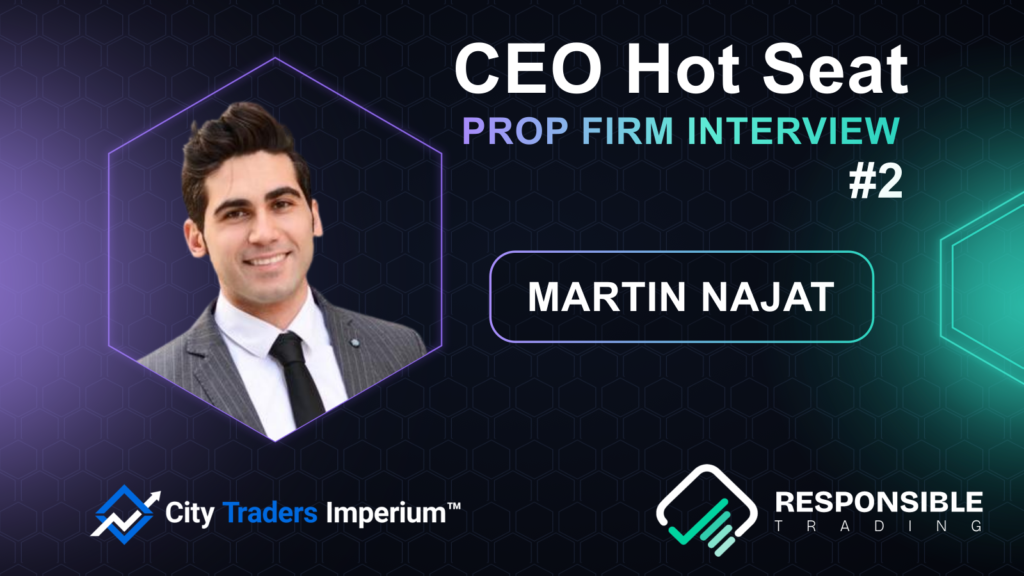
The CEO Hot Seat – ResponsibleTrading.com Interview Series
INTRODUCTION (written by ResponsibleTrading.com)
The prop trading industry paid out over $1 billion to traders in 2025. It also saw 80+ firms shut down, leaving thousands of traders with frozen accounts and unpaid profits.
In between those two headlines is a space where trust is everything and information is scarce. Traders spend hundreds of dollars on challenges based on marketing pages, Trustpilot scores, and forum opinions, rarely hearing directly from the people running the firms.
The ResponsibleTrading.com CEO Hot Seat changes that. We ask the questions traders post on Reddit at 2am when their payout gets denied. We ask the questions forums debate for weeks without an answer. And we publish the responses, unedited, so traders can judge for themselves.
Our second guest is City Traders Imperium one of the longest operating prop firms in the industry. Founded in 2018, CTI has stayed standing through the 2024-2026 industry consolidation that took down 80+ firms, and is currently in the final phase of testing what its CEO describes as a model that decouples trader payouts from challenge fee revenue entirely, something never done before in this industry.
The questions below cover the business model, the hardest trader complaints CTI has faced, regulatory positioning, and where the industry is heading. Answers are published exactly as received.
“That cheap challenge fees mean more value. They don’t. They mean the firm can’t afford to pay you.”
PART 1: THE BUSINESS
Q1. Give us the one-sentence pitch for City Traders Imperium but not the one from your homepage. The one you’d say to a skeptical trader who’s been burned by a prop firm before.
CTI has been operating since 2018, which puts us in a tiny minority of firms with real longevity in this industry. We price our products to reflect what it actually costs to run a legitimate operation and pay traders consistently. If you’ve been burned before, chances are you chased a deal that looked too good to be true. CTI has been here since 2018, we price our products sustainably so we can actually pay you, and we’re not going anywhere.
The pattern we see repeatedly is that traders get hurt by two things: firms that are too new to have proven themselves, and firms that price so aggressively they can never survive to pay their clients. Those rock-bottom challenge fees make great marketing, but they’re not a viable business model, and when traders get to payouts, they find out the hard way.
Q2. CTI has been operating since 2018, which makes you older than 95% of the firms in this industry. Walk us through how the business model actually works in 2026 challenge fees, A-book vs B-book, the brokerage relationship, and how the academy fits in.
Any prop firm that wants to last cannot rely solely on challenge fees or a pure B-book model. The smart approach is a hybrid: A-book and B-book allocation based on trader performance. The real challenge has always been separating the good traders from the bad ones, and that challenge has gotten significantly harder.
The gamification of the prop industry changed everything. Traders no longer try to protect their accounts the way they once did. They’re optimising for getting a payout, not for longevity. That shift broke the traditional A-book/B-book dynamic and introduced risks that most firms weren’t prepared for. We’ve had to adapt constantly.
What I can say is that we are currently testing a model in the final phase that has never been done before in this industry. One that decouples the business from its dependency on challenge fees entirely. The goal is a structure where traders receive their payouts regardless of challenge fee revenue. When that goes live, it will be a fundamental shift in how prop firms operate.
On the brokerage side, managing liquidity provider relationships is an ongoing challenge. LPs want volume and flow, and balancing that with trader interests requires constant negotiation and careful risk management.
As for the Academy, it has always been central to what we do, but it has evolved. We used to teach strategies, but in 2026 we shifted to something more impactful: making all our education completely free to every CTI client. The focus moved away from strategies and toward two things helping traders genuinely understand how prop firms work, including the rules, the terms, and the business mechanics, and deeply investing in trading psychology. As traders scale to larger accounts and bigger payouts, psychology becomes the defining factor. That side of the academy is led by my business partner and performance coach, Daniel Martin.
Q3. 80+ prop firms shut down between 2024 and 2026. CTI didn’t. What, specifically, about how you built the business protected you when MetaQuotes started revoking licences and the industry consolidated and what should traders look for in any firm they’re funding with capital right now?
Most firms weren’t prepared because, for a long time, running an MT5 was cheap and the requirements were minimal. That changed dramatically. Today, holding an MT5 licence is actually a meaningful signal; the KYB requirements and operational standards MetaQuotes now enforces are strict, costly, and harder than ever to maintain. Firms that have it have cleared a real bar.
What killed most of the firms that closed wasn’t the MetaQuotes crackdown itself; it was that they had been pouring everything into marketing and leaving nothing for operational reserves. When a difficult month hit, or regulatory pressure came, they had no cushion. They were one bad quarter away from collapse, and many of them were already there.
Our approach was always different. We maintained enough cash reserves to operate for a full year without any revenue. That discipline is what protected us. When MetaQuotes revoked licences across the industry and later reopened the process with stricter requirements, we were in a position to come back through that process cleanly and move forward without disruption.
For traders evaluating any firm right now, I’d look at three things: how long they’ve been operating, whether they hold their own MT5 licence, and whether their pricing actually makes sense as a sustainable business.
Q4. Your scaling plan markets accounts up to $4 million, but the path to those numbers is on the Instant Funding side via multiple accounts, while evaluation challenges are effectively capped well below that per account. Critics call this confusing marketing. How do you respond, and would you change the way it’s presented?
The criticism misreads what we’re actually saying. We say “up to $4 million”, and that’s precisely what it means. It’s the maximum capital a trader can access across our funding programs. We’ve never claimed that every program delivers $4 million on a single account. Each program has its own structure, its own features, and its own scaling path.
Think of it like a credit card company advertising its highest available limit. They’re not saying every customer gets that limit on day one; they’re showing you the ceiling of what’s possible. That’s exactly what we’re doing. The $4 million is achievable, and the route to get there is clearly tied to the Instant Funding program.
Different traders have different goals and different risk appetites. That’s why we offer multiple programs: One Step, Two Step, Three Step, and Instant Funding. Each is designed for a different type of trader. The $4 million figure represents the top of what CTI can offer, and traders who want to reach that number have a clear path to do so.
PART 2: THE HARD QUESTIONS
Q5. The most consistent trader complaint about CTI on independent review platforms is what some call the “hidden maximum risk rule” funded traders reporting their trades flagged or accounts breached after taking stops between roughly 2.5% and 5.6%, even though they say no specific maximum-risk percentage is published clearly on the rule page. Is this a real rule? What is the exact threshold, and why isn’t it stated in plain language at the top of the rules document?
There is no hidden rule. What we have is a clearly stated overleveraging policy that is visible in our FAQs, our rules page, and the welcome email every trader receives when joining one of our programs.
What the complaints on review platforms don’t tell you is the full picture of what actually triggered the flag. It’s rarely just about a percentage. Our review process looks at overall trading behaviour, and what we consistently find in these cases is a pattern of extremely aggressive, high-leverage trading that constitutes gambling behaviour rather than disciplined trading. Sometimes it’s a single oversized position. Sometimes it’s the same trade split across two tickets to disguise the true exposure. The percentage alone doesn’t capture it, the behaviour does.
I’ll also be direct about something the industry doesn’t talk about enough: there are coordinated groups of traders who deliberately exploit prop firms, follow specific patterns designed to extract payouts, and when they get flagged, they organise complaint campaigns on review platforms to pressure firms into paying. We are aware of these groups, we recognise the patterns, and we enforce our rules regardless of the noise. A firm that folds under that kind of pressure isn’t protecting its legitimate traders; it’s rewarding bad actors.
The rules are clear. The traders who read them, follow them, and trade with discipline don’t have this problem.
Q6. CTI’s published commissions sit around $5 per lot on forex and commodities, higher than several major competitors. The phrase “CTI pricing is extremely high” appears repeatedly in trader reviews. Defend it. What does a trader actually get for that pricing that they wouldn’t get at a firm charging half?
First, let’s correct the record on commissions. $5 per lot on forex and commodities is actually below the industry average. Most firms charge between $6 and $9 per lot. A handful charge $3 to $4, but that is the exception, not the norm. So the commission criticism doesn’t hold up when you look at what the market actually charges.
What traders are more likely referring to is challenge pricing, and I’ll acknowledge that in 2026 our prices sat at a premium. That changed on June 1st. We permanently reduced our pricing across the board, and traders can now access a $100k account for as low as $449 without considering discounts. These are not promotional prices; these are our new permanent prices, and they make us more competitive than we’ve ever been.
But here’s the broader point: price is only one part of the equation. When a trader funds with CTI, they’re not just buying a challenge. They’re trading with a company that has been operating and paying traders since 2018, which puts us in a tiny minority of firms with proven longevity. They get support that responds within 30 minutes. They get full access to our educational content, structured courses, and a genuine trading community. They get the confidence of knowing the firm they’re trading with has a track record of actually paying its traders.
Cheaper firms exist. Some of them won’t be around in six months. That’s the real cost comparison traders should be making.
Q7. Has CTI ever changed rules, drawdown calculations, payout schedules, consistency requirements, anything on traders who already had funded accounts? If yes, when, what changed, and how was it handled? If not, what specifically would have to happen for you to consider it?
Yes, rules have evolved over time; that’s inevitable for any business operating across eight years in a rapidly changing industry. But our principle has always been the same: we do not apply changes retrospectively in ways that harm existing traders.
When we’ve made changes that benefit traders, we’ve applied them universally. Existing accounts included. When we’ve had to make stricter changes, those have always applied to new purchases only. Traders who already held funded accounts under previous terms kept those terms. That’s a line we take seriously.
The one area where we did apply a retrospective change was the copy trading/VPN usage policy. That was a necessary decision, but even then we didn’t simply enforce it and move on. We invited traders to come to us on a case-by-case basis. If a trader could demonstrate they were operating legitimately and not violating the spirit of our rules, we worked with them individually and, in many cases, allowed them to continue under the previous terms. The burden of proof was reasonable; we just needed enough to confirm the trading was genuine.
The underlying philosophy hasn’t changed: when there’s a dispute or a grey area, our default position is to look for a resolution that works in the trader’s favour. That’s not a marketing line; it’s how we’ve operated for eight years, and it’s a large part of why our community stays with us.
Q8. CTI’s operational headquarters is publicly listed in Dubai, but trading services are reportedly run through a registered entity in Comoros. Trader forums regularly ask why a 2018-era firm with a UK origin uses a Comoros entity. Give us the real reason and explain what protection, if any, that gives a trader whose payout is disputed.
The move to Dubai was a straightforward business decision. Dubai is simply a better global hub than the UK for a business of our ambitions: better infrastructure, better access to international markets, and a more favourable environment for scaling globally.
On Comoros: we wanted to ensure the business was properly structured and protected, because a protected business means continuity for our traders. Currently, a prop firm can operate without a regulation, but we chose the route that gave us the most stable foundation in the long term.
But I want to address the broader question behind this, which is really about trader protection. Regulation alone has never been a reliable indicator of whether a firm actually pays its traders.
At CTI, our policy is simple: we pay our traders. We have done this consistently since 2018, including in cases where we identified traders who had violated our rules. Even in those situations, we chose to honour the payout and then part ways. We also significantly improved our payout speed; since 2025, payouts have been processed within 24 hours of the request being made.
For traders who have a dispute, we have a formal complaints process. Every case raised through support is escalated to management and reviewed. And our standing policy is that traders receive their payout regardless of the outcome of that review. That commitment is what actually protects a trader.
Q9. The current risk model uses balance-based (static) drawdown on evaluation challenges and trailing drawdown on Instant Funding. Industry data shows trailing-drawdown accounts fail at materially higher rates. Why offer both, and is the Instant Funding trailing model designed to filter traders out before they reach the higher milestones?
Let me correct the premise of this question, because the information it’s based on is inaccurate. Instant Funding uses a balance-based static drawdown of 6%. It is not trailing. The trailing drawdown is on our 1-Step challenge, not on Instant Funding. Anyone who wants to verify that can check our website directly.
Regarding the trailing drawdown statistics: the claim that trailing drawdown accounts fail at materially higher rates is not as clear-cut as presented. Futures prop firms have used trailing drawdown models for years, and many traders achieve consistently high success rates within that structure.
The reason we offer a trailing drawdown on the 1-Step challenge is simple accessibility. But the most important point here is this: if our goal were to filter traders out, we wouldn’t offer multiple programs with different drawdown models. We offer the 1-Step, 2-Step, and Instant Funding precisely because we understand that different traders have different needs, different budgets, and different trading styles. Traders are free to choose whichever program suits them best.
The variety exists to maximise every trader’s chance of success, not to limit it. We wanted to create a program that any trader could enter regardless of their budget, because we understand that not every trader has the financial means to go straight into a higher-priced program. The 1-Step exists to give those traders a genuine entry point into funded trading at every stage of their journey.
And here is where CTI does something genuinely different from most firms in the industry. With many prop firms, when a trader makes a withdrawal, that withdrawal amount is counted against their drawdown buffer. We think that is fundamentally unfair. At CTI, withdrawals do not affect the drawdown buffer at all. If a trader reaches their payout level and withdraws, their full drawdown buffer remains intact. For traders who are scaling and withdrawing consistently, that is a distinction that matters enormously.
PART 3: THE TRADER’S SIDE
“Regulation alone has never been a reliable indicator of whether a firm actually pays its traders. At CTI, our policy is simple: we pay our traders.”
Q10. Industry research suggests roughly 7% of challenge buyers ever receive a single payout across the prop trading industry. What is CTI’s actual figure the percentage of evaluation buyers who ever withdraw money and how does it differ between your One Step, Two Step, Three Step, and Instant Funding tracks?
We don’t disclose exact internal figures publicly, and I’d be sceptical of any firm that does that. But what I can tell you is that CTI performs above the industry average, and our overall payout rate across programs is well higher than the 7% figure cited.
What I think is more telling than a single snapshot figure is the trajectory of payouts. A few years ago, the industry average payout was sitting around 2% of the initial balance. At CTI, that figure has grown dramatically over the years to 4.5% and continues to improve. That reflects a combination of better trader education, easier rules, and a community that genuinely understands how to trade within the rules.
Across our programs, Instant Funding consistently has the highest payout rate of all, which makes sense given its structure and the type of trader it attracts.
Q11. CTI’s academy is genuinely unusual most prop firms sell a challenge and disappear; you run “Bank Level Trading,” “Trading Psychology Blueprint,” and structured mentorship under Daniel Martin. Critics say the education is a clever retention funnel that keeps traders paying for resets and new challenges. Defenders say it’s the reason your community is so loyal. Which is it, honestly, and what evidence can you point to that the academy genuinely produces consistently funded traders rather than just consistent customers?
Let me give you some context that most people don’t know. CTI was founded as an education company before it became a prop firm. Education was always the foundation, not an afterthought, and certainly not a sales funnel.
The academy is free and included with every funding program purchase. It is not an upsell, it is not a separate subscription, and it is not designed to extract more money from traders. We made that decision deliberately because we understand that many traders don’t pass on their first attempt. If all we did was sell them another challenge without genuinely trying to help them improve, that would be predatory. That model exists across this industry, and we have always refused to be part of it.
Our education focuses heavily on trading psychology because that is where most traders actually fail. It is rarely the strategy. It is the mindset, the discipline, and the ability to handle pressure as accounts grow. That is what Daniel Martin addresses through his mentorship, and the results speak for themselves. You can find traders on our YouTube channel who went through our education, worked with Daniel, and have gone on to get funded multiple times.
But I will also be honest about this. Education can only take someone so far. You can go to the best university in the world and still not succeed in your field. That does not mean the university failed you. We do everything we can from our side to give traders the knowledge, the psychological tools, and the community support they need. What they do with that is ultimately up to them. Our job is to make sure that when a trader is ready, CTI gives them every possible advantage to succeed.
Q12. A trader funded by CTI passes every rule they know about, requests their payout, and gets denied. In your operational experience, what is the single most common reason this happens and what percentage of denials, on review, turn out to be the firm’s mistake rather than the trader’s?
The premise of this question needs addressing first. If a trader genuinely follows every rule at CTI, they receive their payout 100% of the time. There are no exceptions to that. Payout denials at CTI happen for one reason only: our fraud detection systems have identified cheating behaviour.
When we flag a trader for cheating, we do not do so lightly. We always provide proof from our fraud detection systems. We are not in the business of denying legitimate payouts and hiding behind vague justifications.
That said, we absolutely acknowledge that mistakes can happen on our side. That is precisely why we have a two-tier review system in place. If a trader believes their payout was denied incorrectly, they can escalate the case to the management level, where we take a broader view of all the information available. If we find that a mistake was made on our end, we reverse the decision quickly, and the trader receives their payout.
The process exists because we take fairness seriously. We are confident in our fraud detection, but we are equally confident in our willingness to correct ourselves when we are wrong. That two-tier system is what ensures no legitimate trader ever falls through the cracks.
Q13. If a trader walked up to you tomorrow and said, “I want the highest possible chance of getting a payout from CTI” what would you actually tell them to do, and what to avoid? Be specific.
The advice is simpler than most people expect. Read the rules, understand them fully, and then trade the account exactly as you would trade your own personal live account. That mindset shift is everything.
The traders who fail are almost always the ones who treat a funded account like a lottery ticket. They take oversized positions, they gamble on single trades, and they push the boundaries of the rules because they feel like it is not their own money at risk. That is the wrong approach entirely. A funded account is a responsibility, not a free shot.
In terms of which program gives you the highest chance of getting a payout, I would point traders towards either Instant Funding or our Two Step challenge. Both are designed with structures that reward disciplined, consistent trading.
Beyond that, my specific advice is this: size your positions responsibly, do not overleverage, do not go all in on a single trade, and treat every day of trading as if your own capital is on the line. Because in a sense, it is. Your reputation, your account, and your ability to scale to larger capital all depend on how you treat that account from day one.
CTI wants good traders to succeed and scale. We are not looking for reasons to deny payouts. We are looking for traders who prove they can manage risk consistently over time. Give us that, and the payouts will follow.
PART 4: THE FUTURE & REGULATION
Q14. The CFTC’s MyForexFunds action, MetaQuotes’ platform crackdown, and the FCA’s increasing focus on retail “evaluation” products have made it clear that regulation is coming. CTI’s structure already spans the UK, Dubai, and Comoros. Are you preparing for prop firms to be formally regulated as financial services, and if so, what does that look like for traders better protections, or higher costs?
We are already preparing. The Comoros regulation we obtained was a deliberate and forward-thinking decision, not a box-ticking exercise. We wanted to ensure that as the regulatory landscape evolves, CTI is already operating within a recognised framework rather than scrambling to catch up.
That said, I want to be honest about what full broker-style regulation of prop firms would actually mean for the industry, because the conversation around this tends to be overly optimistic.
If prop firms were regulated the same way brokers are, the impact would be severe. Regulation is typically jurisdiction-specific, meaning firms would need to obtain licences country by country. That immediately restricts which markets you can sell into, which for an industry that operates globally, would be a devastating hit to revenue. At the same time, the compliance costs would increase massively. With margins in the prop industry already under significant pressure, that combination of shrinking sales and rising costs would not just hurt prop firms. It would likely kill a large portion of the industry entirely.
For traders, the reality is that broker-style regulation would not necessarily mean better protection. It would mean higher challenge fees, fewer firms to choose from, and reduced access to funding programs depending on where you live. The traders who would suffer most are those in regions that fall outside the approved jurisdictions of surviving firms.
The better path forward is proportionate oversight that addresses the real problems in the industry, which are fraudulent firms and unpaid traders, without imposing a regulatory framework designed for a completely different business model.
Q15. In five years, what does the prop trading industry look like and what does CTI look like inside it? Which firms survive, which don’t, and what’s the one thing CTI is doing today that you believe will still matter in 2031?
The consolidation that happened between 2024 and 2026 is not over. The firms that survive the next five years will be the ones that do the right things, align themselves genuinely with their traders, and have strong operational foundations. The ones that don’t will be the firms still chasing cheap marketing wins, cutting corners on operations, and treating traders as a revenue source rather than a partner. That model has already started collapsing, and it will continue to do so.
At CTI, our ambition is not to be the biggest firm in the industry. It is to be the most trader-aligned prop firm in the world. Those are very different goals, and we are comfortable with that distinction.
In terms of what we are building today that will still matter in 2031, I will say this much without giving too much away: we are working on something that has never been done before in this industry. The goal is to fully decouple payouts from challenge sales, so that trader payouts are 100% independent from the revenue generated by challenge fees. When that model is live, it will fundamentally change the relationship between prop firms and traders because it removes the conflict of interest that sits at the heart of most of the industry’s problems today.
That is the future we are building towards. And we believe that in 2031, the firms that are still standing will be the ones that found a way to put the trader first, not just in their marketing, but in the actual structure of their business.
PART 5: THE LIGHTNING ROUND
Short answers only. First instinct.
Q16a. The one rule you’d remove from the prop trading industry if you could.
Withdrawals counting against your drawdown buffer. It penalises traders for doing exactly what they’re supposed to do, which is making money and taking it out. We already removed it at CTI, and the whole industry should follow.
Q16b. The firm you respect most, other than your own.
FTMO. They built the blueprint for this industry and have maintained their standards consistently. Respect where it’s due.
Q16c. The biggest lie the prop trading industry tells traders.
That cheap challenge fees mean more value. They don’t. They mean the firm can’t afford to pay you.
Q16d. What percentage of CTI traders do you believe genuinely have what it takes to be consistently funded long-term across multiple payout cycles, not just one withdrawal?
Honestly, a very small percentage, because the majority of traders approach this like a casino rather than a long-term professional endeavour.
Q16e. If you weren’t running CTI, what would you be doing?
Honestly, I can’t imagine doing anything unrelated to this industry. I have poured my life into CTI. If I weren’t running CTI, I would probably be building a tech company serving prop firms, which we actually do as well through Prop Fintech.
CLOSING NOTE (written by ResponsibleTrading.com)
We thank City Traders Imperium for participating in the ResponsibleTrading.com CEO Hot Seat. Answers are published as received, unedited.
City Traders Imperium is reviewed independently at https://responsibletrading.com/prop-firm-reviews/city-traders-imperium-review/
Our score reflects trading conditions, payout track record, rule transparency, and community feedback — not participation in this interview series.
If you’re a prop firm CEO and want to take the Hot Seat, contact us at marketing@responsibletrading.com