
The CEO Hot Seat – ResponsibleTrading.com Interview Series
INTRODUCTION (written by ResponsibleTrading.com)
The prop trading industry paid out over $1 billion to traders in 2025. It also saw 80+ firms shut down, leaving thousands of traders with frozen accounts and unpaid profits.
In between those two headlines is a space where trust is everything and information is scarce. Traders spend hundreds of dollars on challenges based on marketing pages, Trustpilot scores, and forum opinions, rarely hearing directly from the people running the firms.
The ResponsibleTrading.com CEO Hot Seat changes that. Because our platform is built to educate traders and highlight how legitimate prop firms offer a superior alternative to traditional brokers, we require absolute transparency from the industry’s leaders.
We ask the questions traders post on Reddit at 2am when their payout gets denied. We ask the questions forums debate for weeks without an answer. And we publish the responses, unedited, so traders can judge for themselves.
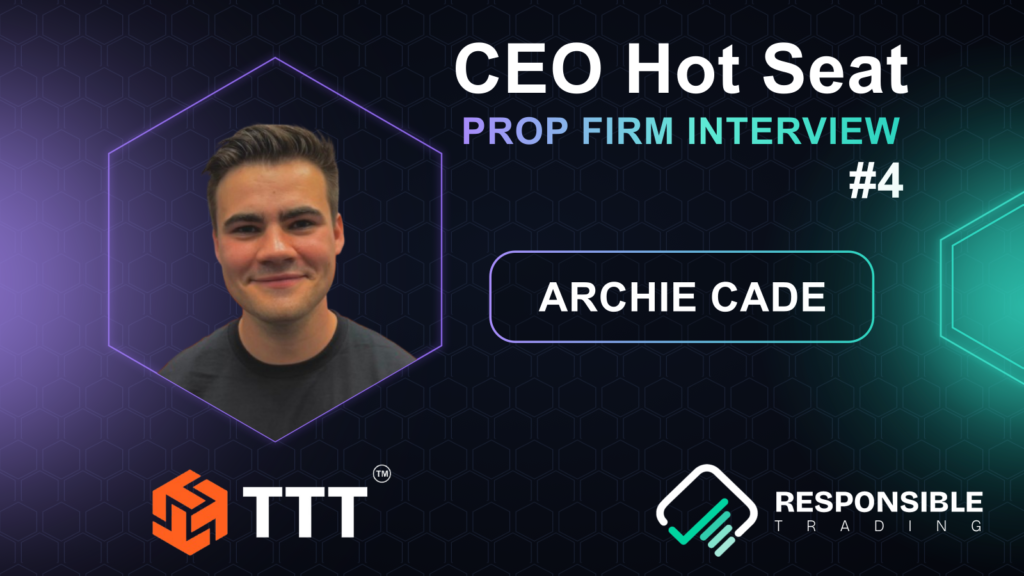
Our next guest is Archie Cade, Founder and Director of TTTMarkets.
PART 1: THE BUSINESS
Q1. Give us the one-sentence pitch for TTTMarkets, but not the one from your website. The one you’d say to a skeptical trader who has been burned by multiple flash-in-the-pan B-book firms recently.
TTTMarkets has been around since 2022, making us one of the longest-standing firms in the industry – we are a company built and run by traders, so everything we do is focused on creating a firm we’d genuinely want to trade with ourselves.
Q2. You’ve recently made headlines by announcing TTTMarkets is expanding into a CFD brokerage to offer live trading alongside evaluations. Walk us through your actual business model today. When a funded trader places a trade, are they trading live market liquidity, or are they still on a simulated server with their trades being B-booked? Let’s clear up the “real money” debate once and for all.
I launched our CFD brokerage because of demand from existing traders. A lot of people were receiving payouts from their prop accounts and wanted somewhere they could continue trading with their own capital, and they wanted to do that with us.
Around 95% of our clients are still trading prop firm challenges, but offering personal CFD accounts has always been part of the long-term vision. It’s actually how I got started in the industry myself.
The brokerage gives traders the option to move beyond the simulated prop environment and trade their own capital with full control over their strategy, rather than being limited to an evaluation model.
Q3. You survived the massive prop industry shakeup that took down dozens of your competitors, and you are registered in Saint Lucia. What is the single biggest operational or financial vulnerability that killed those firms, and how does your “broker-backed” model insulate TTTMarkets from the same fate?
It was definitely a wild time. It felt like every week another prop firm was disappearing. One of the biggest reasons we came through it was that we’d invested heavily in our own technology. Most of our platform is built in-house by our development team, a lot of firms were relying on third-party providers for almost everything. When brokers started offboarding prop firms from using their MQ servers, some companies suddenly had to migrate thousands of trading accounts in a matter of days. That created huge operational problems, downtime, refund requests, and unfortunately some firms just couldn’t recover from it. We were able to adapt quickly because we controlled much more of our own infrastructure. That gave us far more flexibility at a time when the industry was changing incredibly fast. The industry has matured a lot since then. I think firms are generally much better prepared today, but that period really showed how important it is to own your technology and be able to react quickly when the market changes.
Q4. Many of your competitors use aggressive trailing drawdowns, which critics argue is a statistical trick designed to make traders fail when they finally get into profit. TTTMarkets explicitly highlights its fixed, static drawdown rules instead. Why did you opt for the static model, and does offering a fixed drawdown expose the firm to higher risk from aggressive traders?
I think it really depends on the overall structure of the challenge. In many cases, if a firm offers a trailing drawdown, they’ll balance that with fewer evaluation steps or a lower profit target. For us, we chose a static drawdown because we think it’s much simpler for traders to understand and manage. They always know exactly where their maximum loss is, so it’s easier to calculate risk and build consistency into their trading. From a risk perspective, it’s all about the overall challenge design rather than one individual rule. We structure our models so that they’re sustainable for the business while still being fair and straightforward for traders.
PART 2: THE HARD QUESTIONS
Q5. You offer an array of models: 1-Step, 2-Step, Instant Funding, and Subscription accounts. Why the fragmented approach? Is this a genuine attempt to cater to different trading styles, or simply a way to capture every possible retail demographic, including those looking for high-risk gambling models?
No, we genuinely pride ourselves on giving traders flexibility. For a long time, traders were often forced into one model that suited the firm, rather than one that suited the way they actually trade. We wanted to change that. We offer a range of funding models, all with clear, transparent rules, so traders can choose the one that best fits their trading style and experience. Does that mean we appeal to a wider range of traders? Absolutely. But that’s a result of giving people more choice, not the objective. The objective is to let traders decide which model works best for them, rather than forcing everyone into the same structure.
Q6. Let’s talk about execution. On forums, traders occasionally complain about spread widening and execution delays during high-impact news events. Since you operate as a broker-backed firm offering “institutional spreads,” how do you respond to the accusation that liquidity is artificially thinned to trigger stop-losses and fail accounts?
I actually spoke about this on stage at the London Prop Firm Expo when discussing operational excellence. My view is that the trading conditions in an evaluation should be as close as possible to the conditions a trader would experience on a funded account. Consistency is really important. Spreads widening during major news events or periods of lower liquidity is a normal part of financial markets and happens across the industry. But execution issues or artificial degradation of trading conditions shouldn’t be accepted by traders. The same principle applies to things like leverage. The conditions a trader qualifies under should be the conditions they continue to trade with. That’s how we’ve always approached building our products.
Q7. TTTMarkets enforces a profit distribution consistency rule where no single day’s profit can account for a massive percentage of the total target. Traders often hate these rules, claiming they are purely designed as a backdoor to deny payouts. What exactly is your team looking for during account reviews, and has a trader ever hit the profit target only to be denied funding because of a consistency breach?
The purpose of the consistency rule is to encourage genuine trading rather than one-off, high-risk behaviour. For example, if someone places multiple placeholder trades and one trade generates virtually all of the profit, that’s not the type of trading prop firms are there to reward. The rule also helps protect against abusive strategies, coordinated hedging groups, and other forms of rule manipulation. It’s not unique to us – it’s a principle you’ll see across many of the established firms in the industry. During an account review, we’re looking to make sure the profits have been generated in line with the rules of the programme. In the vast majority of cases, if there’s a consistency issue, it doesn’t mean the payout is declined altogether. More commonly, it means the reward is adjusted in line with the programme rules rather than the trader being rejected outright.
Q8. TTTMarkets requires a specific add-on for weekend holding on the 1-Step account, which has been a point of friction for swing traders. Why put basic trading flexibility like overnight and weekend holding behind an add-on paywall instead of building it into your standard risk parameters from the beginning?
It’s worth remembering that this only applies to our 1-Step model. The weekend holding add-on is a relatively small cost compared to the overall challenge, and the reality is that not every trader wants or needs to hold positions over the weekend. Rather than making every trader pay for a feature that only some will use, we decided to make it optional. That way, day traders aren’t subsidising a feature they don’t need, while swing traders still have the flexibility to add it if it suits their strategy. For us, it’s about giving traders the choice to build the account around how they trade, rather than forcing everyone into the same model.
PART 3: THE TRADER’S SIDE
Q9. A trader passes your challenge, gets funded, and is scaling smoothly. Suddenly, they receive an email stating their account is being terminated due to “exploiting the simulated environment”. What constitutes this exploitation in the eyes of TTTMarkets, and where do you draw the line between a highly profitable EA/strategy and an “abusive” one?
Most traders generally know where the line is between a legitimate automated strategy and one that’s designed to exploit the simulated environment. For example, high-frequency arbitrage strategies that rely on latency or technical inefficiencies aren’t permitted. Those types of strategies aren’t trading an edge in the market – they’re exploiting the trading environment itself. On the other hand, if an EA has a genuine trading strategy behind it, whether that’s a breakout strategy, a grid strategy, trend following, or something similar, we’re completely open to that. We don’t have an issue with automation; we have an issue with strategies that are designed to exploit the infrastructure rather than the market. Ultimately, that’s where we draw the line. If the profitability comes from a genuine market edge, that’s exactly what we want to support. If it comes from exploiting a simulated environment or technical loophole, that’s something we won’t allow.
Q10. You recently stated that traders often treat prop trading less seriously than their own capital. If a trader came to you and said, “I want to stay funded with TTTMarkets for the next five years, not just get one lucky payout,” what is the single most common mistake they need to avoid that usually gets long-term accounts blown?
Yes, I still stand by that. I think a lot of traders naturally take their own capital more seriously than a prop account, simply because with a prop firm your maximum loss is limited to the initial challenge fee. That’s one of the biggest advantages of prop trading. But if your goal is to stay funded for the next five years, your mindset has to change. You need to treat that funded account with the same respect you would if it were your own money. The biggest mistake I see is poor risk management. Traders have a good run, they increase their risk, become overconfident, and then give it all back. If you keep your risk consistent and focus on longevity rather than chasing one big payout, you’ve got a much better chance of staying funded over the long term.
Q11. We’ve seen several firms get cut off by major technology providers overnight, and TTTMarkets itself has had to restrict MT5 access in certain jurisdictions like the US. If MetaQuotes decided to pull the plug entirely on the prop space tomorrow, what is TTTMarkets’ immediate backup plan beyond your WebTrader?
From the conversations I’ve had, I don’t think we’re in the same position the industry was a few years ago. Back then, many prop firms were effectively operating through broker sub-licences, which created a single point of failure. Today, firms like us operate under our own platform licences, so the landscape is very different. That said, technology is always evolving, and it’s important not to rely on a single provider. If one platform became unavailable to the prop industry in the future, I think the market would adapt quickly. Other platforms would step in to fill the gap, as we’ve seen before. From our perspective, we’ve also invested in our own WebTrader, so we already have an alternative trading environment. That gives us the flexibility to continue operating while adapting to any future changes in the technology landscape.
PART 4: THE FUTURE
Q12. TTTMarkets navigates complex international regulatory landscapes as a Saint Lucia-registered entity. With regulators globally taking a closer look at “simulated trading” firms, do you believe the industry is headed toward a complete ban on retail prop trading, or will it evolve into a highly regulated, licensed sector?
As of today, it’s still a very speculative topic. Nobody knows exactly what regulation will look like. Personally, I think sensible regulation would be a positive for traders. It would likely mean firms have to meet certain standards, whether that’s around capital, liquidity, governance or transparency, much like we already see in other parts of the financial industry. I don’t personally see a complete ban on retail prop trading. The industry is growing, the demand is clearly there, and I believe there are many firms operating ethically and building long-term businesses. I think the more likely outcome is that the industry matures into a more regulated environment, where stronger firms are rewarded and traders have greater confidence in who they’re dealing with. Ultimately, that’s good for everyone.
Q13. In five years, the basic “pay $50 for a challenge” model will likely be dead, which seems to be why you are pivoting into the CFD brokerage space. What does the next generation of prop trading look like, and how is TTTMarkets positioning itself to lead that shift?
I actually disagree with the idea that the challenge model will be dead in five years. I still think it solves a real problem. It gives undercapitalised traders access to larger amounts of capital for a relatively small fee, while also encouraging good risk management and discipline. That’s a value proposition that I don’t think is going away. Our move into CFD trading isn’t because we think prop trading is disappearing. It’s because of demand from our existing clients. A lot of traders want to progress from a simulated environment into trading their own capital, and we want to support them through that next stage of their journey. I do think the industry will look very different in five years’ time. I expect we’ll see regulation, better technology, and stronger firms continuing to invest in the trader experience. One trend I also think we’ll see is a lot more in-person interaction. This has always been a very online industry, but events like Prop Firm Expo have shown there’s a real appetite for traders, partners and firms to meet face-to-face. I think those communities will only become more important over the next few years.
PART 5: THE LIGHTNING ROUND
Q15a. The competitor rule you find most predatory toward retail traders.
Consistency rules. I think, in some cases, they’re structured more to catch traders out than to genuinely encourage consistency.
Q15b. What is the most common lie retail traders tell themselves when they buy a prop challenge?
That one account is going to change a traders life. In reality, trading is a long-term process. It takes time, experience, and usually multiple accounts before you build something sustainable.
Q15c. What is the actual, honest percentage of your active traders who maintain a funded status for longer than 6 consecutive months?
I don’t have that percentage off the top of my head, so I wouldn’t want to guess. But I can say we have hundreds of traders who have maintained funded accounts since 2025, so we do see success from many traders for over 6 months.
Q15d. If you weren’t running TTTMarkets, what industry would you be trying to disrupt?
I’ve got a lot of interests outside of trading – sport, music and acting are probably the biggest ones. It would likely be one of those. I enjoy building things, testing myself and growing within tough challenging industries, so I think I’d naturally end up doing that wherever I was.
We thank Archie Cade for participating in the ResponsibleTrading.com CEO Hot Seat. Answers are published as received, unedited.
TTTMarkets is reviewed independently at https://responsibletrading.com/prop-firm-reviews/ttt-markets-review-2026/
Our score reflects trading conditions, payout track record, rule transparency, and community feedback – not participation in this interview series.