
The CEO Hot Seat – ResponsibleTrading.com Interview Series
The prop trading industry lost 80 to 100 firms in 2024 alone. Most of them did not collapse because anyone was trying to cheat traders. They collapsed because nobody in the building understood risk well enough to see the payout obligations catching up until it was too late.
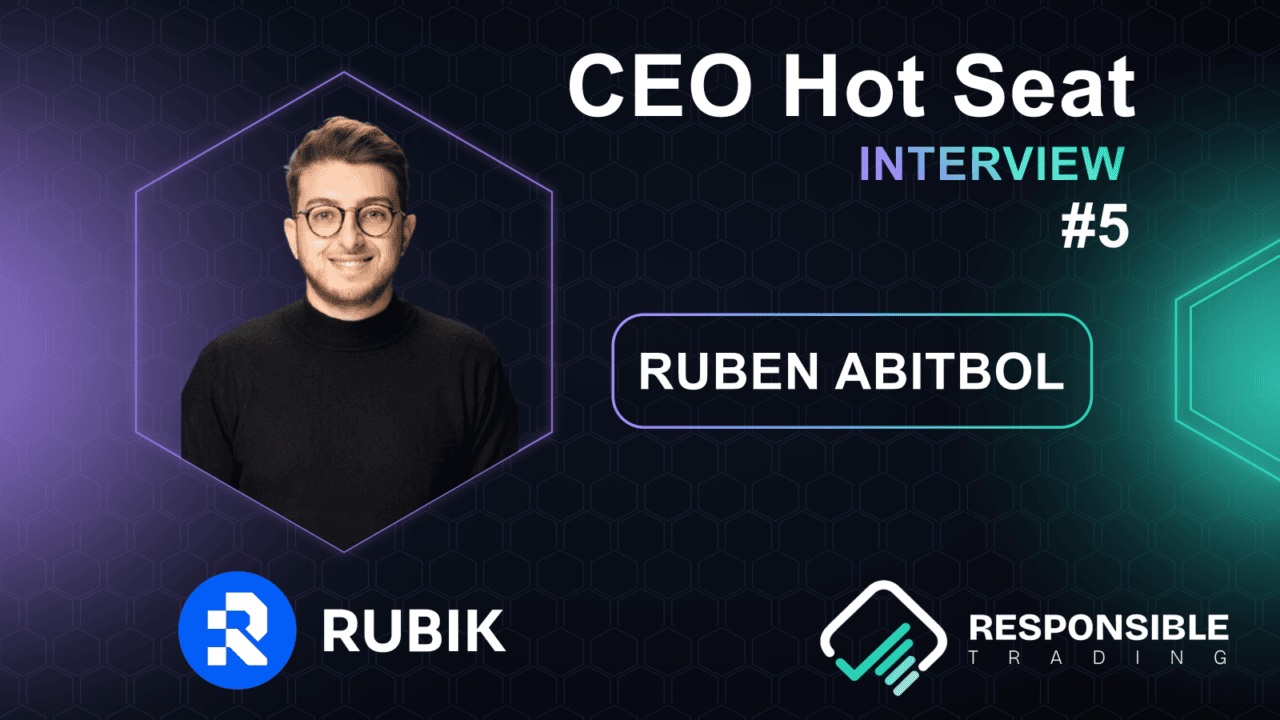
That is the gap Ruben Abitbol has spent his career closing. He built his reputation as Head of Trading and Risk at The5ers, one of the industry’s longest-running firms, then moved to PropFirmMatch as Head of Risk and Research, where he helped build Prop Firm One and got a front-row seat to how dozens of other firms were getting risk wrong. In late 2025 he launched RUBIK, a Risk Management as a Service practice built specifically for prop firms who cannot afford, or do not know how to build, a real risk desk in-house.
We wanted to know what that actually looks like from the inside: what a firm gets for the money, how much of it is genuinely automated versus human judgement, and where the line sits between advising a firm and being financially tied to its top traders staying profitable.
Our next guest is Ruben Abitbol, Founder of RUBIK.
PART 1: THE BUSINESS
Q1. Give us the one-sentence pitch for RUBIK, but not the one from your website. The one you’d say to a firm owner who thinks “risk management” just means having a dashboard with some red and green numbers on it.
Risk management is dynamic and requires human decision-making and execution. A dashboard won’t do the job for you, it’s only a tool. What you really need is a sharp, experienced team with a proven track record. That’s what RUBIK is.
Q2. You spent three years as Head of Trading and Risk at The5ers and a year as Head of Risk and Research at PropFirmMatch, where you helped build Prop Firm One. What’s the one thing you saw from inside two very different companies (a firm running its own challenges versus a company benchmarking the entire industry) that convinced you the real opportunity was consulting, not building another firm yourself?
Around six years ago, when I first joined the prop firm industry and The5ers, there were no real benchmarks or standard practices. Even today, industry standards remain unclear. I had to research, experiment, and develop my own understanding of risk to build something that could protect a company over the long term.
At PropFirmMatch, I saw the industry from a completely different angle. I could see the mistakes firms were making in their challenge design, pricing and in the way they approached and enforced risk management. At the same time, firms were actively looking to strengthen their risk operations, and I started being approached to help them.
That’s when I realized that combining my experience from The5ers with the broader industry perspective I gained at PropFirmMatch created a clear path for what became RUBIK.
Q3. RUBIK operates on a “Risk Management as a Service” model. Walk us through what a firm actually gets for that. Is this you personally reviewing payout requests and flagging accounts, building their risk framework and then leaving, or an ongoing embedded relationship? What does month one look like versus month six?
We operate as a professional risk desk from A to Z. We’ve developed our own internal risk engine that can connect to different CRMs and trading platforms. We filter, analyze, detect, and ultimately make risk decisions on behalf of the companies we work with.
We also handle communication with traders, whether that means explaining how they can improve their trading behavior or identifying cases involving exploitation, arbitrage, or other activity that requires us to end the relationship.
It’s an ongoing, embedded relationship. With some larger firms, we also work hand-in-hand with their internal risk teams.
Every firm has its own policies and rules, but we combine that with the best practices we’ve developed across the industry. We adapt when necessary, but the core methodology remains consistent. The first month is generally focused on onboarding. After a few weeks, we’re already fully operational, and after around three months, firms typically start seeing measurable improvements and results.
Q4. You’ve said between 80 and 100 prop firms collapsed in 2024, and that most of those failures came down to cashflow lag rather than bad intent, founders not grasping that today’s revenue determines payout obligations months down the line. If that’s such a well-understood mechanic, why do so many experienced operators still walk straight into it?
Operators are often more attracted to growth than to stability and long-term sustainability. To capture market share, some firms also adopt aggressive strategies or offer conditions that may generate traction in the short term but simply aren’t sustainable over the long term.
PART 2: THE HARD QUESTIONS
Q5. You’ve said less than 1% of traders can actually bankrupt a prop firm, but most firms don’t know how to identify them. What does that 1% actually look like on a dashboard before they’ve done the damage, and if the signal is that identifiable, why is nearly every firm still missing it?
Risk in the prop industry has shifted from simply analyzing trading activity to detecting behavioral patterns. Most firms still don’t know how to identify those patterns properly.
You need to collect multiple data points, not only from trading activity, but from the trader’s entire journey, and connect those dots to understand the full picture. Too many companies still look at individual data points in isolation instead of assembling the puzzle.
Q6. You’re building a new tool that combines pattern detection with machine learning, on top of a risk methodology you say already has a track record. Firms are already burned by black-box “AI risk engines” that reject or approve payouts with no explainable reasoning. What stops your tool from becoming exactly that, and how do you keep a human actually in the decision loop?
That’s exactly the issue. There are already third-party risk tools on the B2B side, and some of them may be good. But if a company doesn’t know how to interpret and use the information properly, the tool can quickly become useless.
AI should never make the final decision automatically. The human needs to remain in control. At RUBIK, we’re a team of risk professionals using technology and AI to enhance our decision-making, not replace it. The technology gives us better information, but the final decision remains human.
Q8. You still actively run risk desks for firms while building this new tool. Is there a conflict there? If your tool eventually recommends flagging or restricting a client’s top-performing trader, and that client makes serious money off that trader’s volume, whose interest wins?
As I mentioned before, the tool is just that, a tool. It doesn’t make the final decision. We take all the available information into consideration, and risk decisions can be very dynamic. We don’t operate with a rigid, rule-based approach, which is exactly why risk management in prop trading isn’t easy or straightforward.
Beyond running risk desks, I also act as an active advisor to firms, helping them with challenge design, emerging trading patterns, industry benchmarks and overall strategy decisions.
There is also a clear trend toward moving top-performing traders into live environments. This is something we actively advise firms on, using financial ratios and forecasting to determine when it makes sense. The objective is to build a model that works for both the trader and the firm.
Q9. From the inside, when a firm calls you in, is it usually before things go wrong or after? What’s the tell-tale sign in a firm’s numbers that they’re six months from being another one of the “80 to 100” that don’t make it, and have you ever taken on a client you privately thought was already too far gone to save?
Most of the time, firms call us when they’re already in the hole. The most obvious sign is usually a very high payout ratio. At that point, we need to clean the book from toxic flow, and it can take a quarter before the company starts seeing profitable months again. It’s also a learning process for the company because they often need to rebuild parts of their model.
There are also firms that come to us from day one. Those companies can build solid risk management from the beginning and avoid many of these problems altogether.
We’re confident that we can reduce the risk exposure of almost any firm, so from a pure risk perspective, it’s rarely too late. But risk isn’t the only factor. One of the biggest questions is whether the company still has enough financial cushion and reserves to reinvest in areas like marketing while the business recovers.
PART 3: INSIDE THE INDUSTRY
Q10. You’ve talked about prop firms evolving from just selling challenges to actively employing traders who’ve passed them. What does that shift actually mean for a trader today? Are they becoming closer to employees, and does that change what a firm owes them if things go wrong?
Some companies are moving in this direction to break away from the perception that the firm is always the counterparty to the trader. We see this particularly in futures, where traders who become “too good” for the simulated environment are moved to live capital.
There are really two types of traders who can reach that point. First, you have traders who statistically “game” challenges and build a positive expected value over time without necessarily demonstrating genuine discretionary trading. Then you have real traders with genuine alpha.
For traders with real alpha, firms can potentially allocate significantly more capital because their performance has a better chance of translating into profitability in the real market.
Q11. You’re also involved in the collision between prop trading and prediction markets. From a pure risk-management standpoint, are prediction markets an easier or harder environment to build sustainable payout economics around than traditional CFD prop challenges, and is that shift being driven by genuine trader demand or by firms chasing the next thing that isn’t regulated yet?
Risk management in prediction markets is still relatively unclear. From a risk perspective, it’s closer to a sports-betting model, and there are already some large established players that can help set the direction for the industry.
That said, the prop business model for prediction markets can be similar to traditional trading prop firms. What I don’t believe is that prediction-market challenges should simply copy the same structure used in CFDs or futures. The underlying product is different, so the challenge and risk framework should be different as well.
Q12. Having sat inside The5ers and then benchmarked the wider industry at PropFirmMatch, what’s a risk practice you saw at The5ers that you think should be industry standard and isn’t, and conversely, something the industry broadly does that you think is quietly reckless?
There are two main things I believe should become standard across the industry.
First is understanding cash-flow lag. The cash coming into a firm today may ultimately be paid out to traders two months later. When a company is growing consistently, that lag can be difficult to see. But the moment revenue growth slows, liquidity can quickly come under pressure.
Second is behavioral risk rather than purely trading-based detection. Many companies still miss this. A significant part of risk management today is about behavioral economics and understanding the trader behind the activity, not simply analyzing trades in isolation. Trader interviews are an important part of identifying discrepancies in behavior. I was one of the first to implement this approach at The5ers, and today much of the industry has adopted similar practices.
On the other hand, I think banning traders solely because of an IP or CID discrepancy, without supporting information, is reckless. Those signals need to be combined with other facts before making a decision.
PART 4: THE FUTURE
Q13. Regulators are starting to circle the prop trading industry. If real regulation lands in the next 24 months, does RMaaS become mandatory infrastructure that every firm needs to survive, or does it get absorbed and commoditized by the platforms and brokers themselves?
I believe regulation will ultimately be positive for the industry. I’ve always said that. Exactly what those regulations will look like is still unclear.
What is clear is that firms will need to adopt more standardized practices. That should create a stronger need for professional risk infrastructure, clear processes, and consistent decision-making across the industry.
Q14. In three years, what does “risk management” mean for a prop firm that it doesn’t mean today? Is RUBIK still a consulting practice at that point, or does it become something else, a certification body, a software company, an insurer?
It’s interesting you ask that. When I started RUBIK, the company was called “RUBIK Prop Firm Consulting”. Very recently, we changed the name to simply “RUBIK”. Part of the reason is that we’re already well known within the space, so we no longer need “Prop Firm” in the name. More importantly, we’re no longer just a consulting firm.
Today, we execute on behalf of companies and operate as a true partner rather than simply advising them from the outside.
We’re also investing heavily in technology and AI. Whether we eventually sell our technology as a standalone SaaS product is still an open question. But what we’re building is quite unique: we combine technology with real industry experience, execution, and a proven risk track record to provide firms with capabilities they typically don’t have internally.
PART 5: THE LIGHTNING ROUND
Q15a. The risk mistake you see repeated most often by firms that come to you for help.
Relying too heavily on technology and assuming automated systems can replace proper human risk oversight and judgment.
Q15b. The biggest myth traders believe about how prop firms actually manage risk internally.
That firms deliberately manipulate slippage or execution conditions to make traders lose or eliminate them from challenges.
Q15c. One thing The5ers got right that you still use today.
Behavioral detection, looking beyond individual trades and focusing on patterns of behavior to understand how a trader actually manages risk.
Q15d. If you weren’t running RUBIK, what would you be doing?
I would probably be managing a prop firm, combining risk management, trading operations, and the overall strategy of the business.
We thank Ruben Abitbol for participating in the ResponsibleTrading.com CEO Hot Seat. Answers are published as received, unedited.
RUBIK is not a prop firm and is not part of our firm rating or affiliate program. This interview reflects Ruben Abitbol’s own views on risk management inside the industry, not an endorsement of any specific prop firm. You can find out more about his work at rubikpropfirm.com.