


Passing a prop firm challenge is often where most retail traders focus their energy, yet it represents only the beginning of a much longer journey. Once you’re funded, the real test begins: growing your account without triggering disqualification. Scaling a prop trading account demands discipline, precise strategy, and a thorough understanding of each firm’s specific requirements. Many traders lose funded accounts not from poor trading but from preventable mistakes made during the scaling phase. This guide breaks down exactly what you need to know, step by step, so you can grow your account size confidently and sustainably.
Table of Contents
- What you need to know before scaling your prop account
- Step-by-step: How to scale a prop trading account
- Managing risk as you scale
- Common mistakes (and how to avoid them) during scaling
- How prop firms evaluate scaled accounts
- Our perspective: Why most traders stumble with scaling — and what really works
- Tools and resources to help you scale smarter
- Frequently asked questions
Key Takeaways
| Point | Details |
|---|---|
| Preparation is key | Know your firm’s rules, track your performance, and maintain strict discipline before requesting a scale-up. |
| Step-by-step growth | Follow clear steps to progress account sizes while monitoring targets and drawdown limits at every stage. |
| Risk management matters | Protect your account with smart position sizing and by never exceeding risk thresholds as you grow. |
| Learn from common mistakes | Avoid overleveraging and rule violations—addressing frequent errors increases your scaling success rate. |
| Firm evaluation continues | After scaling, ongoing review of your performance and consistency is essential for further growth opportunities. |
What you need to know before scaling your prop account
Now that the importance of a structured plan is clear, let’s outline exactly what you’ll need before you even attempt to scale your prop account.
Before any scaling attempt, you need a solid understanding of how prop firms structure their accounts and what they require from traders. Most firms offer tiered account levels, starting from amounts like $10,000 or $25,000 and scaling up to $200,000 or beyond. Each tier comes with its own rules around profit targets, maximum drawdown, and minimum trading days. Missing any one of these criteria can disqualify you from scaling entirely.
Prop firms assess performance and consistency before permitting account growth. That means your job isn’t just to be profitable. You need to be consistently profitable within defined parameters. Understanding these parameters before you trade is non-negotiable.
Here are the core prerequisites most prop firms require before you can advance:
- Minimum profit target met: Usually 8% to 10% of starting account size.
- Maximum drawdown not breached: Both daily and overall limits must be respected.
- Minimum trading days completed: Often 10 to 30 trading days depending on the firm.
- Consistency rule adherence: Some firms require no single day’s profit to exceed a certain percentage of total gains.
- No rule violations: Any breach of trading rules can reset or void scaling eligibility.
Below is a comparison of typical scaling requirements across leading prop firms:
| Firm type | Profit target to scale | Max drawdown | Minimum trading days |
|---|---|---|---|
| Aggressive growth model | 10% | 8% overall | 10 days |
| Balanced model | 8% | 10% overall | 15 days |
| Conservative model | 6% | 12% overall | 20 days |
| Consistency-focused | 5% per phase | 5% daily / 10% overall | 30 days |
For a more detailed breakdown of how to approach scaling a funded account roadmap, including firm-specific nuances, it helps to study real firm policies before selecting a challenge. Passing a prop firm challenge with discipline also prepares you mentally for what scaling will demand.
You can also explore account management efficiency tips to better organize multiple account phases from the start.
Pro Tip: Document every trade, including entry rationale, exit decision, and emotional state. Firms increasingly reward traders who demonstrate structured, repeatable behavior. Your trade journal is also your best self-coaching tool when you review what is and isn’t working.
Step-by-step: How to scale a prop trading account
Having covered the essentials, let’s walk through the exact process you need to follow when scaling your prop trading account.
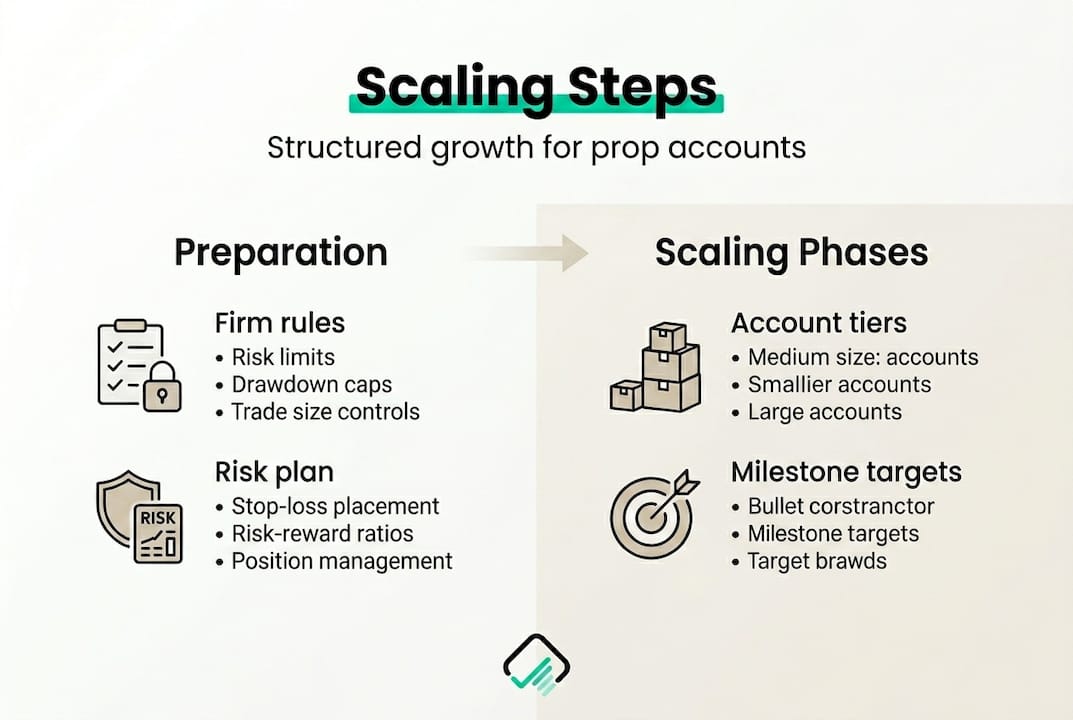
There are proven processes and strategies for growing the size of a prop trading account. The key is treating each phase as a separate challenge rather than continuing on autopilot after initial funding.
Follow these numbered steps to progress through scaling levels safely:
-
Review your current phase rules. Before trading even one day of a new funded account level, read the firm’s full terms for that specific tier. Rule changes between levels are common and often catch traders off guard.
-
Set your risk parameters for the new account size. If you were risking 1% per trade on a $50,000 account, recalculate that to 1% of your new $100,000 balance. Never carry over fixed dollar risk amounts without adjustment.
-
Trade conservatively for the first 10 sessions. Statistically, the highest risk of failure comes immediately after scaling. Markets don’t change, but overconfidence does. Keep risk below 0.75% per trade initially.
-
Track performance against scaling criteria. Build a simple tracking sheet that shows your daily P&L, running drawdown, and distance from your next profit target. Real-time visibility prevents surprises.
-
Request scaling review or automatic upgrade. Depending on the firm, scaling may be automatic upon meeting targets or may require a manual application. Know which applies to you and submit documentation promptly.
-
Repeat the evaluation cycle. After scaling, treat the new phase as phase one again. Reset expectations and do not rush toward the next level.
Here is an example of how a scaling path might look in practice:
| Phase | Account size | Profit target | Max drawdown | Estimated timeframe |
|---|---|---|---|---|
| Phase 1 | $50,000 | $5,000 (10%) | $4,000 (8%) | 4 to 6 weeks |
| Phase 2 | $100,000 | $8,000 (8%) | $8,000 (8%) | 6 to 8 weeks |
| Phase 3 | $150,000 | $10,500 (7%) | $12,000 (8%) | 8 to 10 weeks |
| Phase 4 | $200,000 | $12,000 (6%) | $16,000 (8%) | 10 to 12 weeks |
Funded account scaling strategies work best when traders are patient with each phase. Reviewing avoiding scaling pitfalls beforehand helps you anticipate and prevent the most common derailments.
For traders managing multiple funded accounts across phases, tools like splitting MT4 trades for scaling can streamline execution considerably.
Pro Tip: Use trade copying software to mirror consistent strategies across multiple accounts. This reduces manual error and keeps your approach uniform, which is exactly what firms reward.
Managing risk as you scale
Scaling is only half the equation. Without proper risk management, gains can be wiped out quickly. Here’s how to protect your account through the growth process.
Managing risks is essential when increasing trading account size in proprietary trading. The most common risk factors traders encounter during scaling include:
- Drawdown creep: Small losses across multiple trades compound quickly. A 5-trade losing streak at 1% risk each represents a 5% drawdown, which can be enough to end a funded account at firms with tighter rules.
- Consecutive losses: Emotional pressure increases dramatically after two or three losses in a row. Many traders abandon their system precisely when it is statistically likely to recover.
- Overtrading: Scaling to a larger account often makes traders feel they need to “earn” the bigger size by trading more frequently. This is one of the fastest ways to fail.
The core principles of risk management during scaling are straightforward but require consistent execution:
- Position sizing adjusts with every scale. Never use the same lot size across different account tiers. Always recalculate based on account equity and risk percentage.
- Apply strict stop-losses on every trade. A trade without a stop-loss on a funded account is a violation risk and a financial risk simultaneously.
- Reduce risk after a drawdown event. If you reach 50% of your maximum allowed drawdown, cut your per-trade risk by half until you recover to a comfortable margin.
- Avoid trading high-impact news events. Many prop firms flag or restrict news trading. Even if permitted, volatility during major news events creates an unpredictable risk environment.
Understanding the specific drawdown rules explained by your firm, including whether limits are trailing or static, is critical before you size up.
Safety warning: Crossing your drawdown threshold, even by a fraction, typically results in immediate account termination without appeal. There is no grace period at most firms. Monitor your equity in real time, not just at session end.
For traders interested in automating risk management across accounts, reviewing copy trading methods for prop firms can reveal powerful tools that reduce manual error.
Additional guidance on prop firm risk management covers the technical side of managing exposure at scale.
Common mistakes (and how to avoid them) during scaling
Even skilled traders can derail their scaling progress. Let’s examine the most common mistakes and how to avoid them.
Potential errors and pitfalls are common when attempting to increase proprietary trading account size. Recognizing these patterns early gives you a significant advantage over traders who only learn from experience.
The most frequent mistakes include:
- Overleveraging after a size increase. Traders who move from a $50,000 to a $100,000 account often double their lot sizes out of excitement, breaking the consistency metrics the firm is tracking. Fix: Maintain the same percentage-based risk regardless of account size.
- Violating news trading or weekend holding restrictions. Many firms prohibit specific trade behaviors that traders forget about once they’re funded. Fix: Keep a printed copy of firm rules at your workstation.
- Emotional trading after losses. Revenge trading is one of the most universally documented causes of funded account loss. Fix: Implement a hard daily loss limit below the firm’s limit, giving yourself a personal buffer.
- Skipping trade documentation. Traders who don’t journal their trades miss critical patterns and fail to demonstrate consistency to the firm. Fix: Use a structured journal template and review it weekly.
- Misunderstanding profit withdrawal timing. Withdrawing profits too early or too late can affect your account balance relative to drawdown calculations. Fix: Understand exactly how your firm calculates drawdown relative to withdrawals.
Critical warning: Triggering a disqualification rule, such as a drawdown breach or holding a trade over a restricted period, typically results in immediate and permanent account closure. There is no warning system at most firms. One rule violation can erase months of progress.
For newer traders especially, reviewing mistakes new traders make can prevent the most avoidable errors before they happen. Data also shows significant rates of failure, and understanding why traders fail challenges offers important context for approaching scaling with appropriate caution.
Reviewing prop trading best practices for multi-account copying can also help streamline your process and reduce the risk of manual execution errors.
How prop firms evaluate scaled accounts
After you’ve scaled your account, the work isn’t over. Here’s how most firms evaluate your performance and what it takes to keep growing.
Prop firms assess performance and consistency before permitting further account growth. Most firms look at a combination of quantitative metrics and qualitative behaviors to determine whether a trader continues to receive larger allocations. Understanding these criteria prepares you to meet them proactively.
The key evaluation criteria across firm types generally include:
| Criterion | Conservative firms | Balanced firms | Aggressive growth firms |
|---|---|---|---|
| Consistency (no single day dominates P&L) | Strictly enforced | Moderately enforced | Less enforced |
| Drawdown adherence | Very strict | Strict | Moderate |
| Profit target maintenance | Required across all periods | Required per phase | Flexible |
| Documentation and trade history | Often required | Sometimes required | Rarely required |
| Trading frequency | Minimum days required | Minimum days required | Flexible |
Post-scaling, traders also carry ongoing responsibilities that many overlook:
- Regular performance submissions are required by some firms to maintain scaling eligibility.
- Continued rule compliance is monitored by automated systems that flag unusual patterns.
- Profit maintenance matters. Some firms reserve the right to reduce your account size if performance falls significantly below expectations for an extended period.
- Communication with support helps when navigating edge cases, rule clarifications, or technical issues that could affect your account status.
The The5ers scaling review offers an excellent case study of how a structured scaling program works in practice, including what traders need to sustain growth over multiple phases.
Understanding account size allocation at the technical level also helps when managing multiple funded accounts simultaneously.
Our perspective: Why most traders stumble with scaling — and what really works
After analyzing performance data and trader outcomes across multiple prop firms, one pattern stands out clearly: the single biggest cause of scaling failure is not a lack of strategy. It is moving too fast.
Traders who scale aggressively, pushing toward the next account tier the moment they qualify, consistently show higher failure rates than those who consolidate at each level before advancing. The urge to grow quickly is understandable, but prop firms are not rewarding speed. They are rewarding repeatability.
Rule-based trading, the kind that feels almost boring in execution, outperforms high-conviction discretionary approaches over every meaningful time period we’ve observed. Reviewing the prop trading mistakes guide reinforces this. Traders who document their process, follow fixed rules, and review their trading sessions regularly are the ones earning multiple scaling rounds. Those who rely on feel, instinct, or momentum tend to give back gains during volatile periods.
The traders who last longest in funded accounts are not necessarily the most talented. They are the most consistent. Document your process. Keep reviewing it. That habit separates those who scale once from those who scale repeatedly.
Tools and resources to help you scale smarter
Ready to take the next step? Here are the top resources to help make your scaling journey more data-driven and less stressful.
At Responsible Trading, we provide unbiased, independently tested reviews and comparisons designed specifically for traders navigating the prop firm landscape.
Whether you’re still deciding which firm to join or actively working through scaling phases, our resources cover every stage of the process. Explore our guide to the best forex trading platforms for prop firms to make sure your tools match your strategy. Use our step-by-step framework to choose the right prop firm based on your trading style and risk tolerance. And when you’re ready to evaluate specific options, compare top prop firms side by side using our six-point scoring system built on real-world testing and verified payout data.
Frequently asked questions
What is prop trading account scaling?
Prop trading account scaling is the process of systematically increasing your funded account size as you meet the prop firm’s defined performance and risk management requirements over consecutive trading periods.
How quickly can I scale my prop trading account?
The timeline depends on your firm’s specific rules, but consistent performance and rule adherence typically allow traders to qualify for their next scaling phase every one to three months under standard program structures.
What causes most traders to fail scaling their accounts?
Most traders fail due to breaking firm rules, overleveraging, or applying inconsistent risk management immediately after receiving a larger funded account, often driven by overconfidence following their initial scaling success.
What is the most important risk management metric when scaling?
Drawdown thresholds are critical across all prop firm programs. A single violation of the drawdown limit, whether daily or overall, typically results in immediate account termination with no recourse or appeal available.
Recommended
- How to Scale a Funded Trading Account in 2026: A Practical Roadmap (2026) | Responsible Trading
- The5ers Review 2026: The Best Scaling Plan in Prop Trading? (2026) | Responsible Trading
- Funded Account Trading Strategies That Actually Work in 2026 (2026) | Responsible Trading
- How to Choose the Right Prop Firm for Your Trading Strategy (Step-by-Step Guide) (2026) | Responsible Trading