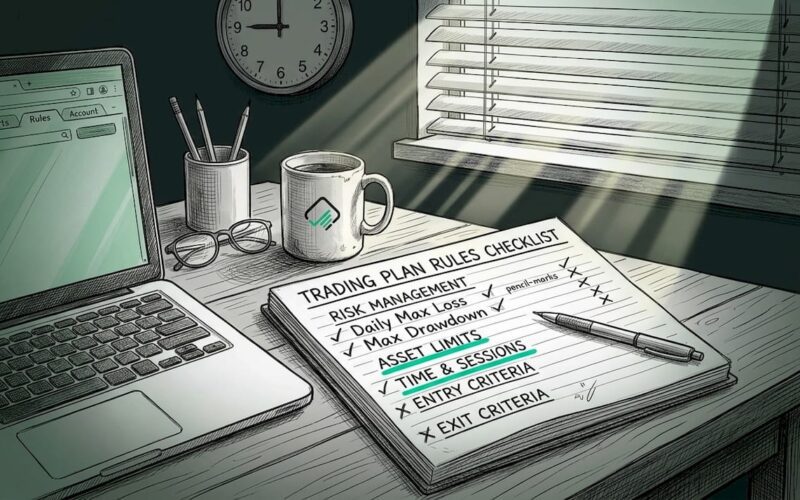
Most traders entering prop firm challenges believe that raw profit is the ultimate measure of success. Hit the target, pass the challenge, collect the funded account. That logic made sense a few years ago. In 2026, it no longer holds. Prop firms are increasingly enforcing behavioral and process constraints that go far beyond profit and loss, and traders who fail to adapt those assumptions are failing challenges they could otherwise pass. This article breaks down what has changed, what strategies still work, and how to position yourself for funding success this year.
Table of Contents
- How prop trading is changing in 2026
- New rules and restrictions: What traders must know
- Evolving prop trading strategies: What works now?
- Technology, automation, and your edge in 2026
- What most traders get wrong about prop trading in 2026
- Find your edge with the right prop firm resources
- Frequently asked questions
Key Takeaways
| Point | Details |
|---|---|
| Process rules matter most | Success in 2026 is about following behavioral and process-based constraints, not just maximizing profit. |
| Consistency is key | New caps on daily profit contributions and news trading restrictions favor steady, low-volatility approaches. |
| Tech choices impact results | The right trading platform and automation can help you comply with firm rules and improve performance. |
| Adaptation is essential | Adjusting your trading style to fit evolving rules greatly improves your challenge pass rate. |
How prop trading is changing in 2026
With the stage set, let’s break down what’s actually changing in how prop traders are evaluated and funded.
The prop trading industry operates through a challenge and evaluation model. Traders pay a fee to access a simulated account, meet specific performance targets within a defined timeframe, and earn a funded account if they pass. That basic structure is still in place. What has changed significantly is the layer of behavioral rules layered on top of that framework.
In past years, a trader could grind through a challenge by catching one or two high-impact news events, booking large single-day gains, and coasting to the profit target. Firms tolerated this because it demonstrated raw market skill. In 2026, that approach will get you disqualified or flagged before you reach payout. Always read the fine print in prop firm rules before committing to any challenge, because the restrictions have multiplied.
The shift is driven by two forces. First, prop firms have become more sophisticated about identifying unsustainable trading patterns. A trader who books 80% of their profit in a single news spike is statistically unlikely to produce consistent returns over a funded period. Second, firms are managing their own risk exposure more carefully, which means they want traders who operate within predictable, manageable parameters.
Here is a comparison of how evaluation standards have shifted:
| Evaluation factor | Pre-2024 standard | 2026 standard |
|---|---|---|
| News trading | Broadly permitted | Blackout windows enforced |
| Drawdown model | Often intraday trailing | Mostly static/end-of-day |
| Single-day profit cap | Rarely enforced | 35% to 40% of total target |
| Consistency requirement | Informal expectation | Formalized rule with thresholds |
| Overnight holding | Permitted by most firms | Restricted by select firms |
“The era of pass-by-any-means is over. Prop firms in 2026 are evaluating whether you can trade correctly, not just profitably.” This shift represents a structural change in how firms define trader quality.
News blackout windows, static drawdown models, and consistency caps are now common across most major prop firm offerings. Traders who do not account for these rules from day one of a challenge face a much higher risk of disqualification, even if their raw P&L looks healthy.
New rules and restrictions: What traders must know
Now, let’s get specific. Here are the rules that can make or break your success in 2026.
Understanding the mechanics of each rule helps you build a strategy that is compliant from the start rather than one that requires mid-challenge corrections.
Static drawdown vs. intraday drawdown
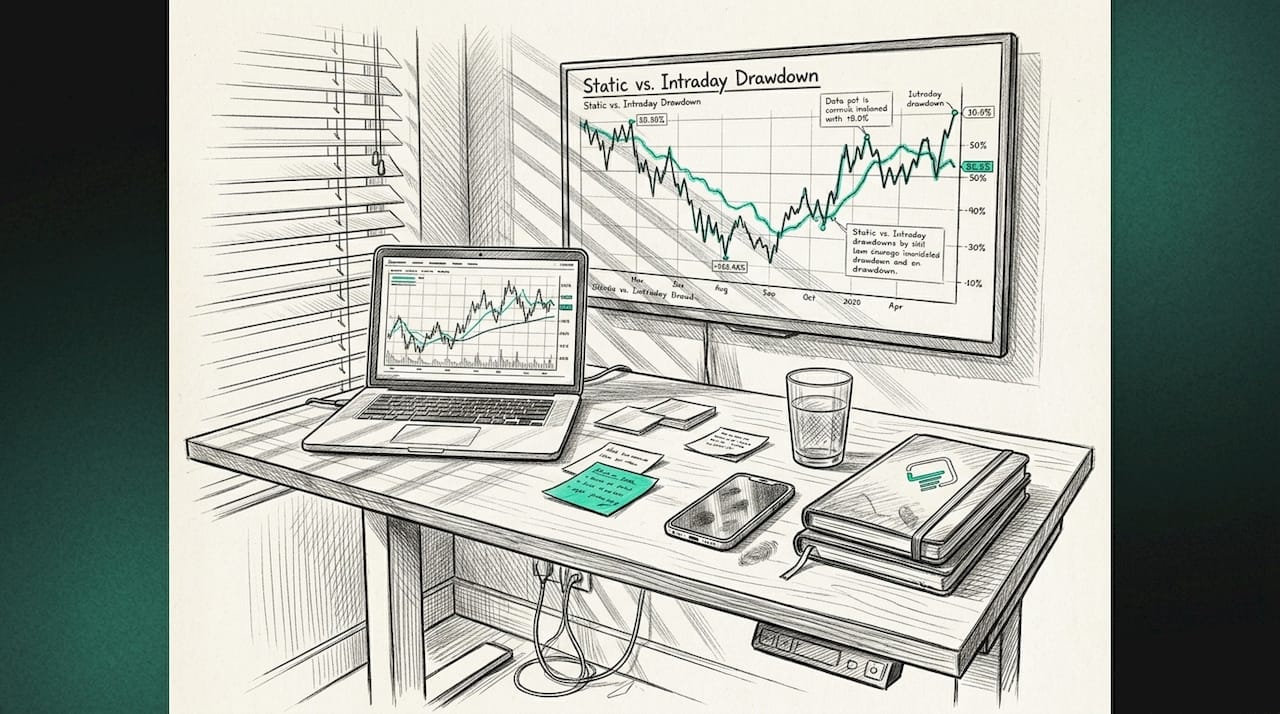
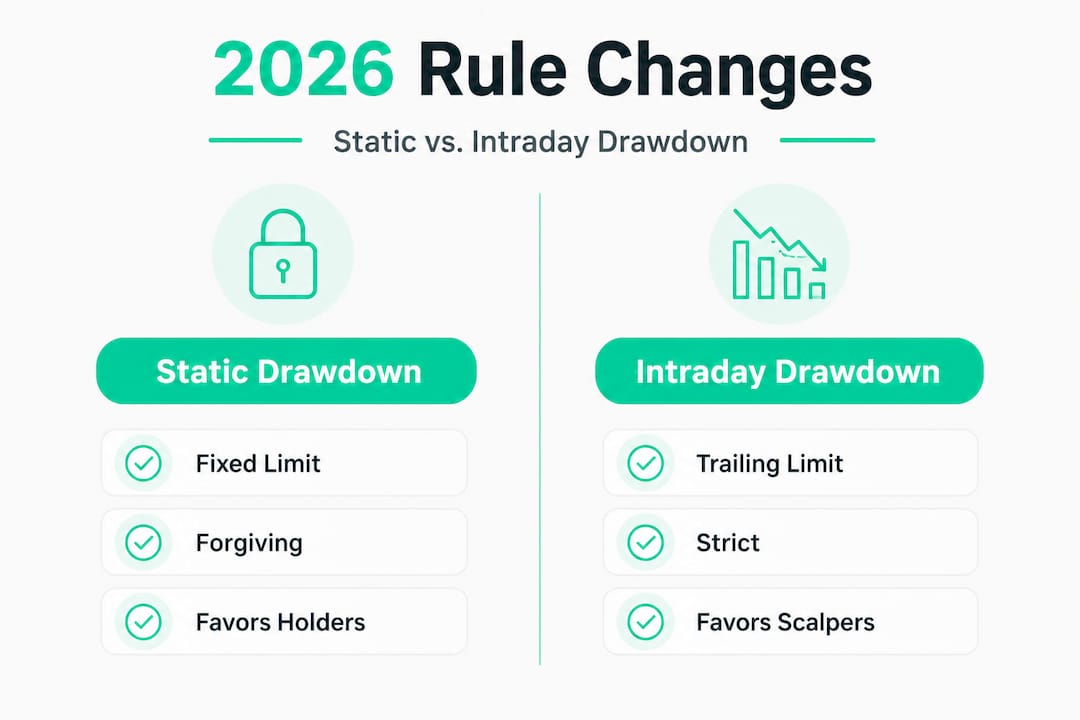
The drawdown model is one of the most consequential rule changes to understand. An intraday trailing drawdown tracks your account’s peak in real time, meaning unrealized losses count against your limit during the trading session. A static drawdown, which more firms are adopting in 2026, is calculated based on your end-of-day balance. This means open positions during the day do not reduce your available drawdown limit until they are closed and settled.
For traders who hold positions through volatile intraday moves, static drawdown is significantly more forgiving. However, it also encourages traders to close positions before the session ends, which changes how you manage multi-day swing trades. Know which model your firm uses before you open a single trade.
The best-day cap and consistency rules
The enforcement of the “best day” rule is one of the most impactful 2026 additions. Under this rule, your single best trading day cannot account for more than 35% to 40% of your total profit over the challenge period. This is designed to discourage traders from clustering their results into a single extraordinary session while underperforming on all other days.
For example, if your challenge profit target is $1,000 and you earn $500 in one day, that single day represents 50% of your target. Under a 35% cap, you would be in violation even if your total profit eventually reaches $1,000 by the end of the challenge. This forces a more distributed performance pattern across multiple trading days.
Here are the key steps to stay compliant with consistency rules:
- Calculate your permitted daily maximum at the start of each challenge based on the firm’s stated cap percentage.
- Track your running total profit each day and stop trading once you approach the daily limit.
- Spread your trading activity across at least five to seven active sessions during the challenge window.
- Avoid concentrating trades exclusively around high-impact economic events that produce outlier single-day results.
- Review your trade journal weekly to confirm that no single session is disproportionately weighted toward your total.
News blackout windows
Most firms now enforce a restriction period of 2 to 5 minutes before and after major scheduled economic releases such as the U.S. Non-Farm Payrolls report, CPI data, and central bank rate decisions. During this window, new trades cannot be opened, and some firms require all existing positions to be closed. Violating this rule results in immediate disqualification in many cases, regardless of profitability.
Pro Tip: Use an economic calendar with clear color-coded impact ratings and set your own internal alerts 10 minutes before any high-impact event. This gives you time to evaluate whether you need to close existing positions before the blackout window begins.
Building strong risk management for prop challenges means designing your trading schedule around known news events from the start of each challenge, not reacting to them in real time.
Evolving prop trading strategies: What works now?
So, what are the actual strategies that can still thrive or fail under these new regimes?
The rule changes described above have a direct and measurable impact on which trading styles remain viable during challenges. Consistency rules and news event restrictions are actively pushing traders toward lower-volatility, less event-driven approaches. This is not just a preference. It is a structural requirement that shapes which strategies survive.
Strategies favored by 2026 rules
- Session-based trend following: Trading in the direction of the dominant market trend during the London or New York session, without relying on news spikes, aligns well with consistency requirements. Gains are distributed across multiple trades and sessions.
- Range trading in controlled volatility: In quieter market conditions between major news events, range-bound strategies with defined entry and exit zones allow for predictable, modest returns that accumulate without spiking on any single day.
- Disciplined position sizing with fixed risk: Risking 0.5% to 1% per trade across multiple setups each week creates a smooth equity curve that satisfies both drawdown rules and consistency checks.
- Multi-asset diversification: Trading across forex pairs, indices, and commodities during different sessions spreads risk and avoids over-concentration in one instrument or event.
Strategies increasingly penalized
- News spike scalping: Holding or entering positions around major releases now creates immediate compliance exposure. Even if the trade is profitable, timing violations can void the result.
- All-in leverage plays: Using maximum leverage on a single event-driven setup is the fastest route to both a drawdown breach and a best-day rule violation simultaneously.
- Single session “hero” trading: Booking all your challenge profit in one exceptional day, then going quiet, is exactly what the best-day cap is designed to eliminate.
Review effective 2026 trading strategies to see how experienced funded traders are structuring their approach this year. For algorithmic traders, the compliance picture is more nuanced. Automated strategies must be carefully coded or configured to respect news blackout windows automatically. Poorly configured expert advisors (EAs) that fire orders during restricted periods will cause violations without any deliberate action from the trader. Understand using EAs under new rules before deploying any automated system on a live challenge account.
Copying trades across accounts also carries risks. Multi-account copying best practices from operators familiar with the prop environment highlight the importance of configuring lot size scaling, timing filters, and news event restrictions at the copier level, not just at the source account level.
Pro Tip: If you run an EA or trade copier, test it on a demo account during a scheduled high-impact news event to confirm it respects your firm’s blackout windows before deploying it on a real challenge.
Technology, automation, and your edge in 2026
To maximize your chances, tech choices and automation can help or hurt, but only if you understand how they intersect with the new rules.
Platform selection is more consequential in 2026 than it was in previous years. Traders must adapt technological tools and automation to remain compliant with stricter process rules. The platform you use affects your ability to set automated alerts, implement rule-based order logic, and access real-time account monitoring.
Here is what to evaluate when choosing a trading platform for prop challenges:
- News filter functionality: Does the platform or connected EA support automatic position management around scheduled economic events? This is now a baseline requirement, not a feature.
- Real-time drawdown tracking: Some platforms offer custom drawdown monitors or dashboard widgets. These help you stay within your daily and overall limits without manual calculation.
- Execution speed and reliability: During periods of restricted trading just after news blackout windows lift, execution quality matters. Slippage on re-entries can affect your risk calculations.
- Reporting and journaling integration: Firms increasingly scrutinize trade logs. A platform that exports clean, detailed trade histories simplifies compliance documentation if a dispute arises.
The forex platform comparison available through Responsible Trading helps you evaluate platforms specifically in the context of prop firm use, covering execution quality, rule-support features, and broker compatibility.
For automation, MT4’s role in 2026 remains significant despite newer platforms entering the market. Many prop firms still operate on MT4 or MT5 infrastructure, making it the most compatible environment for EAs and trade copiers. Understanding account management efficiency tips within this ecosystem can give you a meaningful operational edge during challenges.
The core principle here is simple: technology should support rule compliance, not circumvent it. Any automation tool that creates compliance ambiguity is a liability in 2026’s tighter environment.
What most traders get wrong about prop trading in 2026
Here is the uncomfortable reality most trading education does not address directly: the majority of traders who fail prop firm challenges in 2026 are not failing because they lack market skill. They are failing because they misunderstand what they are actually being evaluated on.
Hitting a profit target is a necessary condition for passing a challenge, but it is not sufficient. The evaluation is equally, and in many cases more heavily, weighted on how you generated that profit. Changing process-based constraints are what separate traders who adapt from those who keep failing the same challenge repeatedly with strong raw P&L numbers.
The traders who succeed are not necessarily the most talented. They are the most rule-literate. They approach each challenge as a structured compliance exercise alongside a trading exercise. They read every rule document before placing a trade, configure their tools around those rules, and treat the behavioral constraints as part of their performance criteria rather than obstacles to ignore.
There is a broader implication here for how you choose which firm to trade with. Not all rules are equal, and not all firms apply them fairly. Some firms use vague rule language to retain flexibility in disqualification decisions. Others are transparent, consistent, and fair. Selecting from the most trusted prop firms is a strategic decision, not just a preference. A brilliant strategy executed on a firm with opaque rules is a much riskier proposition than a solid strategy executed on a firm with clear, consistently enforced standards.
The mindset shift that matters most in 2026 is this: stop asking “how do I make the most profit?” and start asking “how do I make consistent, compliant profit?” Those two questions lead to very different trading behaviors, and only one of them is aligned with how prop firms are actually evaluating traders right now.
Find your edge with the right prop firm resources
If you’re ready to apply these trends and tactics, here are the top resources to support your 2026 trading journey.
Navigating the 2026 prop firm landscape requires more than a solid trading strategy. You need reliable, up-to-date information about which firms are worth your money, which rules are fair, and which platforms give you the best operational foundation.
Responsible Trading provides independent, data-driven evaluations of prop firms specifically designed to help traders make informed decisions. From detailed reviews covering payout reliability and drawdown fairness to step-by-step guidance on choosing a prop firm that matches your trading style, the platform removes guesswork from the selection process. Traders also benefit from in-depth coverage of prop firm challenge rules, including the exact mechanics of consistency requirements and drawdown models discussed in this article. When the rules change, staying informed through a trusted, impartial source is the most reliable edge you can have.
Frequently asked questions
What is the biggest rule change in prop trading for 2026?
The widespread adoption of news blackout windows, static drawdown models, and consistency caps is the most significant structural shift reshaping trader evaluations across the industry this year.
How does the ‘best day’ cap impact my challenge performance?
Under this rule, your single best day can only contribute 35% to 40% of your total profit, which directly penalizes high-variance trading styles that rely on one or two exceptional sessions.
Are news event strategies still viable in 2026 prop firm challenges?
Most firms now enforce blackout periods around major economic releases, making news spike strategies much riskier and often explicitly disallowed under current challenge terms.
What prop trading strategies are most rewarded in 2026?
Strategies built around consistency and low volatility are favored, as the stricter process-focused rules structurally reward traders who produce distributed, predictable returns over the challenge period.
Does automation help in passing prop challenges under the new 2026 rules?
Automation can support compliance and consistency, but only if your tools are configured for new restrictions such as news blackout filters and daily profit limits from the start.
Recommended
- Funded Account Trading Strategies That Actually Work in 2026 (2026) | Responsible Trading
- Prop firm rules explained: Your guide to funding success (2026) | Responsible Trading
- Best Prop Firms for Swing Trading 2026: Rules, Restrictions and Recommendations (2026) | Responsible Trading
- Cheapest Prop Firm Challenge – Responsible Trading