

Most retail traders hit the same wall: not enough capital to trade meaningful position sizes, and too much personal money at risk when markets move against them. Prop firm funding directly addresses both problems. Instead of depositing tens of thousands of dollars from personal savings, traders pay a comparatively small evaluation fee to access funded accounts that can reach $300,000 or more. This article breaks down the seven core advantages of prop firm funding, including hard data on profit splits, evaluation realities, and what it actually takes to succeed under a structured trading model.
Table of Contents
- Access to large trading capital with minimal personal risk
- High profit splits and scalable accounts
- Enforced discipline and professional structure
- The realities of evaluation: Pass rates, costs, and risk
- Psychological and professional benefits
- Top prop firms, credibility, and real-world benchmarks
- The real edge: Why disciplined traders thrive with prop firm funding
- Get started with prop firm funding: The next step in your trading journey
- Frequently asked questions
Key Takeaways
| Point | Details |
|---|---|
| Higher trading capital | Prop firms let you trade with up to $300K+ while risking only a fee, not your own money. |
| Attractive profit splits | Traders keep 70-95% of profits, with scalable account sizes for continued growth. |
| Discipline and risk control | Firm-set rules help you develop professional trading habits and safeguard your capital. |
| Industry credibility | Top firms boast high ratings and substantial payouts, proving reliability to traders. |
| Mindset and career boost | Trading with a firm reduces emotional strain and helps build long-term professional habits. |
Access to large trading capital with minimal personal risk
The most immediate benefit of prop firm funding is straightforward: you get to trade with far more capital than most retail traders can realistically fund on their own. Opening a self-funded retail account with $5,000 or $10,000 severely limits position sizing, which in turn limits returns even when the trading strategy performs well.
Prop firm funding provides access to large capital up to $300,000 or more, with your personal financial exposure capped at the evaluation fee, which typically ranges from $50 to $1,000. This completely changes the risk equation. Personal financial exposure is minimal compared to what a trader would risk by self-funding a large account.

There is also a psychological dimension here. When you trade your own savings, every losing trade carries an emotional weight that directly affects decision-making. Trading with firm capital, once earned through evaluation, reduces that burden significantly. Traders often report better execution discipline and cleaner decision-making because the personal financial stakes are framed differently.
| Account size | Typical evaluation fee | Personal capital at risk |
|---|---|---|
| $10,000 | $50-$100 | Evaluation fee only |
| $50,000 | $200-$350 | Evaluation fee only |
| $100,000 | $400-$650 | Evaluation fee only |
| $200,000+ | $700-$1,000 | Evaluation fee only |
Understanding prop firm rules before you start is critical, because the structure of those rules determines how much flexibility you have once funded.
“The ability to access institutional-level capital without institutional-level personal risk is the defining feature that separates prop firm trading from conventional retail trading.”
Pro Tip: Before committing to any firm, confirm whether they offer a capital increase pathway as part of the funded account agreement. Some firms increase your allocation automatically after hitting profit milestones, which is a significant long-term advantage.
High profit splits and scalable accounts
Capital access is only valuable if you retain a meaningful share of what you earn. Prop firms have largely moved in favor of traders on this front. Profit splits favor traders at rates of 70-95%, with some firms offering up to 100% in promotional periods, and scaling plans that double or increase account sizes every 3-6 months based on consistent performance.
Understanding prop firm profit splits is essential before selecting a firm, because the headline percentage does not always reflect the real payout structure. Some firms require a minimum balance threshold before a withdrawal is processed, while others have rules around how often you can withdraw.
Here is how the top firms generally compare on profit splits and scaling:
| Firm | Base profit split | Max split | Scaling available |
|---|---|---|---|
| FTMO | 80% | 90% | Yes |
| FundedNext | 80% | 95% | Yes |
| The5%ers | 50-100% | 100% | Yes |
| MyFundedFX | 85% | 90% | Yes |
Scaling is where the real earning potential compounds over time. A structured approach to account scaling in prop trading typically follows these stages:
- Pass the evaluation phase and receive your initial funded account.
- Trade consistently within the drawdown and profit rules for the required period.
- Request a profit withdrawal to trigger the scaling review.
- Receive an increased account allocation, often 25-50% larger.
- Repeat the process until you reach the firm’s maximum account cap.
For traders serious about scaling a funded account, the key is consistency over aggression. Firms reward steady, rule-compliant performance, not high-variance trading that happens to work short term.
Pro Tip: Focus on meeting scaling milestones rather than maximizing profit in a single month. Consistent 3-5% monthly returns build account size faster through scaling than inconsistent 10-15% months that trigger drawdown limits.
Enforced discipline and professional structure
Many retail traders know what good risk management looks like in theory but struggle to apply it consistently without external accountability. Prop firm rules solve this problem by making discipline non-negotiable.
Structured rules enforce discipline through daily drawdown limits of 4-6%, maximum drawdown ceilings of 8-12%, profit targets of 8-10%, and consistency requirements that vary by firm. These rules come in different forms: static drawdown (fixed from starting balance), trailing drawdown (adjusts with peak equity), and equity-based versus balance-based calculations, each carrying different risk implications.
The key rule categories traders must understand include:
- Daily drawdown limit: Typically 4-5%, meaning a single bad day ends your trading session for that calendar day.
- Maximum drawdown: Usually set at 8-10%, representing the total loss threshold before the account is breached.
- Profit target: Set at 8-10% in most phase-one evaluations, with a lower target in phase two.
- Minimum trading days: Many firms require at least 5-10 trading days to complete an evaluation phase.
- Consistency rules: Some firms cap your best single day’s profit to ensure you aren’t relying on one lucky trade.
Understanding prop firm scoring systems helps traders recognize which rule structures align with their trading style before paying an evaluation fee.
“The daily drawdown rule is simultaneously the most restricting and the most valuable feature of prop firm trading. It forces risk awareness that most self-funded traders never develop.”
This structure effectively simulates a professional trading desk environment, where position sizing and daily loss limits are standard practice. For traders aspiring to institutional roles, this experience is directly transferable.
The realities of evaluation: Pass rates, costs, and risk
Transparency requires acknowledging what the data shows about how difficult these evaluations actually are. Evaluation pass rates are low: only 5-14% of traders pass challenges, and approximately 7% of all traders who attempt evaluations ever receive a payout. The average trader attempts 2-4 challenges and spends $4,000 or more in fees before achieving consistent funded profitability.
| Metric | Industry average |
|---|---|
| Phase one pass rate | 14-25% |
| Overall challenge pass rate | 5-14% |
| Traders receiving payouts | ~7% |
| Average attempts before funding | 2-4 |
| Estimated fees before profitability | $4,000+ |
These numbers are sobering, but context matters. Compare a $4,000 spend on evaluation fees against the alternative: risking $50,000-$100,000 of personal capital in a self-funded account. The potential downside in the prop firm model is structurally capped, even if the path to consistent profits is not easy.
Here are the most effective steps for maximizing your evaluation success rate:
- Study the specific rules of your chosen firm before entering the challenge. Many failures come from traders who misunderstand trailing drawdown mechanics.
- Set a lower internal drawdown limit than the firm requires. If the daily limit is 5%, trade as if yours is 2.5%.
- Use smaller position sizes in the early days of the evaluation to build a buffer before reaching for the profit target.
- Keep detailed trade logs to identify patterns in winning and losing sessions.
- Avoid high-impact news events unless your strategy is specifically designed around them, as volatility spikes can breach daily limits quickly.
Understanding prop firm pass rates in context helps set realistic expectations. The evaluation phase is not just a hurdle; it’s a real-world filter that distinguishes disciplined traders from those who rely on luck or oversized risk.
Psychological and professional benefits
Beyond the financial structure, prop firm trading offers measurable psychological advantages that directly affect performance quality. Trading firm capital, once you have internalized that your personal exposure is limited to the evaluation fee, removes the kind of fear and over-attachment that causes retail traders to move stop losses, hold losing positions too long, or overtrade after a losing day.
Key psychological and professional benefits include:
- Reduced emotional pressure from losses, since personal savings are not directly at stake beyond fees.
- Structured daily routines enforced by minimum trading day requirements and session rules.
- Objective performance feedback through the firm’s dashboard, which shows whether you are meeting targets and staying within risk parameters.
- Professional habit formation, including journaling, risk sizing, and consistency reviews.
The reduced emotional pressure and structured environment that prop firms provide genuinely mimics professional trading desk conditions. Traders who go through this experience often find the transition to institutional or full-time independent trading significantly smoother.
“The discipline demanded by prop firm rules does not just protect the firm’s capital. It protects the trader from the worst version of their own decision-making.”
Pro Tip: Treat your prop trading account exactly as you would treat capital belonging to a client or employer. This mindset shift alone improves rule adherence and reduces emotional trading patterns measurably.
Top prop firms, credibility, and real-world benchmarks
Credibility in the prop firm industry is measurable. Established firms like FTMO, FundedNext, and The5%ers carry Trustpilot ratings between 4.5 and 4.9 out of 5, with millions in documented trader payouts. FundedNext alone has paid out over $261 million to traders, while The5%ers has surpassed $43 million in documented payouts.
| Firm | Trustpilot rating | Documented payouts |
|---|---|---|
| FTMO | 4.8/5 | $2B+ (estimated total) |
| FundedNext | 4.7/5 | $261M+ |
| The5%ers | 4.6/5 | $43M+ |
| MyFundedFX | 4.5/5 | Growing track record |
These figures matter because they represent verifiable evidence that payouts actually occur at scale. The industry has had its share of firms that closed without honoring trader withdrawals, which is why rating platforms, independent reviews, and third-party data remain essential tools for evaluating any firm.
Reading detailed prop firm reviews gives traders access to payout timing data, rule change histories, and customer support quality scores that are not visible from a firm’s own marketing materials. When industry standards are clear and firms consistently meet them, traders benefit from a fairer, more transparent environment.
The real edge: Why disciplined traders thrive with prop firm funding
The most common misconception about prop firm funding is that it’s primarily about accessing capital. It isn’t. The capital is the tool. The real advantage is the forced adoption of a professional risk management framework that most retail traders never develop on their own.
For retail traders, prop funding accelerates scaling and reduces personal risk, but it requires genuine discipline to navigate strict rules. The low pass rates confirm this. Traders who approach prop funding as a shortcut to quick profits consistently fail. Traders who approach it as a structured performance environment where their edge is tested and refined tend to succeed over time.
Advantages in capital and risk shifting are real, but the rules that enable those advantages also constrain certain trading styles. Aggressive breakout traders who hold through high volatility news events, or scalpers who rely on extremely tight margin management, often find prop firm rules incompatible with their method. Aligning your strategy with the firm’s specific rule structure is not optional; it is the entire game.
Most traders focus narrowly on the funded account size and the profit split percentage. The traders who thrive focus on the rule structure first, then select the firm whose constraints best fit their proven trading method. Understanding why most traders fail ultimately comes down to this misalignment between strategy and structure.
The uncomfortable reality is that prop firm funding does not make a poor trader profitable. What it does for a disciplined, rule-compliant trader is remove the capital constraint that would otherwise limit their growth for years. That distinction defines who benefits and who doesn’t.
Get started with prop firm funding: The next step in your trading journey
Choosing the right prop firm requires more than reading a sales page. Payout speed, drawdown rule clarity, profit split transparency, and customer support quality all vary significantly across the industry.
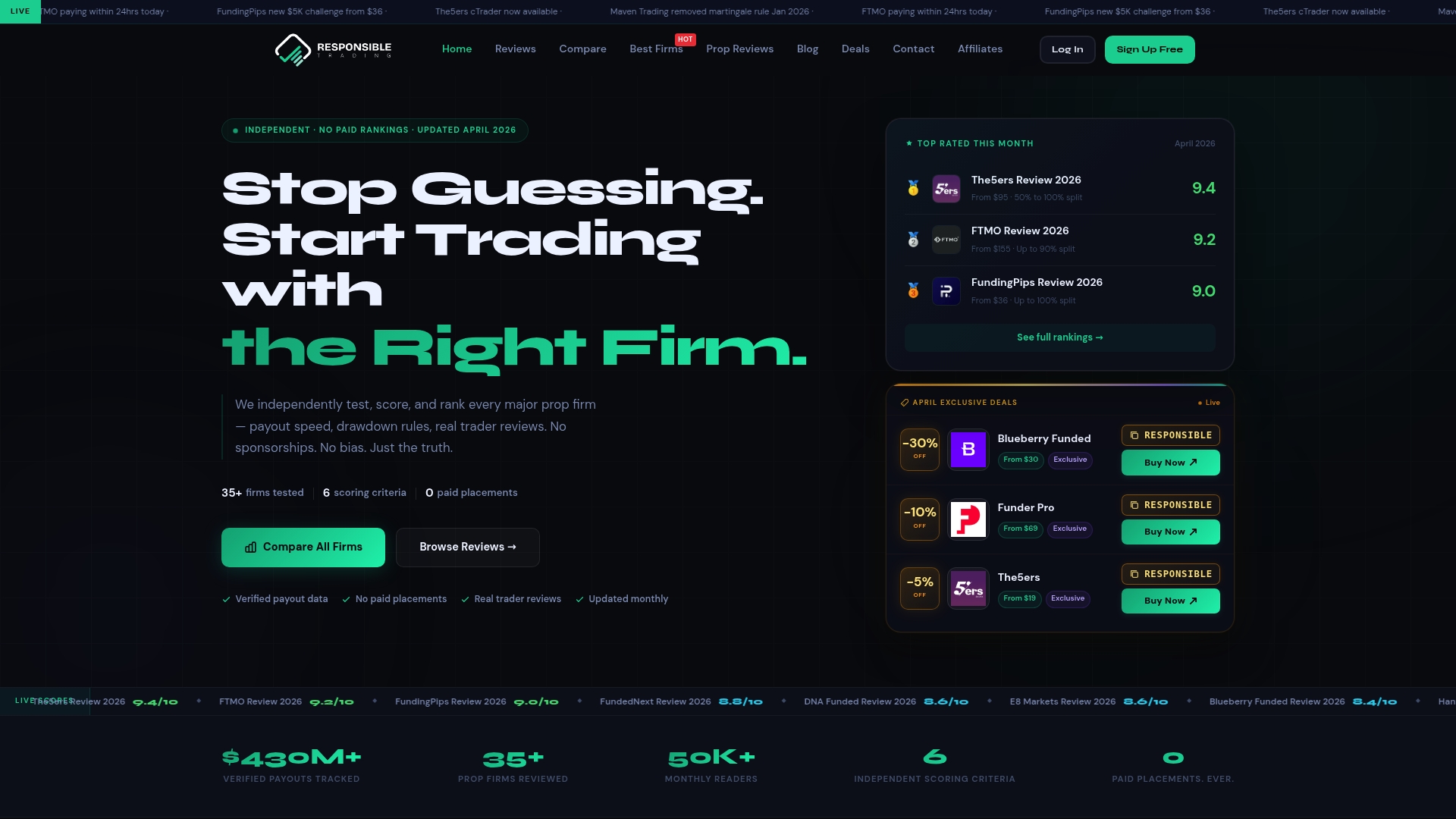
Responsible Trading provides independent, data-verified evaluations of the leading prop firms so you can make that decision with confidence. Access detailed analysis of best platforms for prop trading, read verified prop firm reviews from real traders, and follow a step-by-step guide to pass your prop firm challenge built around proven risk management frameworks. Every resource is designed to help you enter the evaluation process prepared, not guessing.
Frequently asked questions
What is prop firm funding and how does it work?
Prop firm funding gives traders access to large capital accounts of up to $300,000 or more, allowing them to trade using the firm’s money after paying an evaluation fee and meeting performance criteria. Traders earn a predetermined profit split on all gains generated in their funded account.
How much can you earn with prop firm funding?
Profit splits favor traders at 70-95%, and scaling programs can double or increase account sizes every 3-6 months for consistent performers. Top traders working through multiple scaling cycles can access significantly larger capital allocations over time.
What are the main risks of prop firm trading?
Personal financial exposure is minimal since losses beyond the evaluation fee are covered by the firm’s capital, not the trader’s personal savings. The primary risks are losing evaluation fees across multiple attempts and spending time on challenges without achieving consistent funded status.
Why do most traders fail prop firm evaluations?
Evaluation pass rates sit between 5-14%, with only about 7% of all traders receiving payouts, primarily because traders underestimate the rule complexity, trade inconsistently, or apply strategies that violate drawdown parameters under normal market volatility.
How do I choose a reputable prop firm?
Prioritize firms with high Trustpilot ratings of 4.5 or higher, transparent rule documentation, and verifiable payout histories. Independent review platforms that cross-reference payout data against trader-submitted evidence provide the most reliable picture of a firm’s real credibility.
Recommended
- Prop firm rules explained: Your guide to funding success (2026) | Responsible Trading
- Prop Firm vs Forex Broker: Which Is Better for Retail Traders in 2026? (2026) | Responsible Trading
- Best Forex Trading Platform For Prop Firms: The 2026 Trader’s Guide (2026) | Responsible Trading
- Prop Firm News 2026 — Trading Insights | Responsible Trading