

Prop trading firms present themselves as a gateway to significant capital, promising retail traders access to six or seven-figure accounts in exchange for proving their skills through a paid evaluation. Many traders assume this means easy leverage with minimal personal risk. The reality is more complex. Firm revenue comes primarily from evaluation fees (60-90%), with failure rates between 80-95% sustaining the model. Understanding what prop trading actually delivers, for your specific situation, requires looking beyond the marketing and into the mechanics, data, and real trader experiences.
Table of Contents
- What is prop trading and how do firms create value?
- Evaluating performance metrics: Success rates, profit splits, and payout timelines
- Uncovering the risks: Fees, rules, and why most traders fail
- Who actually benefits? Recognizing value for disciplined traders
- A realistic take: Value in prop trading is about strategy, not quick wins
- Take your next step in prop trading
- Frequently asked questions
Key Takeaways
| Point | Details |
|---|---|
| Fee-driven model | Prop firms earn most profits from trader evaluation fees, not market trading. |
| Low pass rates | Only 5-10% pass challenges, and just 1-3% are long-term profitable. |
| Strict risk controls | Most traders fail due to firm-imposed rules, especially drawdown limits. |
| Best for disciplined traders | The greatest value is found by skilled, disciplined traders who master firm expectations. |
| Verify firm reputation | Choose established prop firms and always check payout histories and community feedback. |
What is prop trading and how do firms create value?
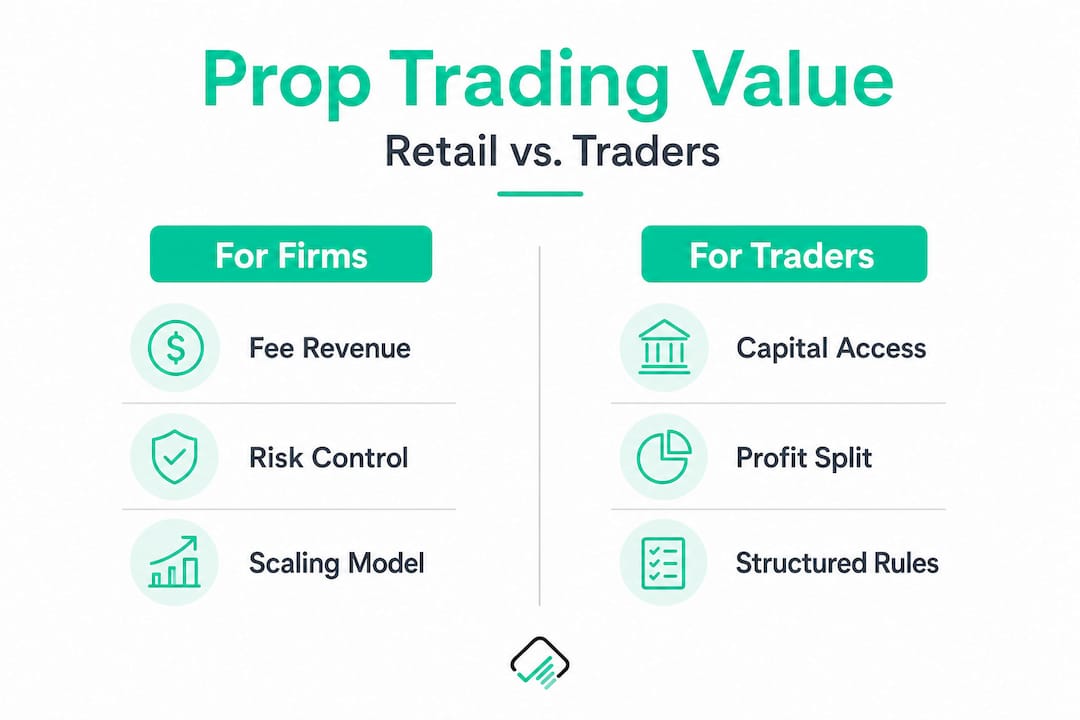
Prop trading, short for proprietary trading, refers to a setup where a firm allocates capital to traders who keep a share of the profits. For retail traders, the modern version works through structured challenge programs. You pay an evaluation fee, prove you can trade within specific rules, and then get access to a funded account. Understanding these prop trading concepts is essential before you commit any capital.
The business model here matters enormously. Most firms are not primarily in the business of trading profits. They earn revenue by selling challenges and evaluation programs to large volumes of retail traders, the majority of whom will not pass or will lose their accounts after a short period. Funded accounts are often simulated and payouts do not always come from live trading profits, but rather from the pool of incoming evaluation fees.
This creates a distinct incentive structure:
- Firms profit most when traders fail evaluations repeatedly
- High failure rates are financially sustainable for firms
- Rules are designed to protect the firm’s capital above all else
- Scaling opportunities exist but are reserved for the very few who pass consistently
“Understanding ‘value’ in prop trading means recognizing that the firm’s interest is capital preservation and fee revenue, not trader success. That doesn’t make the model illegitimate, but it does mean you must approach it with clear expectations.”
The advantages of prop firm funding are real for the right trader. You gain access to institutional-level leverage and capital without risking your personal savings in live markets. Firms also enforce strict risk management mechanics through position sizing rules, drawdown limits, and no-overleveraging policies, which ironically can improve discipline for traders who struggle with self-imposed boundaries.
The key takeaway is this: firms create value structurally by providing capital access and risk frameworks. Whether that value translates to profit depends entirely on your skill, discipline, and how well you understand the rules you are operating within.
Evaluating performance metrics: Success rates, profit splits, and payout timelines
Now that you understand the underlying model, let’s break down what the numbers tell us about the actual value you can expect from different firms.
The statistics are sobering. Only 1-3% of retail traders are long-term profitable with prop firms, even when measured against elite standards. Evaluation pass rates range between 5% and 10% depending on the firm’s rules and the challenge type. These numbers should reset your expectations before you evaluate any firm’s marketing claims.
That said, for those who do pass, profit splits have become increasingly competitive. Profit splits vary significantly across firms: FTMO offers 80-90%, FundedNext reaches 95-100%, and Apex pays 100% on the first $25,000 earned. Payout timelines also differ, with FundedNext processing payouts within 24 hours while FTMO operates on a 14-day cycle. Scaling potential ranges from $2 million to $4 million in allocated capital for top-performing traders.
Here is a side-by-side breakdown of key performance metrics across major firm categories:
| Metric | Competitive firms | Standard firms |
|---|---|---|
| Profit split | 90-100% | 70-80% |
| Payout timeline | 24-72 hours | 14-30 days |
| Evaluation pass rate | 5-10% | 5-10% |
| Long-term profitability | 1-3% | 1-3% |
| Max account scaling | $2M-$4M | $200K-$500K |
| Evaluation fee range | $100-$600 | $100-$600 |
Statistic to note: The gap between evaluation pass rates (5-10%) and long-term profitability (1-3%) illustrates that passing is not the hardest part. Sustaining profitability within firm rules over months is the true challenge.
Here is how to evaluate a firm’s performance metrics with clear priorities:
- Check the profit split percentage and when it applies. Some firms offer high splits only on later payout milestones, not immediately.
- Verify payout timelines with third-party sources. Community reviews on Reddit, Discord, and Trustpilot often reveal real payout wait times that differ from advertised figures.
- Understand the scaling plan in detail. Scaling requires consistent profitability within strict rules, and the capital increases are only available to traders who perform at a very high level.
- Factor in the evaluation fee cost per attempt. If you attempt a challenge multiple times, the cumulative cost directly affects your effective profit split.
Learning how to apply account scaling strategies correctly makes a material difference in how much capital you can eventually access. Similarly, understanding your payout methods options before you join a firm prevents surprises when it’s time to withdraw your earnings.
Uncovering the risks: Fees, rules, and why most traders fail
Understanding the perks is only half the story. Digging into the risks and failure points is just as crucial, particularly if you are considering spending real money on evaluation challenges.
The most significant financial risk is the cumulative cost of repeated evaluations. Trader discussions reveal that the average cost to successfully fund an account is approximately $4,270 when accounting for multiple failed challenge attempts. This figure surprises most new traders who factor in only the cost of a single evaluation when calculating potential returns.
Here is a breakdown of the most common risk categories:
- Drawdown limit violations. Maximum drawdown rules (typically 5-10% of account size) are the number one cause of account termination. One bad trading session can end a funded account entirely.
- Consistency rule breaches. Some firms require that no single trading day accounts for more than a defined percentage of total profits, limiting how you can structure your sessions.
- News trading and overnight holding restrictions. Many firms prohibit trading during major news events or holding positions overnight, rules that conflict with common retail strategies.
- Time limit pressure. Evaluation phases often have deadlines, which can push traders into taking risks they otherwise would not accept.
| Risk factor | Impact level | Frequency |
|---|---|---|
| Drawdown breach | Account termination | Very common |
| Consistency rule violation | Account termination | Common |
| News event breach | Warning or termination | Moderate |
| Evaluation expiry | Fee loss | Moderate |
| Withdrawal delay | Financial strain | Occasional |
Pro Tip: Before purchasing any evaluation, map every firm rule against your actual trading strategy. If your strategy relies on holding positions through news events or overnight, eliminate any firm that explicitly prohibits those behaviors. Misalignment between your style and firm rules is a guaranteed path to failed challenges.
Reputable firms do reduce some of these risks through clearer rule sets and faster dispute resolution. Community feedback consistently praises firms with transparent rules and reliable payouts, while warning against those with vague policies or slow processing. Knowing how to navigate passing a prop firm challenge with a risk management blueprint gives you a structured approach rather than relying on intuition. Checking an evaluating firm reputation resource before you commit also provides critical protection.
Who actually benefits? Recognizing value for disciplined traders
With a grounded sense of risk, let’s highlight who can truly extract value from prop trading and how.
The honest answer is that prop trading offers the most value to traders who already have a tested, rules-based strategy and the emotional discipline to execute it consistently. It is not a system for developing skills at someone else’s expense. The evaluation period is not a learning phase; it is a proving ground.
Prop trading offers real value specifically to disciplined traders because it provides access to capital without personal financial risk post-evaluation, though only 5-10% pass evaluations and fee dependency makes it high-risk and high-reward overall. The article also notes that failed challenges carry diagnostic value, revealing specific patterns in a trader’s behavior that can be improved.
Here is a practical framework for self-assessment before committing to a challenge:
- Track record first. Can you demonstrate at least 3-6 months of consistent, rules-based profitability in a demo or live account? If not, evaluate fees will likely compound until you develop that foundation.
- Risk tolerance alignment. Your personal drawdown tolerance must match or exceed the firm’s maximum drawdown rules. If you regularly exceed 5% drawdown in your own trading, passing firm challenges will be extremely difficult.
- Rule comprehension. Read every firm rule in full, not just the highlighted metrics. Subtle rules around consistency, daily loss limits, and trade timing are where experienced traders get caught unexpectedly.
- Firm selection criteria. Prioritize established firms with verifiable payout histories and positive community reviews over newer entrants with aggressive marketing but unproven track records.
- Cost budgeting. Set a hard limit on how much you will spend on evaluation fees before reassessing your readiness. Treating challenge fees as an open-ended expense is a path toward significant losses.
“The traders who extract genuine value from prop funding are not those who see it as a shortcut. They are those who already trade well and use firm capital to scale an approach that already works.”
Understanding the legitimacy of prop firms is also critical here. Not every firm that appears credible has a consistent payout record. Cross-referencing firm claims with community data and independent review platforms gives you a materially more accurate picture than any firm’s marketing page alone.
A realistic take: Value in prop trading is about strategy, not quick wins
The standard narrative around prop trading tends to fall into one of two extremes. Either prop firms are promoted as an exciting path to financial freedom, or they are dismissed entirely as fee-extraction schemes with no legitimate value. Neither position is accurate, and both fail the trader trying to make an informed decision.
Most traders enter evaluations aiming for capital access and high leverage. What they underestimate is that prop trading’s real value is not the funded account itself. It is the framework it forces you to operate within. Consistent position sizing, strict drawdown adherence, and disciplined session management are the behaviors that make traders profitable over the long run. The evaluation is a structure that demands these behaviors from day one.
The market does not reward hope or ambition. It rewards systematic risk management applied consistently across a large number of trades. Traders who approach each challenge as an objective diagnostic of their own process, not a lottery ticket, are the ones who eventually extract sustainable value from prop firm models. When you fail a challenge, the question should not be “What went wrong in the market?” It should be “Which rule did I violate, and why did I take that trade?”
The most overlooked source of value in prop trading is the learning derived from repeated, structured failures. Each failed attempt, when analyzed correctly, reveals a specific behavioral pattern. Overtrading after a loss. Increasing position size during drawdown. Trading during prohibited periods under emotional pressure. These patterns are expensive to identify in live personal accounts where losses directly affect your capital. In evaluation accounts, identifying these patterns costs only the evaluation fee.
The real benefits of firm funding are most accessible to traders who approach the model this way: as a structured environment for proving and scaling a strategy, not as a mechanism for bypassing the hard work of becoming a consistently profitable trader. That shift in perspective is the most valuable thing any retail trader can bring to their first prop firm challenge.
Take your next step in prop trading
Equipped with a clear-eyed understanding of how prop trading works, where the value lies, and where the risks concentrate, you are in a stronger position to act deliberately rather than reactively.
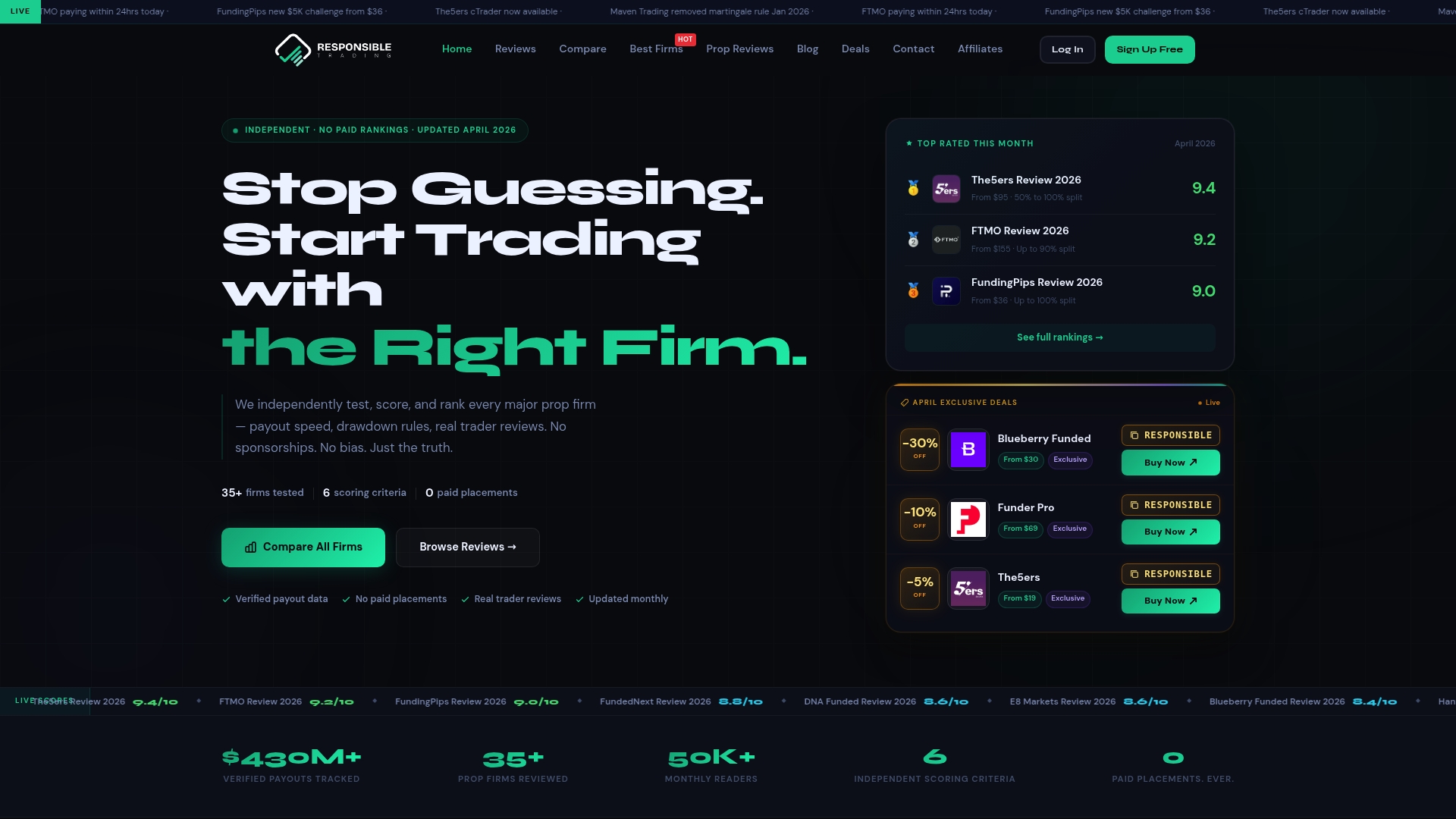
Responsible Trading provides independent, evidence-based comparisons of the best forex prop trading platforms, with rankings built on real testing and cross-referenced payout data from trader communities. Staying current on 2026 prop trading trends helps you align your strategy with shifts in firm rules and funding structures before they affect your account. If you are preparing for your first or next evaluation, our trading challenge guide provides a step-by-step framework grounded in verified performance data, designed to increase your probability of passing and sustaining funded account status.
Frequently asked questions
What is the main source of revenue for most retail prop firms?
Most retail prop firms earn revenue primarily from trader evaluation fees, which account for 60-90% of total revenue, not from actual trading profits.
How likely am I to become a profitable prop firm trader?
Only 1-3% of retail traders are long-term profitable with prop firms, making sustained success statistically rare even among experienced participants.
What makes a prop firm trustworthy?
Established firms with transparent rules, documented payout histories, and consistent positive community feedback from sources like Reddit and Trustpilot are generally considered the most reliable options.
Why do most traders fail prop firm evaluations?
Drawdown limit breaches are the primary cause of evaluation failure, not an inability to reach profit targets, making strict rule adherence more critical than raw profitability.
Is the capital real in retail prop firm funded accounts?
Funded accounts are often simulated rather than live market accounts, and payouts typically come from firm fee revenue rather than actual trading profits generated in the market.
Recommended
- Prop trading terminology: 9 key concepts for funded success (2026) | Responsible Trading
- Avoid these prop trading mistakes: a practical guide (2026) | Responsible Trading
- Trading rules checklist for prop firm success (2026) | Responsible Trading
- Prop firm rules explained: Your guide to funding success (2026) | Responsible Trading