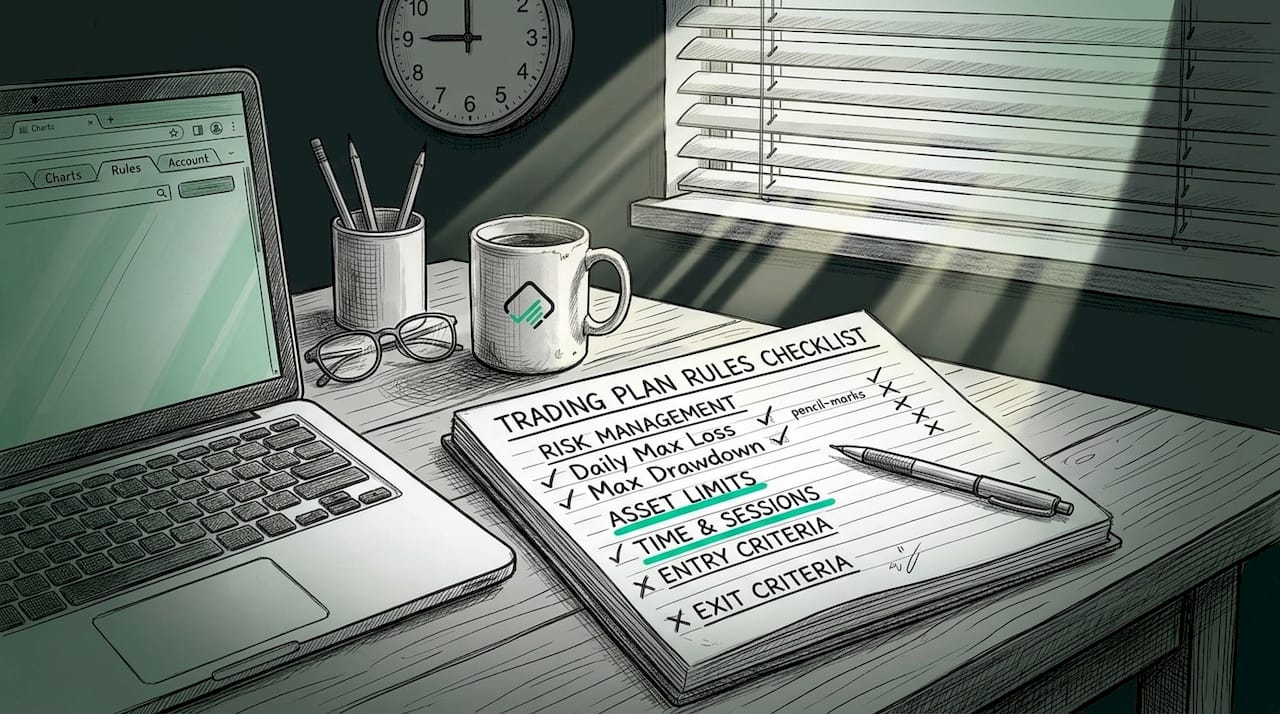
Failing a prop firm challenge often comes down to one preventable cause: overlooking a specific trading rule at the wrong moment. Many retail traders spend weeks refining their strategy, only to get disqualified for exceeding a daily loss limit or failing to apply consistent position sizing. The frustration is real, and it is surprisingly common. A structured checklist approach changes that dynamic. Instead of relying on memory or intuition during high-pressure trading sessions, a checklist turns complex rule sets into a repeatable, manageable routine. This article walks you through the key rules, risk parameters, consistency habits, and error prevention tactics that belong on every prop trader’s evaluation checklist.
Table of Contents
- Core trading rules every prop trader must follow
- Risk management and stop loss: Protecting your evaluation
- Consistency and discipline: The keys to passing prop challenges
- Common mistakes and how to prevent them: Checklist optimization
- Our take: Why checklists beat intuition every time
- Ready to upgrade your trading checklist?
- Frequently asked questions
Key Takeaways
| Point | Details |
|---|---|
| Stick to core rules | Checklist discipline prevents instant disqualification and builds prop challenge consistency. |
| Risk management is vital | Daily risk and stop loss limits safeguard your account and your progress. |
| Consistency breeds success | Following structured routines and tracking adherence pays off over multiple evaluations. |
| Learn from mistakes | Add prevention tactics to your checklist to avoid common prop trading errors. |
Core trading rules every prop trader must follow
After establishing the role of trading rules, let’s detail the essential ones every funded trader must check daily. Prop firm challenges are governed by a specific set of parameters, and violating even one of them can end your evaluation instantly. Understanding what these rules are and why they exist gives you a real advantage before you place your first trade.
The most commonly enforced rules across challenges fall into four categories:
- Daily loss limit: The maximum amount your account can lose in a single trading day, typically set between 4% and 5% of account balance. Breaching this limit is one of the leading reasons traders fail their evaluations.
- Overall drawdown limit: Also called the maximum drawdown, this is the total loss your account can absorb from its highest point before the challenge is voided. Firms often set this between 8% and 12%, depending on the program structure.
- Consistency requirements: Some firms require that no single trading day accounts for a disproportionate share of total profits. This rule is designed to prevent traders from “luck trading” by swinging large positions on one day and calling it skill.
- Maximum position size: Most prop firms cap the number of lots or contracts you can hold simultaneously, often relative to account size. Ignoring this is a prop trading mistakes guide that new traders repeat more than any other.
These rules exist for a clear reason. Prop firms are allocating real capital, and their internal risk models depend on traders maintaining disciplined exposure. It is not about restricting your strategy; it is about proving that you can manage risk consistently. The foundational trading rules used across the industry reflect professional risk management standards that institutional trading desks have applied for decades.
One often-overlooked area is the time-based rule. Some firms prohibit holding trades over weekends or during major news events. Swing traders in particular need to confirm these restrictions before building a strategy around longer hold times, since breaking a news restriction can invalidate an otherwise profitable run. Review the errors new prop traders commonly make to see how frequently these time-based rules catch traders off guard.
Pro Tip: Set phone calendar reminders 30 minutes before your daily loss limit would be reached based on your current open positions. This gives you time to reassess before a loss becomes a disqualification.
Risk management and stop loss: Protecting your evaluation
Having covered core trade rules, let’s examine how risk management and stop loss fit into your daily checklist. Many traders understand risk management in theory but fail to apply it systematically under evaluation pressure. A checklist makes execution automatic.
Follow these numbered steps each time you prepare to place a trade during your challenge:
- Calculate your risk per trade. Most funded traders limit this to 0.5% to 1% of account equity per position. If your account is $100,000, one trade should risk no more than $500 to $1,000.
- Verify your daily loss budget. Before opening any position, check how much of your daily loss limit remains. If you have already taken a 2% loss and your daily limit is 4%, your remaining budget is only 2%. Adjust position size accordingly.
- Set your stop loss before entry. This is non-negotiable. Placing a trade without a predefined stop loss is the fastest route to exceeding your drawdown limit on a single session.
- Confirm the stop level is realistic. A stop placed too tight will trigger on normal market noise. A stop placed too wide may expose you to more loss than your daily budget allows. Size the position to fit the stop, not the other way around.
- Record the trade in your journal. Logging the planned risk, the stop level, and the entry rationale creates an audit trail. This habit also reveals patterns in your risk behavior over time.
The risk management blueprint for passing challenges in 2026 reinforces a principle that many traders underestimate: the stop loss is not just a safety tool; it is evidence that you planned the trade. Firms that review trader behavior before approving funded accounts look for exactly this kind of structured approach.
“Traders who consistently use predefined stop losses during evaluations demonstrate the kind of risk discipline that distinguishes professional behavior from amateur trading.”
Applying funded account strategies that emphasize disciplined stop placement significantly improves your probability of not just passing the challenge, but thriving once you are managing real capital. Once funded, the same discipline helps you scale a funded account without hitting drawdown ceilings that would otherwise cap your growth.
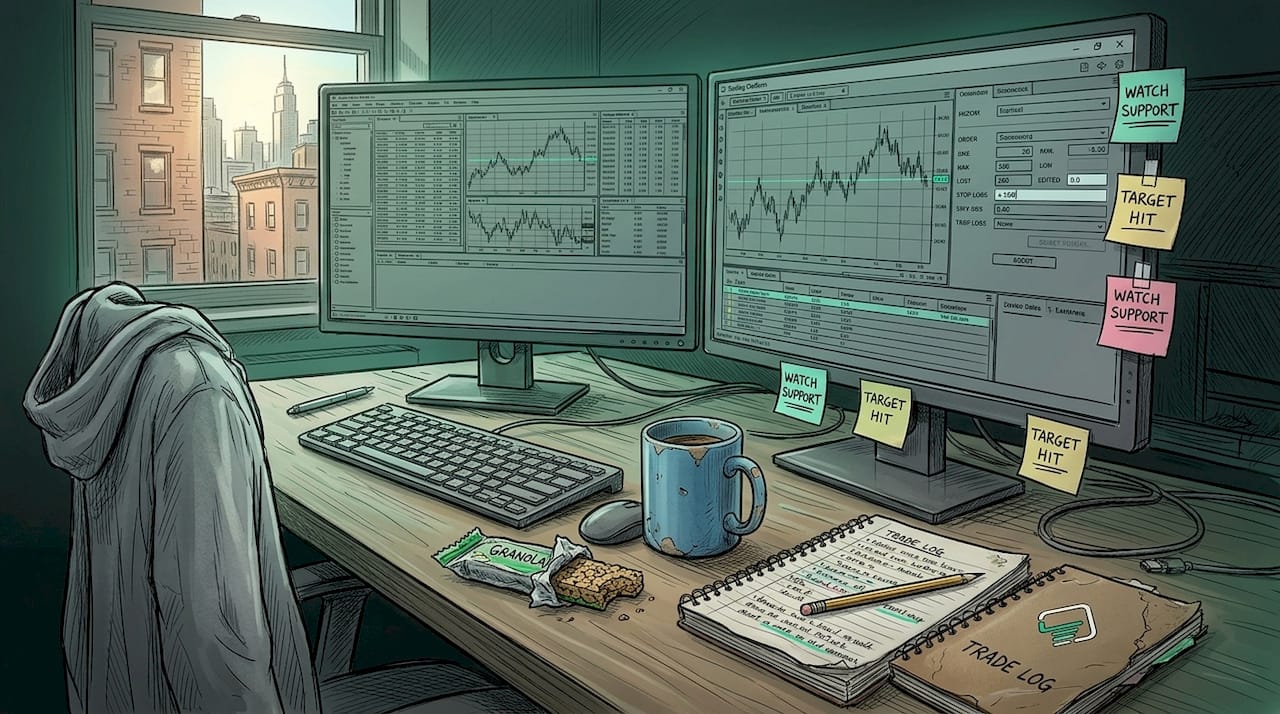
Pro Tip: Many prop firms provide built-in risk calculators in their trading dashboards. Use these every session rather than estimating position size mentally. A 10-second check can save your entire evaluation.
Consistency and discipline: The keys to passing prop challenges
Risk management alone isn’t enough; consistency and discipline set winners apart in the evaluation phase. Some traders hit their profit target but still fail because their trading pattern looks erratic. Firms that use consistency scoring systems are evaluating behavior, not just results.
Consistency in a prop firm context means several things at once. It means trading a comparable number of positions each day. It means maintaining similar risk per trade rather than doubling up on “high conviction” setups. And it means keeping your profit-and-loss distribution within acceptable variance. The prop firm consistency rule is specifically structured to filter out traders who rely on one or two outlier days to push through an evaluation.
Here are behaviors to monitor and include on your daily consistency checklist:
- Position sizing uniformity: Track whether your lot sizes are within a consistent range each session.
- Trade frequency: Avoid dramatic swings between trading 10 setups one day and 1 setup the next.
- Session timing: Stick to the same market sessions where your edge applies. Randomly entering unfamiliar sessions increases variance.
- Profit per day distribution: Flag any day where your profit exceeds 25% to 30% of your total challenge target, as some firms will flag this automatically.
- Emotional decision logging: Record any trade where you deviated from your plan, even if it was profitable. Profitable deviations create overconfidence; unprofitable ones accelerate drawdown.
The following table compares outcomes between consistent and inconsistent trading approaches in a typical two-phase challenge evaluation:
| Behavior | Consistent trader | Inconsistent trader |
|---|---|---|
| Daily risk per trade | Fixed at 0.5% to 1% | Varies widely, 0.25% to 3% |
| Drawdown pattern | Gradual, controlled | Spiked, reactive |
| Profit distribution | Spread across sessions | Concentrated in 1 to 2 days |
| Challenge outcome | High pass rate | Frequent disqualification |
| Funded account behavior | Sustainable growth | High volatility, account breach |
The data above reflects patterns observed across prop challenge failure reasons studied by our review team. Traders who pass challenges with consistent behavior almost always perform better once funded because the habits are already established. Consistency is not a constraint; it is the foundation your trading performance is built on, as outlined in the 7 rules every trader needs to clear evaluation phases.
Common mistakes and how to prevent them: Checklist optimization
Even with a solid checklist, traders slip up. Here are the most common pitfalls and how to prevent them with targeted checklist updates.
The most frequently overlooked checklist items include:
- Forgetting to check news events: Major economic releases such as non-farm payrolls or central bank decisions can hit stop losses instantly or trigger spread widening that forces unexpected exits.
- Failing to reset daily drawdown tracking: Some traders calculate daily loss from the wrong baseline, especially if they confuse floating losses with realized ones. Know your firm’s specific definition.
- Skipping post-trade review: Not reviewing completed trades means you cannot catch patterns that are slowly eroding your risk budget.
- Over-relying on automation: Automated stop losses can fail due to connectivity issues or slippage. Always verify that protective orders are active before walking away from your screen.
- Trading while fatigued or emotionally reactive: This is consistently cited as a contributing factor in challenge failures, particularly after a significant losing session.
The mistakes new prop traders make include nearly all of the above, and addressing them does not require a complex system. It requires a written checklist reviewed before, during, and after each session.
The following table maps common mistakes to practical prevention measures you can add directly to your checklist:
| Mistake | Prevention measure |
|---|---|
| Missing daily loss limit | Check remaining daily budget before each entry |
| No stop loss set | Confirm stop level as a required pre-entry step |
| Inconsistent position sizing | Use a fixed lot calculator every session |
| Trading during restricted news | Review economic calendar every morning |
| No trade journal | Log entry, stop, target, and rationale for every trade |
| Overtrading after a loss | Set a maximum daily trade count as a hard rule |
To optimize your checklist for your own trading style, you need to know which mistakes are most likely for you specifically. Review your last 20 trades and identify the three rules you came closest to violating. Those become the top items on your personal checklist. Generic checklists help, but personalized ones are far more effective at avoiding trading mistakes in live evaluation conditions.
Style-specific adjustments matter too. Scalpers need to check maximum position hold time restrictions more carefully than swing traders. Day traders need to verify that their firm allows the number of trades they typically take per session. Understanding the intersection of your personal approach and your firm’s specific rules is what separates traders who repeatedly pass challenges from those who keep failing at the same stage.
Our take: Why checklists beat intuition every time
Across our reviews of dozens of prop firms and the traders who attempt their challenges, one pattern is remarkably consistent. Traders who document their process outperform those who trade by feel, even when the intuitive traders appear to have stronger raw skills. Under the pressure of an evaluation, memory degrades, emotions interfere, and small rules get forgotten.
Intuition is a product of experience, but it is also subject to cognitive bias. After a strong winning streak, traders tend to take on more risk than their checklist would allow. After a losing run, they shrink their position size below what their edge requires. Neither behavior is rational, and both erode performance. A structured rule checklist removes that variability by replacing judgment calls with predetermined steps.
What our testing consistently shows is that traders who treat their checklist as a non-negotiable protocol, not a suggestion, maintain far more stable drawdown curves during evaluations. The checklist is not a sign of inexperience. It is a professional tool used in virtually every high-stakes decision environment, from aviation to surgery. Applying it to prop trading is not overcautious. It is the correct response to a high-stakes environment where one oversight can cost you weeks of work.
Ready to upgrade your trading checklist?
Now that you have the full trading rules checklist, here is how to take your prop trading to the next level.

At Responsible Trading, we provide independent, data-driven resources built specifically for traders navigating prop firm evaluations. Whether you are selecting a platform using our best forex trading platform guide, reviewing the exact challenge rules you need to follow, or comparing firms through our prop firm rankings, our tools are designed to give you a clear, unbiased picture of your options. Our real-world testing and cross-referenced payout data mean you are working from accurate information, not marketing claims. Use our resources to build a checklist that is fully aligned with your chosen firm’s specific requirements.
Frequently asked questions
What is the most important trading rule for prop firm challenges?
The most critical rule is typically the daily loss limit; exceeding it almost always results in instant disqualification, as confirmed by the foundational rules applied across major prop firm programs.
How can I track my adherence to trading rules effectively?
Use written or digital checklists and verify each rule before and after every trading session, a practice consistently recommended in challenge rule guides for traders in active evaluations.
What are the most common mistakes traders make in prop firm challenges?
Missing risk limits, neglecting stop loss placement, and failing to maintain consistency are the top mistakes, all of which are preventable with the right checklist as detailed in guides covering new trader errors.
Are trading rules different across prop firms?
Yes, firms set unique rules for risk, position size, and consistency; always check the firm’s published guidelines, since rule structures vary significantly between programs and account types.
Recommended
- Step-by-step guide: prop firm account setup made simple (2026) | Responsible Trading
- Prop firm scoring systems: how to evaluate and succeed (2026) | Responsible Trading
- How to Choose the Right Prop Firm for Your Trading Strategy (Step-by-Step Guide) (2026) | Responsible Trading
- Avoid these prop trading mistakes: a practical guide (2026) | Responsible Trading