
Many traders enter their first prop firm challenge convinced the rules are designed to make them fail. That belief is understandable, but it is also wrong. Prop firm rules exist primarily to protect capital, both the firm’s and yours, and to build a structured environment where disciplined traders can actually thrive. The traders who struggle most are not those with poor strategies. They are the ones who never took the time to truly understand what the rules require. This guide breaks down every major category of prop firm rules, from drawdown limits to hidden fine print, so you can approach your next challenge with clarity and confidence.
Key Takeaways
| Point | Details |
|---|---|
| Know the core rules | Understanding drawdown, profit targets, and consistency requirements is essential before joining a prop firm challenge. |
| Watch for hidden policies | Always read the fine print for less obvious restrictions to avoid disqualification and lost profits. |
| Adapt your trading | Success comes from tailoring your strategy to fit each firm’s specific rules, not the other way around. |
| Mind the technology rules | Check all guidelines for automation, EAs, and copy trading if you rely on software. |
| Continuous compliance | Staying informed about updates and clarifying with your prop firm helps keep your funded status. |
What are prop firm rules and why do they matter?
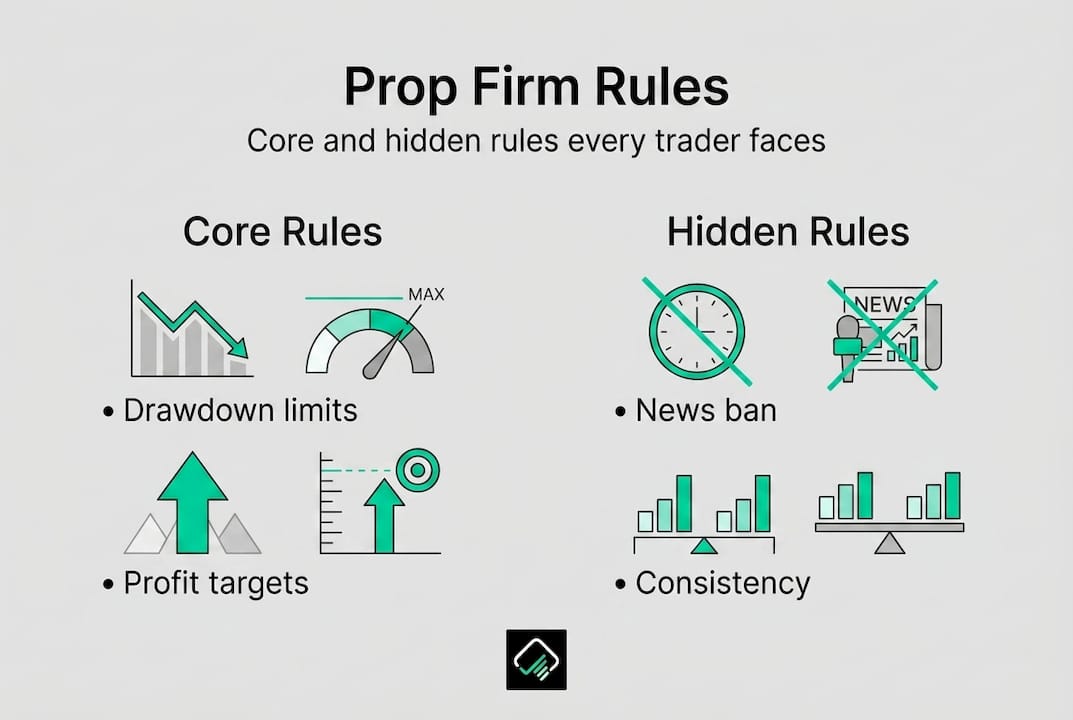
Prop firm rules are the formal conditions a trader must follow to pass a funded challenge and maintain a live account. They fall into several core categories: risk management rules, behavioral rules, consistency requirements, and trading style restrictions. Each category serves a specific function, and understanding that function is the first step toward working with the rules rather than against them.
From the firm’s perspective, these rules are straightforward business logic. A prop firm is allocating real or simulated capital to traders it has never met. Without structured controls, a single reckless trader could cause significant losses. Prop firms set specific rules to manage risk and ensure responsible trading across their entire trader base. That is not a trap. It is standard risk management.
Here is a quick overview of the most common rule types you will encounter:
- Maximum drawdown: The total loss limit before your account is closed
- Daily loss limit: The maximum you can lose in a single trading day
- Profit target: The minimum gain required to pass a challenge phase
- Consistency rule: A requirement that no single day’s profit dominates your overall performance
- Trading style restrictions: Bans on news trading, scalping, or holding positions overnight
The prop firm drawdown rules are arguably the most impactful category, as they define the absolute boundaries of your risk tolerance during a challenge. Violating them ends your account immediately, regardless of your overall performance.
“Treating prop firm rules as adversaries is the fastest route to failure. Understanding them as a framework transforms your entire approach.”
It is also worth noting that hidden prop firm rules buried in terms and conditions can catch even experienced traders off guard. We will cover those in detail later. For now, the key takeaway is this: rules are not arbitrary obstacles. They are the operating system of every funded trading program.
Key prop firm rules explained: The essentials every trader must know
With the foundational context established, let’s look closely at the most critical rules you will face during a challenge and what each one actually means in practice.
- Static vs. trailing drawdown. A static drawdown is fixed from your starting balance. A trailing drawdown moves upward as your account grows, locking in a floor that follows your peak equity. Trailing drawdown is significantly stricter because a winning streak can actually shrink your available risk buffer. Drawdown and profit target rules shape the vast majority of trader outcomes in prop firm challenges.
- Balance vs. equity drawdown. Some firms measure drawdown from your account balance (closed trades only), while others measure it from your real-time equity (including open positions). Equity-based drawdown is more dangerous because a temporary floating loss can trigger a breach even if you never close the trade at a loss.
- Daily loss limits. Most firms set a daily loss cap between 4% and 5% of the account balance. Hitting this limit on any single day disqualifies you, regardless of your cumulative performance. This rule punishes revenge trading and emotional decision-making more than any other.
- Profit targets. Challenge phases typically require a 8% to 10% gain to advance. This sounds straightforward, but it interacts directly with the consistency rule. You cannot simply take one massive trade to hit the target.
- Consistency rule. This is where most traders fail. The prop firm consistency rule requires that no single trading day accounts for a disproportionate share of total profits, often capped at 30% to 50% of overall gains. It forces steady, repeatable performance over time.
- Profit split structures. Once funded, your profit split rules determine how much you actually keep. An 80% split sounds generous, but the calculation method, whether it includes fees, resets, or scaling conditions, can significantly affect your real earnings.
Pro Tip: Before starting any challenge, map out your maximum allowable daily loss and work backward to determine the position sizes that keep you safely within that limit at all times. This single habit eliminates most rule violations before they happen.
Hidden rules and gray areas: What most traders overlook
With the core rules covered, it is important to address the category that causes the most unexpected account closures: hidden and ambiguous rules that never appear in the headline marketing.

Many prop firms incorporate discretionary, unpublished, or fine print rules that can void accounts even when main targets are met. These include trading style restrictions, news trading bans, time-based limits, and algorithm or Expert Advisor policies that only appear deep in the terms and conditions.
Here is a comparison of commonly overlooked rules across major challenge types:
| Rule type | What it restricts | Risk level |
|---|---|---|
| News trading ban | Trades placed within 2 to 5 minutes of major news events | High |
| Overnight holding ban | Positions held past market close | Medium |
| EA/algorithm restrictions | Automated trading tools or copy trading | High |
| Time-limited challenges | Minimum or maximum trading days | Medium |
| Lot size caps | Maximum position size per trade | Medium |
| Martingale strategy ban | Doubling down after losses | High |
The Expert Advisor restrictions are particularly nuanced. Some firms allow EAs with disclosure, others ban them outright, and a few will retroactively disqualify accounts if automated patterns are detected in trading history. This is not always communicated upfront.
Steps to protect yourself:
- Read the full terms and conditions before purchasing a challenge, not after
- Check community forums such as Reddit and Discord for real trader experiences with that specific firm
- Contact support directly to confirm any rule you are uncertain about, and save the response in writing
- Review compliance requirements again after receiving a funded account, as rules sometimes differ between challenge and live phases
Applying funded trading strategies that are explicitly designed for rule compliance is far safer than adapting a personal strategy and hoping it fits.
Pro Tip: Create a personal rule checklist for every firm you consider. List every restriction, confirm it with the firm’s support team, and check it off before your first trade. This takes 20 minutes and can save your entire challenge fee.
How to adapt: Strategies for passing and thriving under prop firm rules
Knowing the rules is only half the work. The other half is building a trading approach that operates comfortably within those boundaries without sacrificing performance.
Traders who develop rule-adaptive strategies are significantly more likely to pass funding challenges. Here is a practical framework for doing exactly that:
- Identify the strictest rule first. Every challenge has one rule that is hardest to satisfy. For most traders, it is the consistency rule or the trailing drawdown. Build your entire risk plan around that constraint before considering anything else.
- Standardize your position sizing. Inconsistent lot sizes are the primary cause of consistency rule violations. Use a fixed risk percentage per trade, typically 0.5% to 1% of account balance, and do not deviate regardless of how confident you feel about a setup.
- Avoid overconcentration. Taking multiple correlated positions in the same direction multiplies your effective risk. If your daily loss limit is 5%, three correlated trades at 2% each can breach it in a single move.
- Document every trade during the challenge. Keep a trading journal that records your entry, exit, rationale, and rule compliance for each trade. If a dispute arises with the firm, this documentation is your only defense.
- Simulate before you trade live. Run your strategy through historical data using the exact rules of the challenge. This reveals whether your approach naturally respects the consistency rule and drawdown limits before real money is involved.
- Ask for clarification early. If any rule is ambiguous, contact the firm before your challenge begins. Firms generally respect traders who engage proactively, and the answer may reveal a restriction you had not considered.
For a structured approach to passing prop firm challenges, the core principle is always the same: protect your account first, pursue profit second.
Pro Tip: Set your personal daily loss limit at 60% to 70% of the firm’s stated limit. This buffer absorbs bad days without ever approaching the actual breach threshold.
Why most traders underestimate prop firm rules (and how to flip the script)
After reviewing hundreds of trader outcomes and challenge results, one pattern stands out clearly: the traders who fail most often are not the least skilled. They are the ones who treated the rulebook as background noise.
Most traders scan the headline numbers, the profit target and the drawdown percentage, and assume they understand the challenge. They do not. The real complexity lives in the interaction between rules. A trailing drawdown combined with a consistency rule and a news trading ban creates a very specific trading environment that rewards patience and penalizes aggression. Treating those rules as adversaries leads to frustration and failed challenges. Treating them as the operating boundaries of a professional trading environment leads to consistent performance.
The traders who succeed long term are those who study the overlooked hidden rules as carefully as they study price action. They adapt their strategies to fit the firm’s framework rather than forcing their existing habits into an incompatible structure. The mindset shift is simple but powerful: rules are not the enemy. Ignorance of them is.
Next steps: Find the best prop firm for your trading style
Understanding prop firm rules is only valuable if you apply that knowledge to the right firm. Not every challenge structure suits every trading style, and choosing the wrong firm is one of the most common and most avoidable mistakes traders make.
At Responsible Trading, we provide independent, data-driven reviews of prop firms so you can compare rule structures, payout reliability, and challenge conditions before committing. Whether you are a scalper, a swing trader, or an algo trader, our guides help you choose the right prop firm based on your specific approach. For high-frequency traders, our dedicated resource on best prop firms for scalpers covers the firms with the fewest restrictions and fastest execution. You can also explore our best forex trading platform guide to pair the right tools with your chosen firm.
Frequently asked questions
What are the most common reasons traders fail prop firm challenges?
Most failures are linked to rule infractions related to drawdown, consistency, or hidden rule breaches. Traders who study all rule categories before trading significantly reduce their risk of disqualification.
Can you use trading robots or Expert Advisors in prop firm challenges?
Expert Advisor and algorithm rules vary across firms and can void accounts if broken. Always confirm EA permissions directly with the firm before using any automated tool.
What happens if you break a hidden rule in a prop firm account?
Hidden rule breaches often result in full account disqualification, including forfeiture of all profits, even if the main performance targets were met.
How can I find a prop firm whose rules match my trading style?
Strategic alignment is key to success in prop trading challenges. Compare official rulebooks with your preferred trading methods and cross-reference with independent review platforms before selecting a firm.
Recommended
- Prop firm scoring systems: how to evaluate and succeed (2026) | Responsible Trading
- Prop Firm Reviews – Responsible Trading
- Step-by-step guide: prop firm account setup made simple (2026) | Responsible Trading
- Prop Firm Hidden Rules: The Fine Print That Catches Traders Out in 2026 (2026) | Responsible Trading
- A New Approach to Prop Trading in 2026: Why Structured Development Matters