
Prop trading attracts retail traders at every skill level, yet the failure rate remains stubbornly high. A significant portion of traders who enter evaluation challenges never receive funding, not because markets are impossible to navigate, but because the same recurring mistakes appear again and again. Recognizing these pitfalls before they cost you real money is one of the most practical steps you can take toward consistent performance. This article breaks down the four most critical mistake categories in prop trading, from weak strategy foundations to misread firm rules, and gives you concrete steps to sidestep each one.
Table of Contents
- Weak trading strategies and lack of preparation
- Ignoring risk management principles
- Falling into psychological traps and overtrading
- Overlooking prop firm rules and evaluation criteria
- Why most prop trading advice misses the real problem
- How Responsible Trading helps you avoid costly mistakes
- Frequently asked questions
Key Takeaways
| Point | Details |
|---|---|
| Plan your strategy | Successful prop traders always prepare defined, tested trading plans before applying. |
| Prioritize risk rules | Risk management is non-negotiable—stick to loss limits and position sizes at all times. |
| Master your mindset | Self-discipline and awareness of bias protect against costly mental errors in live trading. |
| Know firm requirements | Each prop firm has unique rules; review all documentation and seek clarification as needed to avoid disqualification. |
Weak trading strategies and lack of preparation
Foundational strategy errors trip up even talented traders during evaluation phases. A trading plan that looks solid in theory often falls apart under the pressure of real evaluation conditions, especially when position sizing is inconsistent or risk rules are undefined. Many traders fail challenges due to poorly defined strategies, which means the problem is not always execution but preparation.
The signs of an underdeveloped plan are usually visible before you even place a trade. Watch for these red flags:
- No fixed position sizing rules: You decide lot sizes based on gut feel rather than account percentage.
- Unclear entry and exit criteria: You enter trades based on vague signals rather than defined setups.
- Strategy mismatch with firm model: Your scalping approach conflicts with a firm that restricts trades held under 60 seconds.
- No defined maximum daily loss threshold: You have no hard stop that forces you to step away from the screen.
- Untested on relevant market conditions: Your strategy was backtested in trending markets but the evaluation period is range-bound.
Matching your strategy to the specific prop firm evaluation systems used by your target firm is not optional. Some firms reward consistency over raw profit, while others score based on Sharpe ratio or maximum drawdown. If you do not know which metrics matter most, you are trading blind.

Before applying to any firm, run through this preparation checklist. Write down your entry rules, exit rules, and maximum risk per trade. Backtest your strategy over at least 100 trades in recent market conditions. Review the prop firm basics to understand how evaluation phases are structured. Then compare your plan against the firm’s specific scoring criteria.
Pro Tip: If you are still deciding where to apply, start with a review of the best prop firms for beginners to find firms whose evaluation models align with lower-risk, rule-based strategies.
The goal is not to have a perfect strategy. The goal is to have a documented strategy that you can execute consistently under pressure.
Ignoring risk management principles
Building on strategy, mastering risk management is equally essential, and arguably more important during evaluation phases. Risk management in prop trading refers to the set of rules governing how much capital you risk per trade, your maximum daily drawdown limit, and your overall account loss ceiling. Improper risk management directly leads to challenge failures and lost accounts, making it the single most disqualifying factor across all experience levels.
The most common errors traders make in this area include:
- Over-leveraging positions: Using 5% or more of account equity on a single trade when the firm’s rules or sound practice calls for 1% to 2%.
- Skipping stop-loss orders: Entering trades without a defined exit point, hoping the market will reverse.
- Emotional allocation: Increasing position size after a winning streak, assuming momentum will continue.
- Ignoring daily drawdown caps: Trading past the point where your daily loss limit has been reached, triggering automatic disqualification.
- No record-keeping: Failing to log trades means you cannot identify which setups are draining your account.
Setting up a solid risk framework starts with one rule: never risk more than 1% of your account on any single trade. From there, set a hard daily loss limit at 2% to 3% of account equity and stop trading the moment you hit it. Review your prop firm red flags guide to understand which firms have hidden drawdown rules that could catch you off guard.
“The traders who survive evaluation are rarely the most aggressive ones. They are the ones who treat capital preservation as their primary objective.”
Consistency in risk parameters, applied trade after trade, is what separates traders who pass evaluations from those who blow accounts in week one.
Falling into psychological traps and overtrading
With technical risks addressed, the mental pitfalls unique to prop trading deserve equal attention. Psychological traps are behavioral patterns that cause traders to deviate from their written plan, often at the worst possible moment. Mental biases and overconfidence frequently cause traders to break rules and overtrade, and consistent mindset errors are behind the vast majority of challenge failures.
The most damaging psychological traps include:
- Revenge trading: After a losing trade, immediately entering another position to recover losses, usually with higher size and lower discipline.
- FOMO (fear of missing out): Chasing a move that has already happened because you feel you missed the opportunity.
- Abandoning the plan after a losing streak: Assuming your strategy is broken after three or four losses and switching approaches mid-evaluation.
- Overconfidence after wins: Relaxing your rules because a strong run makes you feel invincible.
- Analysis paralysis: Overthinking entries to the point where you miss valid setups entirely.
Avoiding overtrading requires structure. Set a maximum number of trades per day, typically three to five, and stop when you reach it regardless of market conditions. Use a pre-trade checklist that forces you to confirm your setup meets all criteria before executing. Review your prop firm challenge mindset resources to build a routine that keeps you anchored to your plan.
“A trader who follows a mediocre plan consistently will outperform a trader with a great plan who abandons it under pressure.”
When you notice emotional decision-making creeping in, the correct response is to stop trading for the day. Breaks are not a sign of weakness. They are a risk management tool. Understanding why traders fail prop firm challenges often comes down to this single factor more than any other. Even reviewing a firm like Eightcap Challenges shows that their top-performing funded traders share one trait: disciplined session management.
Overlooking prop firm rules and evaluation criteria
After discussing individual habits, the importance of firm-specific rules in making or breaking your evaluation cannot be overstated. Every prop firm operates with its own rulebook, and the differences between firms can be significant. Misreading or ignoring a firm’s rules and scoring criteria is a frequent reason for failed evaluations, even among experienced traders who have passed challenges elsewhere.
Common rule types and the mistakes traders make against them are outlined below:
| Rule type | What it means | Typical trader mistake |
|---|---|---|
| Maximum daily drawdown | Max loss allowed in one trading day | Trading past the limit without tracking it |
| Overall drawdown limit | Total account loss ceiling | Confusing trailing vs. static drawdown rules |
| Lot size restrictions | Maximum position size per trade | Using full leverage without checking limits |
| Instrument restrictions | Which assets you can trade | Trading crypto or commodities when restricted |
| Minimum trading days | Must trade for a set number of days | Hitting profit target too fast, skipping days |
| News trading restrictions | No trading around major news events | Entering positions during NFP or FOMC releases |
Before starting any evaluation, use this checklist:
- Download and read the firm’s full terms and conditions, not just the marketing page.
- Identify whether the drawdown rule is trailing or static, as this changes your risk calculation entirely.
- Note any instrument or time-based restrictions.
- Contact support with specific questions before you fund your account.
- Use the prop firm scoring systems framework to compare evaluation criteria across firms objectively.
Choosing the wrong firm for your style is just as costly as trading poorly. Use the prop firm selection process to match your approach to a firm whose rules work in your favor, not against you.
Why most prop trading advice misses the real problem
Most articles on prop trading mistakes focus on surface-level fixes: use a stop-loss, do not overtrade, read the rules. That advice is accurate, but it addresses symptoms rather than the underlying issue. The real problem is that most traders do not have a performance process. They have a strategy, and they hope it works. That is fundamentally different from systematically reviewing what went wrong, why it went wrong, and what specific adjustment will prevent it from happening again.
Honest, objective journaling is one of the most underused tools in trading. Not a log of trades, but a structured post-session review that captures your emotional state, decision rationale, and rule compliance on every trade. Traders who build this habit catch small mistakes before they compound into account-ending errors. Reviewing beginner prop trader challenges consistently reveals that the traders who improve fastest are not the most naturally talented. They are the ones who review their performance with the same rigor they apply to market analysis. The difference between failing and succeeding in prop trading is often not knowledge. It is the willingness to look at your own behavior objectively and change it.
How Responsible Trading helps you avoid costly mistakes
Putting these lessons into practice is easier when you have reliable, tested resources guiding your decisions. Responsible Trading provides independent, data-backed reviews and guides built specifically for traders navigating the prop firm landscape.
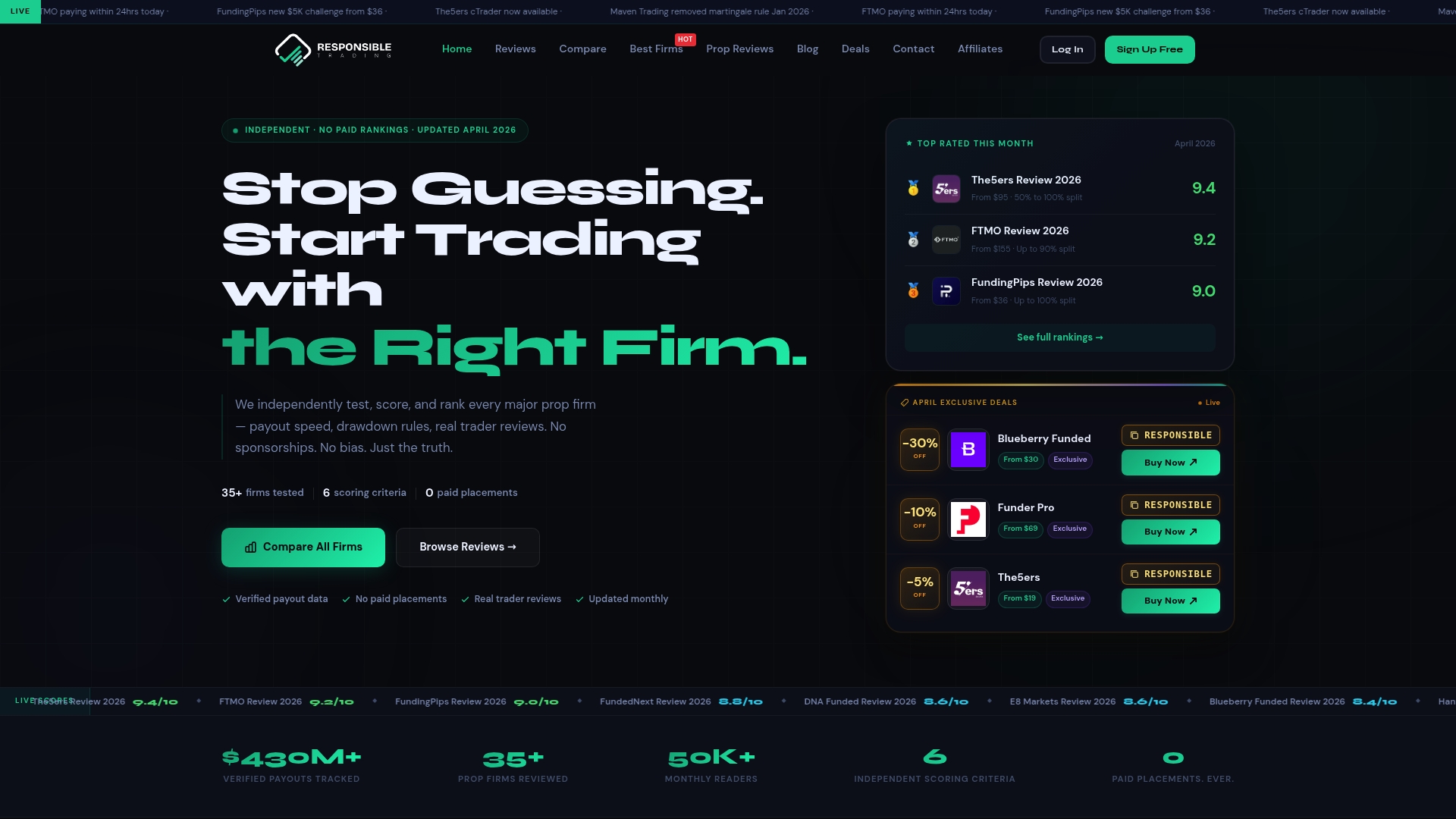
Whether you need to find the right best forex platforms for your trading style, follow a proven risk management guide to structure your evaluation approach, or use our prop firm selector to match your strategy with the right firm, Responsible Trading gives you the tools to make informed decisions. Every review is grounded in real testing and cross-referenced data, so you are not relying on guesswork when your capital is on the line.
Frequently asked questions
What is the number one mistake prop traders make?
Improper risk management directly leads to challenge failures, making it the most common and most costly mistake traders make during evaluations.
How can I avoid breaking a prop firm’s rules?
Always read the firm’s full documentation before starting, ask support for clarification on unclear rules, and use a pre-evaluation checklist. Misreading a firm’s rules is a frequent cause of failed evaluations that is entirely preventable.
Does psychology really affect trading results?
Yes. Mental biases and overconfidence frequently cause traders to break their own rules and overtrade, which are leading causes of challenge failure.
Can beginners succeed in prop trading?
Beginners can succeed by building a documented strategy, practicing strict risk management, and selecting a firm that fits their skill level. Many traders fail challenges due to poorly defined strategies, so preparation is the clearest path to early success.
Recommended
- 5 Common Mistakes New Prop Traders Make (And How Responsible Trading Fixes Them) (2026) | Responsible Trading
- How to Choose the Right Prop Firm for Your Trading Strategy (Step-by-Step Guide) (2026) | Responsible Trading
- Best Prop Firms for Beginners in 2026 — A Trader’s Complete Guide (2026) | Responsible Trading
- How to Pass a Prop Firm Challenge — 7 Rules Every Trader Needs (2026) | Responsible Trading
- Improve trading skills with prop evaluation simulation