
Most traders who fail a prop firm evaluation assume the problem was their strategy or their nerves. The real reason is often simpler and more fixable: they didn’t fully understand the scoring system. Prop firms don’t just measure profit. They measure how you made that profit, and the rules governing that process can disqualify even genuinely skilled traders. This guide breaks down exactly how prop firm scoring systems work, why rule changes can catch you off guard, and what it takes to put yourself among the fewer than 10% of candidates who actually pass and receive funding.
Table of Contents
- What are prop firm scoring systems?
- Types of rules firms use: Consistency, drawdown, and more
- How scoring systems impact your evaluation and funding odds
- Adapting your trading to pass any scoring system
- Why most traders misunderstand scoring and how to stand out
- Next steps: Get the right tools and insights for your prop firm journey
- Frequently asked questions
Key Takeaways
| Point | Details |
|---|---|
| Know the rules | Understanding each firm’s unique scoring system is key to passing evaluations and getting funded. |
| Discipline wins | Most failures come from rule breaches, so trading within guidelines makes the difference. |
| Rule changes happen | Firms update scoring and risk rules often, so check the latest terms before every challenge. |
| Strategize for success | Adapting your trading plan to each scoring system greatly increases your chances of success. |
What are prop firm scoring systems?
A prop firm scoring system is the full set of criteria a firm uses to decide whether a trader qualifies for funded capital. Most traders focus almost entirely on the profit target, but that’s only one piece of the picture. Scoring systems also evaluate how you reached that target, not just whether you did.
The major rule categories typically include:
- Profit target: The minimum gain required to pass a phase, usually 8-10% for phase one.
- Maximum drawdown: The total loss limit on your account, either from starting balance or peak equity.
- Daily loss limit: The maximum you can lose in a single trading day before you’re disqualified.
- Consistency rule: A formula that checks whether your profits are spread evenly across trading days.
- Minimum trading days: Some firms require you to trade for a set number of days before passing.
- Trading style restrictions: Rules around news trading, holding positions overnight, or using certain strategies.
The consistency rule details deserve special attention. As documented by industry sources, the consistency formula works like this: your best single day’s profit cannot exceed 30-45% of your total profit. So if you made $1,000 total but $600 came from one trade on one day, you may fail even though you hit the profit target.
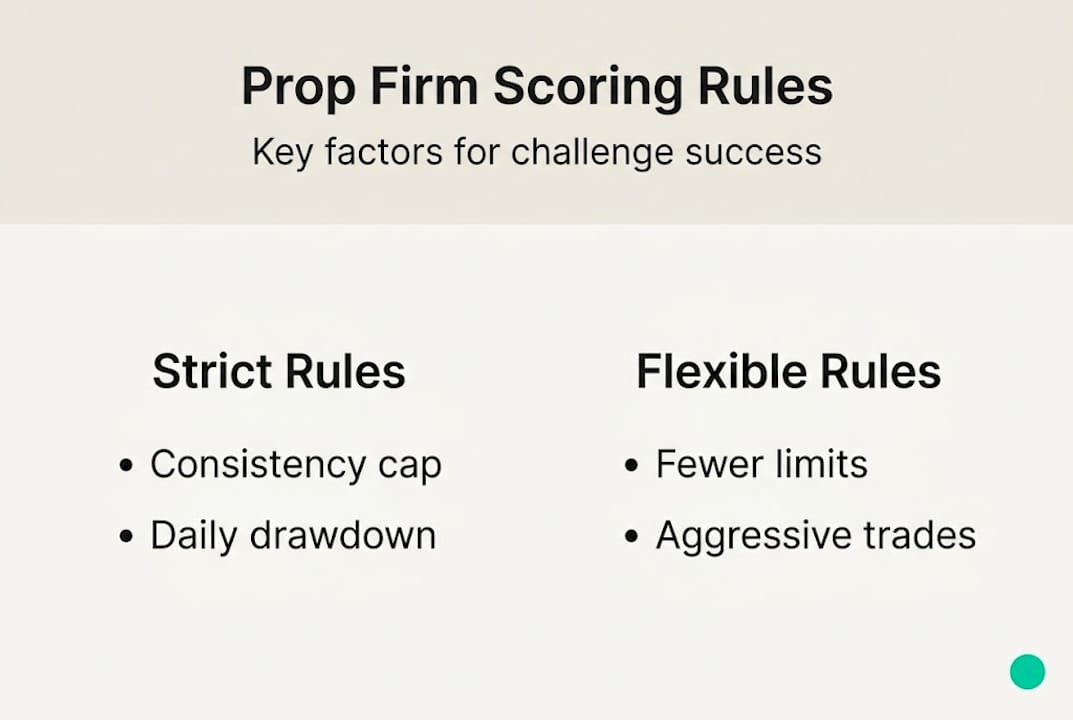
Here’s a quick comparison of how different rule types vary across firm categories:
| Rule type | Strict firms | Flexible firms |
|---|---|---|
| Consistency rule | 30-45% cap enforced | Not enforced |
| Daily loss limit | 4-5% of balance | 5-6% of balance |
| Max drawdown | 8-10% static | 10-12% trailing |
| Min trading days | 4-10 days | None |
| News trading | Restricted | Allowed |
Not all firms use the same system. Some favor aggressive traders and skip the consistency rule entirely, but they compensate with tighter drawdown rules and stricter daily loss limits. Knowing which system a firm uses before you start is the single most important piece of preparation you can do.
Types of rules firms use: Consistency, drawdown, and more
Now that you know the main types of scoring systems, let’s compare how these rules are actually enforced by the top firms and what they mean for your strategy.
The consistency rule is one of the most misunderstood requirements in prop trading. Its purpose is logical: firms want to fund traders who generate steady returns, not traders who got lucky on one big trade. Firms change rules frequently, so what applied when you last checked may have been updated. Always verify the latest terms and conditions before starting any new evaluation phase.
Here’s how a few firm types compare on core rule enforcement:
| Firm type | Consistency rule | Drawdown type | Daily loss limit |
|---|---|---|---|
| FTMO-style | Not enforced | Static balance | 5% |
| Mid-tier strict | 45% cap | Trailing equity | 4% |
| Aggressive-friendly | Not enforced | Static balance | 6% |
| Conservative model | 30% cap | Static balance | 3-4% |
To avoid unintentional rule breaches, follow these steps:
- Download the firm’s full rule sheet before you fund the evaluation.
- Calculate your consistency ratio after each trading day using the formula: best day profit divided by total profit.
- Set your own internal daily loss limit slightly below the firm’s official limit to give yourself a buffer.
- Check for rule updates every time you move to a new phase.
For traders who prefer aggressive, high-conviction trading, firms without a consistency rule may seem ideal. But those firms often apply tighter drawdown controls, so you need to trade consistency rules strategically regardless of which firm you choose.

Pro Tip: Set a personal cap of 30% for your best day’s profit relative to total profit, even if the firm allows 45%. This buffer protects you from borderline violations and builds the kind of consistency record that looks strong to scaling committees.
Avoiding common prop firm mistakes often comes down to one thing: reading the rules carefully and revisiting them often.
How scoring systems impact your evaluation and funding odds
Understanding the rules is only half the battle. It’s crucial to see how these systems affect your funding outcomes.
The numbers are stark. Top firm benchmarks show that leading prop firms offer 80-90% profit splits and scale accounts up to $1-4 million, yet the success rate for evaluations is typically below 10%. The primary reason isn’t poor trading ability. It’s rule violations.
Here’s what rule breaches actually cost traders:
- Drawdown violations are the most common disqualifier, often triggered during volatile market sessions.
- Consistency rule failures catch traders who had one exceptional day that skewed their overall ratio.
- Daily loss limit breaches happen frequently when traders try to recover from a bad morning session.
- Insufficient trading days disqualify traders who passed quickly but didn’t meet the minimum day requirement.
Key stat: Fewer than 1 in 10 traders who start a prop firm evaluation end up funded. Most aren’t eliminated by the market. They’re eliminated by rules they could have studied in advance.
The typical profit splits at top firms range from 80% to 90%, which is a significant income opportunity. But you only access that income if you pass. A single rule breach, even on your best trading day, resets your evaluation and costs you the entry fee.
Pro Tip: Track your drawdown and consistency metrics in a spreadsheet updated after every session. Traders who monitor these numbers daily are far less likely to be surprised by a disqualification.
Data on how long challenges take shows that traders who pass tend to take longer and trade more conservatively, not faster or more aggressively. Patience and rule compliance are measurably correlated with funding success.
Adapting your trading to pass any scoring system
Once you know what’s expected, you can design a plan to beat the system on its terms.
The first step is always rule verification. Firms change rules frequently, and even experienced traders get caught out by updates they didn’t notice. Make it a habit to re-read the full rule set before each new evaluation or phase transition.
Here’s a practical framework for structuring your evaluation trades:
- Set a daily profit ceiling. Decide in advance the maximum profit you’ll book in a single session. This prevents accidental consistency violations on a good day.
- Use position sizing to control drawdown. Risk no more than 0.5-1% of account balance per trade. This keeps you well within daily loss limits even during a losing streak.
- Spread your profit target over time. Aim to hit roughly equal daily gains rather than front-loading your returns. This directly supports your consistency ratio.
- Monitor firm communications weekly. Subscribe to the firm’s newsletter or Discord channel to catch rule changes before they affect your active evaluation.
- Run a simulation before going live. Use a challenge simulator tool to test your strategy against the firm’s specific rules before risking real entry fees.
Solid risk management strategies are the foundation of every successful evaluation. Without them, even a profitable trading strategy can fail on technical rule grounds.
“The evaluation isn’t just a trading test. It’s a rules compliance test. Treat it that way and your odds improve immediately.”
Adapting to different scoring systems isn’t about changing your trading style completely. It’s about understanding what each firm rewards and calibrating your execution accordingly.
Why most traders misunderstand scoring and how to stand out
Here’s the uncomfortable truth few discuss in depth: most traders who fail prop firm evaluations spend their preparation time on strategy and psychology, and almost none on the actual rule structure. That’s a significant and avoidable error.
The trading community talks extensively about mindset, discipline, and market analysis. Those things matter. But they don’t help you if you hit your profit target and still fail because your best day was 52% of your total gains. Rule mastery is a learnable, objective edge, and it’s one that most of your competition ignores entirely.
Treating the evaluation as a scoring exercise, like a structured test with published rules, changes how you prepare. You stop asking “how do I trade better?” and start asking “what does this firm actually reward?” That shift in framing is what separates traders who pass repeatedly from those who keep retrying.
The data on why traders fail consistently points back to rule violations, not market conditions. The market is the same for everyone. The rules are knowable in advance. That’s a solvable problem, and solving it is how you stand out.
Next steps: Get the right tools and insights for your prop firm journey
You now have a clear picture of how prop firm scoring systems work and what it takes to navigate them successfully. The next step is putting that knowledge into practice with the right resources.
At Responsible Trading, we’ve built a library of independent, data-backed guides to help you move forward with confidence. Whether you’re still choosing the right prop firm for your style, looking for a step-by-step plan for passing a prop firm challenge, or comparing the best trading platforms for prop firms, we have the tools and reviews to support every stage of your journey. Our evaluations are based on real testing, real payouts, and real trader feedback.
Frequently asked questions
What is the prop firm consistency rule?
It’s a rule that requires your best day’s profit to be no more than 30-45% of your total profit, ensuring you win consistently rather than by chance.
Why do most traders fail prop firm challenges?
Over 90% fail mainly due to breaking rules like drawdown or consistency limits, not because of poor strategy or psychology.
Are all prop firm scoring systems the same?
No, each firm uses different rules and these can change often, so always check the latest firm guidelines before starting a new evaluation.
How can I adapt my trading to different prop firm scoring systems?
Study each firm’s specific rules, trade with disciplined position sizing, and adjust your daily profit targets to meet requirements like consistency ratios and drawdown limits.