

Many talented traders never access prop firm capital simply because they miss critical steps during account setup or misunderstand what evaluation actually requires. The process looks straightforward on the surface, but small oversights in documentation, platform configuration, or rule interpretation can disqualify you before you place a single trade. This guide walks you through every stage of opening and preparing a prop firm account, from gathering prerequisites to navigating evaluation metrics, so you arrive at the challenge stage ready to perform rather than scrambling to fix avoidable errors.
Table of Contents
- What you need before you start
- Step-by-step: Creating your prop firm account
- Navigating evaluation: Prop firm account rules and metrics
- Troubleshooting and avoiding common mistakes
- Rethinking the prop firm account setup: What really sets you apart
- Open your prop firm account with confidence
- Frequently asked questions
Key Takeaways
| Point | Details |
|---|---|
| Preparation is key | Having your documents and trading history ready smooths the setup process. |
| Follow each step | A clear step-by-step approach reduces errors and boosts your approval chances. |
| Know the rules | Understanding evaluation metrics prevents disqualification for simple mistakes. |
| Troubleshoot early | Addressing small issues up front avoids major delays or rejections. |
What you need before you start
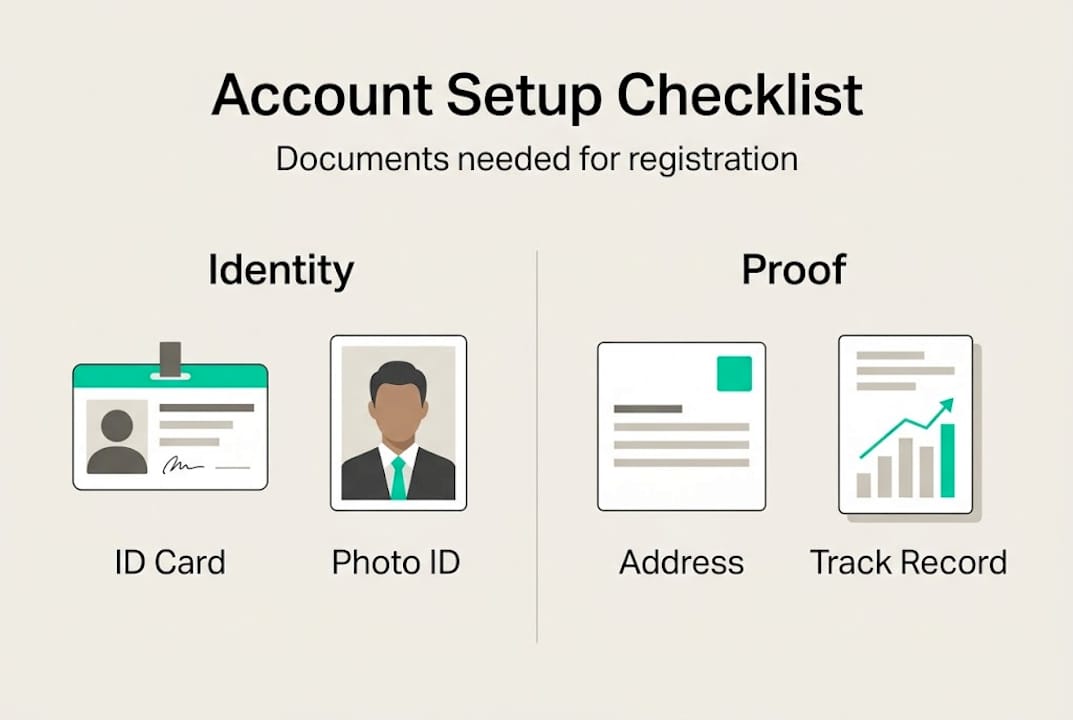
Preparation separates traders who breeze through onboarding from those who spend days resubmitting documents. Before you even visit a firm’s registration page, you should have every required item organized and ready. Identity verification and proof of address are mandatory requirements at most firms before platform access is granted, and delays here push back your entire timeline.
Here is what you need to prepare:
- Government-issued photo ID: Passport or national ID card. Ensure it is not expired and that the scan is clear with no glare.
- Proof of address: A utility bill or bank statement dated within the last 90 days. The name and address must match your registration details exactly.
- Trading track record (if required): Some firms ask for brokerage statements or screenshots showing prior trading history. Even if optional, submitting one strengthens your application.
- Compatible trading platform: MetaTrader 4, MetaTrader 5, or cTrader are the most common. Confirm which version the firm supports before downloading.
- Stable internet connection: Evaluation trading requires consistent execution. A dropped connection during a trade can create rule violations depending on firm policy.
- Payment method: Credit card, debit card, or crypto wallet depending on the firm’s accepted funding options for challenge fees.
The table below summarizes the core tools and their purpose:
| Item | Purpose | Notes |
|---|---|---|
| Government ID | Identity verification | Must be valid and unexpired |
| Proof of address | Compliance requirement | Dated within 90 days |
| Trading platform | Executing challenge trades | Confirm version compatibility |
| Brokerage statement | Track record submission | Optional but recommended |
| Payment method | Challenge fee payment | Check accepted currencies |
| Stable internet | Uninterrupted trade execution | Wired connection preferred |
If you are still deciding which firm to approach, it helps to start small with the right firm before committing to a larger challenge. Understanding prop firm vs forex broker differences also clarifies what you are signing up for.
Pro Tip: Organize all documents in a single folder on your desktop before starting registration. Uploading the wrong file version is one of the most common causes of verification delays.
Step-by-step: Creating your prop firm account
Once you have all prerequisites ready, the registration process itself is manageable. Account setups completed online still require careful matching to each firm’s stated guidelines, so read every instruction before clicking submit.
Follow these steps in order:
- Visit the firm’s official website. Bookmark the URL directly and avoid third-party links to prevent phishing risks.
- Select your challenge type and account size. Most firms offer two-phase or one-phase evaluations with varying capital levels. Choose based on your current risk tolerance and trading style.
- Complete the registration form. Use your legal name exactly as it appears on your ID. Mismatches here trigger manual review and delay approval.
- Upload identity documents. Submit your photo ID and proof of address. Some firms use automated verification tools that process submissions in minutes.
- Pay the challenge fee. Fees range widely depending on account size. Confirm the refund policy before paying, as some firms refund the fee upon successful funding.
- Read and accept the trading rules. Do not skip this step. Print or save the rules document for reference during the evaluation period.
- Download and configure the trading platform. Log in using the credentials sent to your email. Set up your risk parameters before placing any trades.
- Confirm your account is active. Check that your balance, drawdown limits, and profit targets display correctly in the dashboard.
The table below compares typical account creation processes across firm types:
| Step | Standard firms | Instant funding firms |
|---|---|---|
| Identity verification | Required upfront | Required but faster |
| Challenge fee | Paid before access | Paid before access |
| Platform setup | Manual download | Manual download |
| Rule acceptance | Mandatory | Mandatory |
| Account activation | 24 to 72 hours | Often same day |
Pro Tip: Screenshot your dashboard immediately after activation. This creates a timestamped record of your starting balance and drawdown limits, which is useful if a dispute arises later.

If you are unsure which firm to register with, reviewing a guide on choosing the right prop firm before committing saves time. Also watch for warning signs in prop firm setup that suggest a firm may not be legitimate.
Navigating evaluation: Prop firm account rules and metrics
With your account created, the evaluation phase begins. This is where most traders stumble, not because of poor trading, but because they misunderstand or underestimate the rules.
Risk limits and daily drawdown restrictions are the most common reasons traders fail prop firm challenges. Here are the core metrics you must track:
- Daily drawdown limit: The maximum loss allowed in a single trading day, usually calculated from the day’s starting balance or equity high. Breaching this ends your challenge immediately.
- Maximum total drawdown: The overall loss limit from your initial balance. This is a hard ceiling that cannot be recovered from once hit.
- Profit target: The percentage gain required to pass each phase. Typical targets range from 8% to 10% for phase one.
- Minimum trading days: Most firms require you to trade for a minimum number of days, often 5 to 10, to prevent overnight gambling strategies.
- Lot size and leverage restrictions: Some firms cap position sizes or restrict leverage on specific instruments.
“The traders who pass evaluations consistently are not necessarily the most profitable ones. They are the ones who understand every rule before they open their first trade.” This distinction matters more than most new applicants realize.
Common mistakes that trigger automatic disqualification include:
- Trading during restricted news events when the firm prohibits it
- Holding positions over the weekend when overnight holding is banned
- Exceeding daily drawdown by a fraction due to swap charges applied after market close
- Using expert advisors (EAs) that are not permitted under the firm’s automation policy
For a detailed breakdown of what it takes to stay compliant, reviewing the rules for passing prop challenges provides specific guidance by firm type.
Troubleshooting and avoiding common mistakes
Even careful traders encounter problems. The good news is that most issues are predictable and preventable with a structured review process before submission.
Over 90% of traders fail not because of weak strategy, but because of overlooked rule violations or missed documentation. That statistic should shift how you prioritize your preparation time.
The most frequent issues traders encounter include:
- Name mismatches: Your registration name differs from your ID. This triggers manual review or outright rejection.
- Expired documents: An ID or proof of address that is past its validity period will fail automated checks.
- Platform version errors: Downloading MT4 when the firm requires MT5 means your login credentials will not work.
- Misread drawdown rules: Confusing balance-based drawdown with equity-based drawdown leads to unexpected violations.
- Missing trading day count: Not meeting the minimum trading days requirement even after hitting the profit target disqualifies the attempt.
Before submitting your application, run through this checklist:
- All document names match your registration exactly
- Proof of address is dated within the required window
- Challenge rules have been read in full and saved
- Platform version matches firm requirements
- Starting balance and drawdown limits are confirmed in the dashboard
Pro Tip: If your verification is rejected, contact support within 24 hours and ask specifically which document failed. Firms rarely volunteer this detail, but asking directly speeds up resubmission.
If you notice inconsistencies in how a firm communicates its rules or processes refunds, review a current list of prop firm red flags before proceeding further.
Rethinking the prop firm account setup: What really sets you apart
Most traders treat account setup as an administrative task to rush through before the real work begins. That mindset costs them. The setup phase is actually the first test a firm runs on you, even if they never say so explicitly.
Firms see hundreds of applications. The ones that move through verification smoothly, with clean documentation and zero resubmissions, signal a level of detail orientation that carries over into trading discipline. A sloppy application does not just delay your start. It creates a pattern.
The more overlooked factor is how traders use failed evaluations. Most treat a failed challenge as a loss and move on. The traders who consistently get funded treat every failed attempt as a data set. They review which rule was broken, on which day, and under what market conditions. That analysis shapes their next attempt more than any strategy adjustment.
Choosing the right environment matters too. Selecting best platforms for prop trading that align with your execution style reduces friction during evaluation and removes one variable from an already demanding process. Setup is not a formality. It is the foundation.
Open your prop firm account with confidence
If you are ready to put this guide into action, having the right resources on your side makes the process significantly less stressful.
ResponsibleTrading.com provides independent, data-driven reviews of leading prop firms, with detailed comparisons of challenge rules, payout speeds, and platform options. Whether you are evaluating your first firm or reconsidering after a failed challenge, the best prop trading platforms guide helps you match your trading style to the right environment. Use the choose the right prop firm tool to filter firms by evaluation structure, and review the risk management for prop firm challenges blueprint to build a rule-compliant approach before your next attempt.
Frequently asked questions
What is the first thing I need to open a prop firm account?
You need basic identification, proof of address, and a trading track record prepared before beginning. Most prop firms require identity verification and proof of address before granting platform access.
Why do most traders fail the prop firm account evaluation?
The majority fail due to overlooked rule violations or documentation mistakes, not trading skill. Over 90% of traders fail because of missed rules or documentation errors rather than poor strategy.
How long does the prop firm account setup typically take?
Most firms approve accounts in 24 to 72 hours if all documentation and requirements are met on the first try. Account setups require careful matching to firm guidelines to avoid delays.
Can I use the same account for multiple prop firms?
You must repeat verification and evaluation for each firm separately, as accounts are not transferable between firms. Your prior experience does carry over and typically improves your setup speed and evaluation performance with each attempt.
Recommended
- How to Choose the Right Prop Firm for Your Trading Strategy (Step-by-Step Guide) (2026) | Responsible Trading
- Best Prop Firms for Beginners in 2026: Start Small, Learn Fast (2026) | Responsible Trading
- Best Prop Firms for Beginners in 2026 — A Trader’s Complete Guide (2026) | Responsible Trading
- Best Prop Firms for Beginners in 2026: Lowest Risk, Clearest Rules (2026) | Responsible Trading