
Copy trading sounds like a shortcut to consistent profits. Follow a skilled trader, mirror their positions, and collect returns without spending years mastering the markets. But the reality inside proprietary trading firms is sharply different. While general copy trading platforms advertise win rates of 60 to 80%, the actual success rate for traders attempting to pass prop firm evaluations using copy trading strategies sits closer to 7%. That gap is not a minor discrepancy. It reflects a fundamental mismatch between how copy trading is designed to work and how prop firms operate. This article breaks down exactly what copy trading means in the prop firm context, where traders go wrong, and how to approach it with realistic expectations.
Table of Contents
- What is copy trading and how does it work?
- How does copy trading work in proprietary trading firms?
- What are the risks and reality of success rates in prop firm copy trading?
- Choosing the right prop firm and strategy for copy trading success
- Why most traders misunderstand copy trading in prop firms
- Next steps: Find the best prop firm and trading tools for you
- Frequently asked questions
Key Takeaways
| Point | Details |
|---|---|
| Copy trading defined | Copy trading lets you automatically follow the trades of top-performing traders directly onto your account. |
| Prop firm success is rare | Win rates in prop firms are much lower for copy traders, with as few as 7% passing evaluations. |
| Know the firm’s rules | Always verify if the prop firm allows copy trading and what restrictions or platforms are in place before starting. |
| Strategic alignment | Choose prop firms and trading strategies that align with your goals and the platform’s copy trading compatibility. |
What is copy trading and how does it work?
Copy trading is a method where one trader automatically replicates the live positions of another trader in real time. When the signal provider opens or closes a trade, the same action is executed in the copier’s account, proportionally adjusted for account size. It removes the need for the copier to analyze markets independently, making it appealing to newer traders or those with limited time.
The typical workflow on a standard copy trading platform looks like this:
- Signal provider executes trades from their own account
- Platform detects the trade and broadcasts it to subscribers
- Copier accounts receive the signal and execute the same trade automatically
- Results are tracked and displayed publicly, showing performance history
The key roles in this ecosystem are the signal provider (the trader being copied), the copier (the follower), and the platform that connects them. Popular platforms like eToro’s CopyTrader or ZuluTrade handle the technical routing. More advanced setups use APIs or third-party software to integrate copy functionality into specific trading terminals.
While copy trading broadly claims win rates in the 60 to 80% range, those figures often reflect curated performance data from top providers on retail platforms. They do not account for slippage, fees, or the performance decay that happens when too many copiers follow the same signal. Understanding this distinction is essential before applying copy trading in any funded environment. You can explore how best prop trading platforms handle signal execution to get a clearer picture of what tools are available.
Pro Tip: Before copying any signal provider, verify their track record across multiple market conditions, not just recent performance. A strong equity curve in a trending market can collapse quickly when volatility shifts.
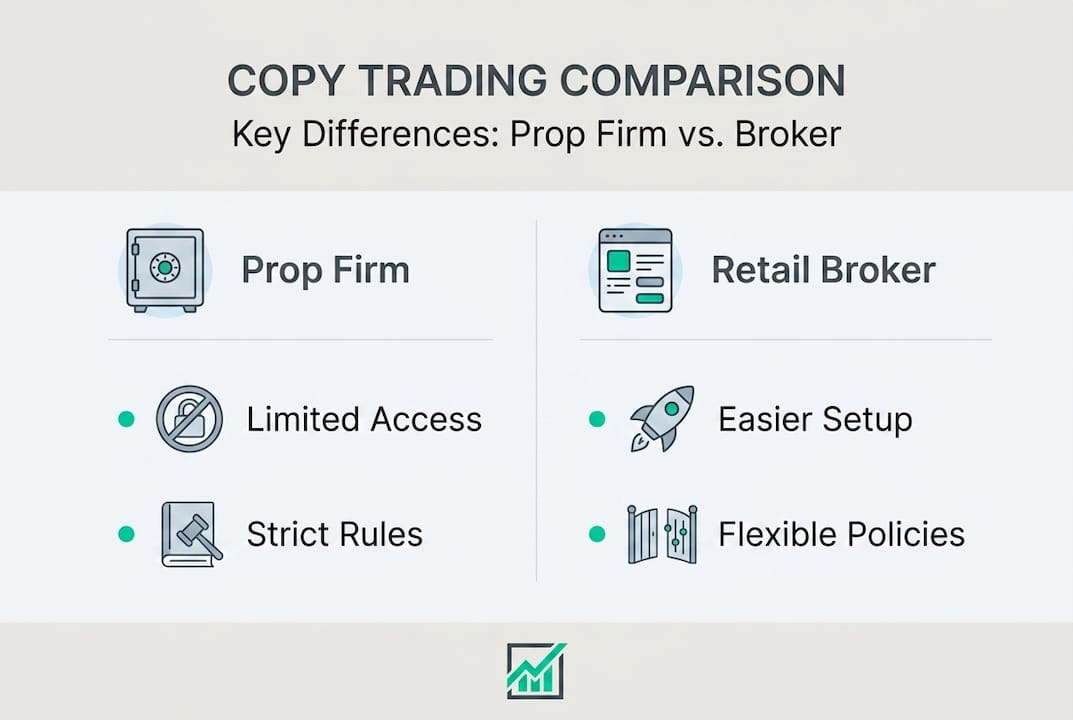
The difference between copy trading with a retail broker and using it inside a prop firm is significant. With a broker vs prop firm comparison, you quickly see that prop firms impose structured rules that retail brokers simply do not apply.
How does copy trading work in proprietary trading firms?
Proprietary trading firms provide traders with access to firm capital after passing a structured evaluation, commonly called a challenge. These evaluations test whether a trader can hit a profit target while staying within strict drawdown limits and following specific trading rules. The firm funds the trader, takes a share of profits, and manages overall risk exposure.
Copy trading inside a prop firm is technically possible, but it operates under a very different set of constraints compared to a standard retail setup. Most firms use MetaTrader 4 or MetaTrader 5 as their primary platform, and copy trading functionality typically requires either a MAM (Multi-Account Manager) or PAMM (Percentage Allocation Management Module) setup, or a third-party API integration. Not all firms permit these tools, and many restrict or outright ban them on evaluation accounts.

Here is a direct comparison of how copy trading differs between environments:
| Feature | Regular broker | Prop firm |
|---|---|---|
| Copy trading allowed | Usually yes | Often restricted or banned |
| Drawdown rules | Minimal or none | Strict daily and overall limits |
| Profit targets | Not required | Mandatory for evaluation pass |
| Platform flexibility | High | Limited to approved platforms |
| Account ownership | Trader owns funds | Firm owns capital |
| Rule violations | Minor consequences | Immediate disqualification |
The evaluation phase creates the most friction. Prop firms require traders to hit specific targets within defined timeframes while avoiding drawdown breaches. A copied strategy that works well in a low-pressure retail account may trigger a rule violation in a prop firm evaluation simply because of trade timing, position sizing, or holding trades over the weekend.
Key compliance concerns for copy traders in prop firms include:
- Platform restrictions: Not all firms allow MAM or API-based copying tools
- Drawdown sensitivity: Copied trades may not respect the firm’s specific risk thresholds
- News trading rules: Many firms ban trading around major economic events, which automated systems may ignore
- Trade duration rules: Some firms prohibit holding positions overnight or over weekends
Understanding whether EA use in prop firms is permitted often clarifies whether copy trading tools will be approved as well, since both fall under automated trading policies. The comparison between prop firms vs forex brokers also helps clarify why the rules diverge so sharply.
What are the risks and reality of success rates in prop firm copy trading?
The numbers are sobering. While general copy trading platforms advertise success rates between 60 and 80%, prop firm evaluation pass rates using copy trading strategies are estimated at roughly 7%. That is not a minor underperformance. It represents a near-complete failure rate for traders who enter prop firm challenges expecting copy trading to carry them through.
| Setting | Claimed win rate | Realistic pass rate |
|---|---|---|
| Retail copy trading | 60 to 80% | Varies widely |
| Prop firm evaluation | Marketed as accessible | ~7% actual pass rate |
“The gap between what copy trading promises and what prop firm evaluations deliver is one of the most consistently misunderstood risks in retail trading today.”
The most common failure reasons, in order of frequency, are:
- Drawdown breach: Copied trades exceed the firm’s maximum daily or overall drawdown limits
- Rule violations: Automated systems trade during restricted periods or use prohibited strategies
- Over-reliance on one provider: A single bad run from the signal provider wipes the evaluation account
- Position sizing errors: Proportional copying does not account for the firm’s specific margin and leverage rules
- Platform incompatibility: The copy tool is not supported by the firm’s trading infrastructure
The risk of over-dependency is particularly underappreciated. When a trader copies a signal provider without understanding the underlying strategy, they have no way to intervene when conditions change. They are entirely exposed to someone else’s judgment and system failures.
Pro Tip: Set a personal maximum daily loss limit that is tighter than the firm’s official threshold. If the firm allows a 5% daily drawdown, cap your copy trading exposure at 3%. This buffer gives you room to absorb a bad day without triggering disqualification.
For a deeper look at why evaluation attempts fail, the data on why most traders fail prop firm challenges is directly relevant. Pairing that with a structured approach to risk management for prop firm challenges gives you a more complete picture of what it takes to succeed.
Choosing the right prop firm and strategy for copy trading success
Not all prop firms treat copy trading the same way. Some explicitly permit it with approved tools. Others ban it entirely. Getting this wrong means purchasing a challenge, attempting to use a copy trading setup, and being disqualified before you even reach the profit target. Due diligence before you commit is non-negotiable.
Key questions to ask before starting:
- Does the firm explicitly allow copy trading on evaluation and funded accounts?
- Which platforms does the firm support, and do those platforms allow MAM or API integrations?
- What are the drawdown rules, and does your signal provider’s historical drawdown stay within those limits?
- Are there restrictions on trade duration, news trading, or position holding?
- What happens to your account if the copy tool causes a technical violation?
Features to verify before committing to any firm:
- Allowed platforms: MetaTrader 4, MetaTrader 5, cTrader, or proprietary platforms
- Copy trading support: Explicit mention in the firm’s terms of service
- Drawdown structure: Daily drawdown vs. trailing drawdown, and how copied trades interact with each
- Leverage and margin rules: Ensure your copied position sizes are compliant
- Profit target flexibility: Some firms offer extended timeframes that reduce pressure
Matching your copy trading strategy to the firm’s account rules and evaluation criteria is the single most important step traders skip. A strategy that passes one firm’s evaluation may fail immediately at another due to different drawdown calculations or restricted trading windows.
When choosing the right prop firm, prioritize firms that publish clear policies on automated and copy trading. Vague terms of service are a red flag. You can also use our forex prop trading platforms guide to identify which platforms offer the most compatibility with copy trading tools. For a broader view, reviewing top-rated prop firms side by side helps you spot which firms are genuinely copy-trading-friendly.
Why most traders misunderstand copy trading in prop firms
The most persistent myth in copy trading communities is that finding the right signal provider solves everything. It does not. Inside a prop firm, the signal provider’s performance is only one variable. The firm’s rules, platform restrictions, and evaluation structure create an entirely separate layer of risk that no signal provider can control.
Most copy trading education is built around retail broker environments where rules are minimal and the only goal is profit. Prop firms introduce mandatory profit targets, strict drawdown thresholds, and compliance requirements that fundamentally change the game. A trader who performs well on a retail platform may still fail every prop firm evaluation because their risk profile does not fit the firm’s parameters.
The uncomfortable truth is that copy trading in prop firms requires nearly as much active management as manual trading. You still need to understand the strategy being copied, monitor for rule compliance in real time, and intervene when conditions shift. The comparison between prop firms vs retail brokers makes this structural difference clear. Passive copying is a retail concept. Prop firm trading, even when automated, demands active oversight.
Next steps: Find the best prop firm and trading tools for you
If you are serious about using copy trading within a prop firm structure, the first step is finding firms that explicitly support it and platforms that make compliance manageable.
ResponsibleTrading.com provides independent, data-driven reviews of prop firms tested in real-world conditions. You can use our forex trading platforms for prop firms guide to identify compatible tools, follow our framework for choosing the right prop firm based on your strategy, and compare top prop firms side by side to find the best fit. Every review includes rule transparency, payout reliability, and platform compatibility, exactly what copy traders need to evaluate before committing capital.
Frequently asked questions
Can you use copy trading on all prop firm accounts?
No, most prop firms limit or prohibit copy trading on funded accounts due to rule enforcement and compliance needs. Always check the firm’s terms of service before setting up any copy trading tool.
What success rate should traders expect from copy trading in prop firms?
Realistic pass rates are around 7% in prop evaluations, far lower than the 60 to 80% win rates advertised on standard copy trading platforms outside prop firms.
How can I find prop firms that allow copy trading?
Check each firm’s rules and platform policies directly, since firms differ in copy trading policies. Some explicitly ban it, while others require specific account types or approved tools.
What tools do prop traders use for copy trading?
Common tools include MAM/PAMM and platform integrations and third-party APIs, all subject to firm approval and compatibility with the firm’s trading infrastructure.
Are there extra fees or risks with copy trading in prop firms?
Yes, traders may face additional fees for copy tools and a higher likelihood of rule breaches and technical violations that lead to disqualification from the evaluation or funded account.
Recommended
- Prop Firm News 2026 — Trading Insights | Responsible Trading
- Best Forex Trading Platform For Prop Firms: The 2026 Trader’s Guide (2026) | Responsible Trading
- Can You Use Expert Advisors (EAs) on Prop Firms? The Full 2026 Rules Breakdown (2026) | Responsible Trading
- Brokers vs Prop Firms: Which Is Right for Your Trading Career in 2026? (2026) | Responsible Trading
- A New Approach to Prop Trading in 2026: Why Structured Development Matters