

Retail traders are drawn to prop trading for good reason. The promise of accessing substantial capital without risking your own funds is genuinely attractive. But the industry also attracts bad actors who design elaborate-looking challenges and funding programs specifically to collect fees and disappear. Losing $200 to $500 on a fraudulent challenge is painful enough on its own, but the real damage is the time lost and the erosion of trust in what can be a legitimate funding path. This guide gives you a structured, evidence-based method for identifying scam firms, vetting legitimate ones, and making funding decisions you can defend with data.
Table of Contents
- Warning signs of prop trading scams
- Checklist for vetting prop firms
- How reputable firms operate and why it matters
- Verifying reputation before you commit
- The uncomfortable truth most traders miss about prop firm scams
- Next steps: trusted resources and tools for safe prop trading
- Frequently asked questions
Key Takeaways
| Point | Details |
|---|---|
| Spot scam warning signs | Recognize vague payout terms, unclear contracts, and poor reputation to avoid scams. |
| Use a systematic vetting checklist | Verify contract clarity, payout history, profit splits, and third-party reviews before committing funds. |
| Learn from top firms | Benchmarks like FundedNext, The5ers, and FTMO set the standard for trusted prop trading. |
| Verify reputation before investing | Always confirm payout evidence and peer reviews before paying any fees or joining a challenge. |
| Stay skeptical, stay safe | Maintaining a skeptical mindset is your best lifelong defense against prop trading scams. |
Warning signs of prop trading scams
Prop trading scams rarely announce themselves. They typically present a polished website, a flashy social media presence, and what appears to be a credible challenge structure. The warning signs are usually buried in the fine print or completely absent from any official documentation.
The most consistent red flags center on three areas: payout terms, fee structures, and transparency.
Vague payout terms are the most reliable indicator of trouble. A legitimate firm specifies exactly when you will receive your profits, through which payment processor, and under what conditions a payout can be denied. Scam firms use language like “payouts processed within a reasonable time frame” or “subject to review,” which gives them an indefinite window to delay or refuse payment with no accountability. In contrast, top rated prop firms commit to specific timelines, often 24 to 48 hours for standard payouts.

Excessive or non-refundable fees are another indicator. Some firms charge challenge fees ranging from $100 to $1,000 or more, with no path to recovery even when you pass. Industry benchmarks show that FTMO refunds challenge fees on the first payout, which has become a standard of credibility. Firms that refuse to offer any form of fee refund, or that bury the refund conditions in inaccessible terms, are signaling that revenue from challenge fees is their actual business model.
Lack of an online reputation is the third pillar. Every firm that operates long enough to be legitimate will accumulate reviews. Platforms like Trustpilot, Reddit, and Discord communities are not perfect, but they produce a measurable signal over hundreds or thousands of reviews. A firm with fewer than 50 reviews or a suspiciously high concentration of five-star reviews within a short window deserves close scrutiny. You can verify prop firm legitimacy through cross-referenced community data rather than relying on a firm’s own marketing materials.
| Feature | Reputable firm | Scam indicator |
|---|---|---|
| Payout timeline | Clearly stated (e.g., 24 hrs) | Vague or undefined |
| Challenge fee refund | Yes, on first payout | No refund policy |
| Profit split | Stated clearly (e.g., 80% or 95%) | Hidden or variable without explanation |
| Trustpilot reviews | 4.5+ with consistent volume | Sparse or suspiciously clustered |
| Contract clarity | Plain language, downloadable | Inaccessible or missing |
| Customer support | Multiple channels with response SLA | Only email, slow or no response |
Safety warning: Never commit to a challenge fee from a firm with no third-party verification, unclear payout terms, or no verifiable contract. The fee is rarely the largest loss. The lost time and opportunity cost is.
Review the most trusted prop firms to benchmark any firm you are considering against verified industry leaders.
Checklist for vetting prop firms
With red flags clear, here’s an actionable checklist you can use to scrutinize any prop trading firm before paying a dollar.
Vetting a prop firm is not a five-minute task. It requires pulling data from multiple sources and cross-referencing what you find. Traders who skip steps in this process are statistically more likely to encounter problems, whether delayed payouts, rule inconsistencies, or outright fraud.
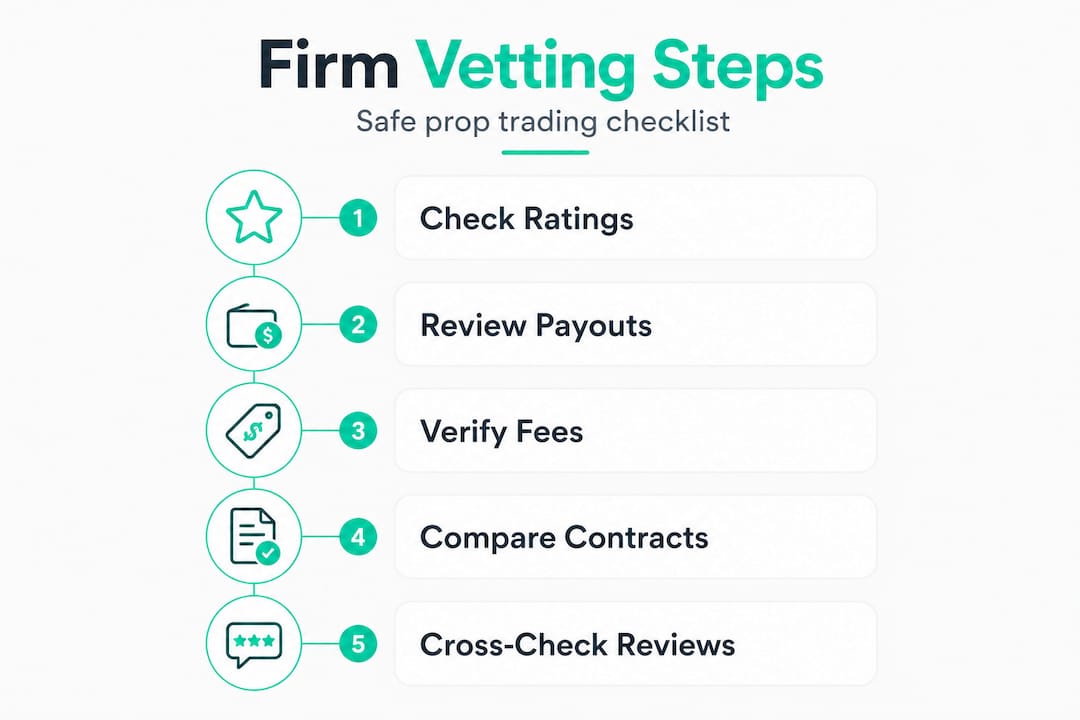
Step-by-step vetting checklist:
- Search Trustpilot first. Look for a minimum of 200 reviews and a score above 4.0. Read the one-star and two-star reviews specifically. These reveal patterns that five-star reviews hide. Look for complaints about payout delays, unexplained account resets, or customer support failures.
- Cross-check on Reddit and Discord. Search the firm’s name in r/Forex, r/Daytrading, or dedicated prop firm Discord servers. Real trader experiences surface here, often with screenshots of payout confirmations or denial letters.
- Review the profit split structure. Legitimate firms like FundedNext offer 95% splits clearly documented in their program terms. If the firm advertises a high split but the actual contract says “up to” or “starting from,” that qualifier changes the deal significantly.
- Evaluate the payout timeline. Specific is better. “Within 24 hours” is a commitment. “As soon as possible” is not. Also check whether payout frequency is weekly, biweekly, or monthly, since this affects cash flow for active traders.
- Confirm the challenge fee refund policy. Does the firm refund the initial challenge fee after your first payout? This practice is an industry benchmark set by firms like FTMO and is now a credibility signal across the sector.
- Request or download the trader agreement. Read it fully. Look for clauses that allow the firm to reset your account, alter profit splits, or deny payouts based on discretionary “risk management” decisions without a defined appeals process.
- Check for regulatory disclosure. Most prop firms are not regulated in the traditional sense because they trade simulated or internal funds. However, some operate under holding companies that are registered entities. Confirming that the firm is a real, registered business is a minimum bar.
| Vetting criterion | Minimum acceptable standard | Red flag |
|---|---|---|
| Trustpilot rating | 4.0 or above with 200+ reviews | Below 3.5 or fewer than 50 reviews |
| Profit split | 70% or higher, clearly documented | “Up to” language or unverified |
| Payout speed | Within 48 hours clearly stated | Undefined or “as soon as possible” |
| Challenge fee refund | Available on first payout | No refund policy stated |
| Trader agreement | Publicly available and clear | Not available or requires direct request |
Understanding prop firm reputation is central to making safe decisions, and that reputation should always be confirmed through third-party sources, not just the firm’s own testimonials.
Pro Tip: Never rely on a firm’s own website testimonials as evidence of legitimacy. Always find the reviews yourself through Trustpilot and active trading communities. Firms can fabricate case studies, but community patterns are much harder to fake.
Cross-checking firm ranking criteria from independent review platforms helps you understand exactly how each firm measures up against documented standards rather than self-reported claims.
How reputable firms operate and why it matters
Now, let’s see what sets reputable firms apart, so you know exactly what to look for when evaluating a firm’s operational structure.
The difference between a legitimate prop firm and a scam is often structural, not cosmetic. Reputable firms build their business model around funded trader success because their revenue depends on consistent, disciplined traders generating returns on real capital. Scam firms build their business model around challenge fee volume, which means they have no incentive for you to pass.
Understanding this distinction changes how you evaluate firms. Reputable firms will have:
- Clear and escalating funding programs. The5ers, for example, scales accounts to $4 million with a 4.9 out of 5 Trustpilot rating, which reflects a long-term commitment to trader growth rather than one-time challenge revenue. Scalable programs reward profitable traders with more capital, aligning the firm’s incentives with yours.
- Documented profit splits with no hidden conditions. A firm advertising an 80% profit split should deliver exactly that, with no surprise deductions, platform fees, or administrative charges that erode the stated percentage. Read the fine print on how the split is calculated.
- Fast and reliable payouts. FundedNext’s 24-hour payout guarantee is a specific, verifiable commitment. When you evaluate any firm, ask whether their payout guarantee is in writing, what happens if they miss the window, and whether traders have publicly confirmed it on review platforms.
- Refund structures that reduce entry risk. FTMO’s policy of refunding challenge fees on the first payout means that successful traders effectively pay nothing. This structure signals confidence in the firm’s business model and reduces the financial risk for traders entering the program.
- Transparent drawdown rules. Legitimate firms specify whether drawdown limits are trailing or fixed, daily or total, and calculated on balance or equity. Scam firms use ambiguous drawdown language to disqualify traders for rule violations that were never clearly defined.
Understanding profit splits explained in detail helps you identify when a firm’s offer is genuinely competitive and when the advertised number is misleading.
Pro Tip: Take any firm’s stated terms and compare them line by line against a known benchmark like FTMO or FundedNext. If the core elements match, including payout speed, profit split clarity, and drawdown definition, you are likely looking at a firm that operates within established industry norms.
Verifying reputation before you commit
Before you open an account or pay any challenge fee, here’s how to verify everything a prop firm claims about itself.
Verification is where most traders cut corners. The excitement of finding a firm with strong marketing and an appealing challenge structure often overrides the slower, more analytical process of confirming that the firm actually pays its traders. Treat every unverified claim as false until proven otherwise.
How to verify reputation step by step:
- Search for payout screenshots. Go to Discord servers for the firm specifically, or to broader prop trading communities, and search “payout” alongside the firm’s name. Real payouts generate real posts with real evidence. If you cannot find any after 15 to 20 minutes of searching, that is meaningful negative data.
- Check review recency, not just volume. A firm with 500 five-star reviews from three years ago and mixed reviews in the last six months is a different story from one with consistent positive feedback. Firms can go from legitimate to problematic quickly, so recent reviews matter more.
- Read the trader agreement for exit clauses. Some firms include clauses that allow them to terminate funded accounts at their discretion, with or without cause, and without payout of outstanding profits. These clauses are usually legal and enforceable, which is why reading the contract before paying is non-negotiable.
- Confirm the withdrawal process. Ask support directly how long payouts take and through which processors. A confident, specific answer is a positive signal. A vague or delayed response from support before you have even paid suggests what post-payment support will look like.
- Verify business registration. Search the firm’s company name in the relevant national registry. This confirms that a real legal entity exists behind the brand.
Additional verification checkpoints include:
- Confirming that Trustpilot approved prop firms match your shortlist before committing funds
- Reviewing the firm’s best trading platform guide compatibility if you already have an established workflow
- Validating that the firm’s drawdown rules are consistent across their website, trader agreement, and FAQ section. Inconsistencies between these sources are a serious warning sign
Critical note: Third-party evidence is not a nice-to-have. It is a requirement. A firm that cannot show you public payout confirmations from real traders, or that has no community footprint on independent platforms, has not earned your challenge fee. The research process is your best financial protection.
FundedNext’s 24hr payout guarantees and The5ers’ scaling structure represent what transparent operations look like in practice. Use these as your reference point when verifying any firm’s claims.
The uncomfortable truth most traders miss about prop firm scams
Beyond practical steps, let’s address something few guides admit about prop trading scams. Checklists help. Research helps. But the traders most frequently caught by prop firm scams are not uninformed beginners. They are experienced retail traders who knew the warning signs and still ignored them.
The mechanism is almost always the same. A trader finds a firm with genuinely good-looking terms, a large account size, and a slightly-too-good profit split. The excitement of potential scale overrides the slower analytical process. They cut corners on verification, tell themselves the reviews are probably fine, and pay the challenge fee before confirming what they should.
Scams persist not because traders lack knowledge, but because hope consistently overrides skepticism at the critical decision moment. The industry’s growth in 2024 and 2025 has only increased the number of firms entering the market, making the landscape more difficult to navigate objectively.
The real defense is not just a checklist. It is a disposition. Skepticism must be the default setting, not the fallback position after something goes wrong. Every claim a firm makes should require verification before it influences your decision. “We pay within 24 hours” means nothing until you have found a dozen traders confirming it on Trustpilot and Discord.
Methodical, slow vetting is not excessive caution. It is the only approach that actually works. Traders who develop genuine funded trader insights do so by treating research as a non-negotiable step, not a box to check quickly. The time you spend verifying a firm before you pay is always better invested than the time you spend seeking refunds afterward.
Next steps: trusted resources and tools for safe prop trading
You now have the framework to identify scams, vet firms systematically, and verify claims before committing. The next step is applying that framework to a curated set of firms that have already been evaluated against rigorous criteria.
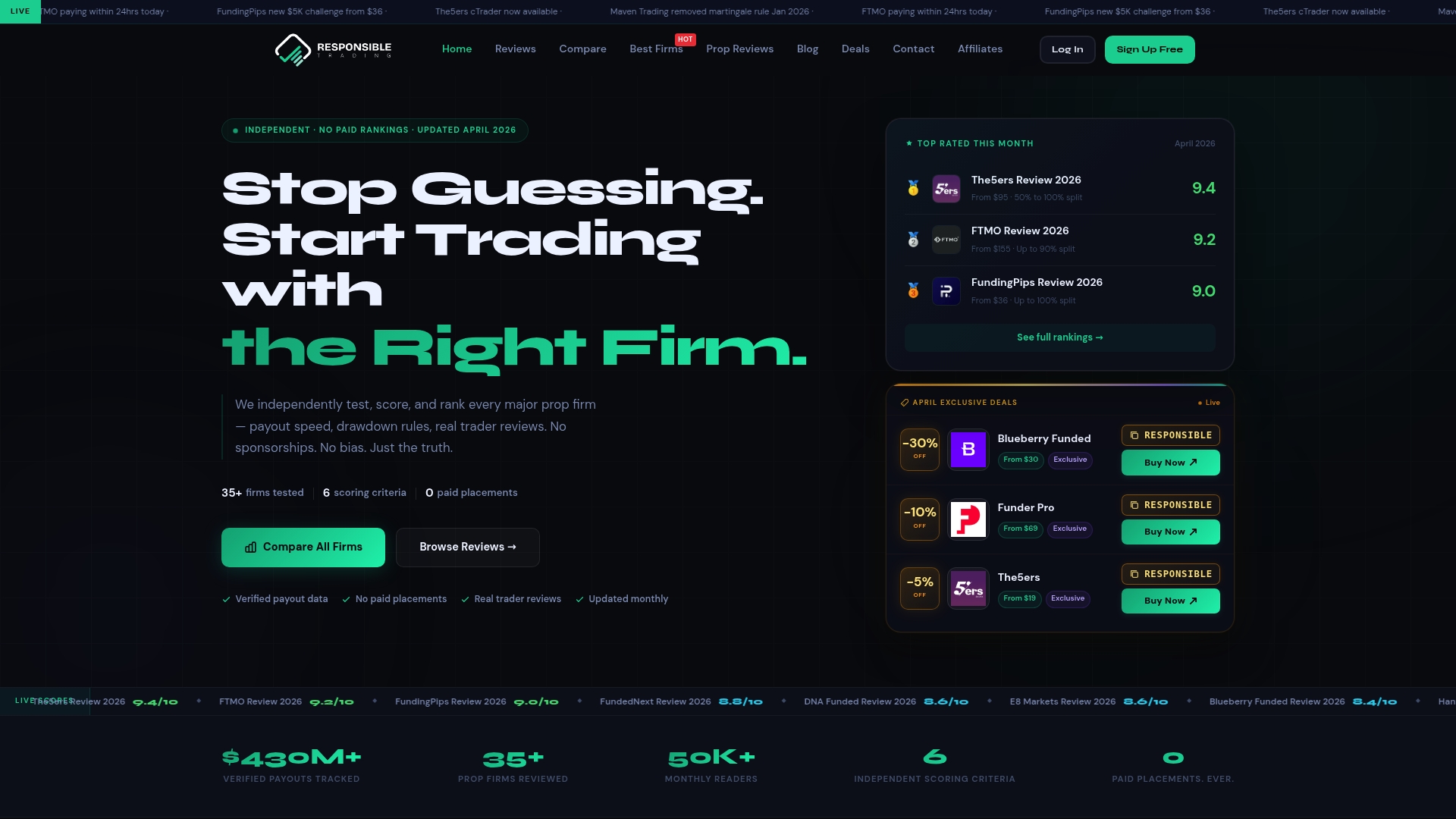
At Responsible Trading, we conduct real-world testing by purchasing challenges, tracking payouts, and cross-referencing trader experiences across Trustpilot, Reddit, and Discord. Our evaluations cover payout speed, drawdown fairness, profit split accuracy, and customer support quality. You can start with our step-by-step firm selection guide, which walks you through the decision process with verified data at every stage. For a ranked overview of firms that meet our credibility standards, our best prop trading firms list is updated regularly. If you are also evaluating platform compatibility, our best trading platforms review covers the key options side by side.
Frequently asked questions
What are the top signs of a prop trading scam?
Warning signs include unclear payout policies, high non-refundable fees, vague contracts, and poor or absent online reputation on independent platforms. Firms like FundedNext and FTMO set the standard with 24hr payout guarantees and refundable challenge fees, making it easy to spot firms that fall short.
How can I check if a prop firm is reputable?
Look for high Trustpilot ratings with consistent volume, clear contract terms, transparent profit splits, and documented refund policies for challenge fees. Firms with 4.9/5 Trustpilot ratings like The5ers demonstrate the kind of consistent community trust that signals genuine credibility.
Are challenge fee refunds proof of legitimacy?
They are a strong positive signal, but legitimacy requires the full picture: solid online reputation, fast payout records, and clear contract terms alongside any fee refund policy to be considered truly credible.
Does a high profit split mean a prop firm is trustworthy?
A high profit split is attractive, but it must be paired with verified payout speed and honest community reviews. FundedNext’s 95% profit splits carry weight because they are confirmed by thousands of trader reviews, not just advertised on a website.