

Most traders assume that passing a prop firm challenge comes down to raw skill. The reality is more nuanced. Industry pass rates average just 5 to 10% across the board, meaning the vast majority of applicants never reach funded status. Even Apex Trader Funding, often cited as more accessible, sees only 15 to 20% of traders pass on their first attempt. Understanding how ranking systems actually work, what criteria firms prioritize, and how to position yourself effectively, is the difference between a funded account and a failed challenge fee.
Table of Contents
- What does ‘ranked’ mean in prop trading?
- The main ranking criteria: how firms judge your trading
- Ranking methods: instant funding vs. evaluation programs
- Improving your rank: actionable strategies for traders
- Why most traders misunderstand prop firm rankings
- Explore top-rated prop firms and deepen your knowledge
- Frequently asked questions
Key Takeaways
| Point | Details |
|---|---|
| Understand ranking criteria | Prop firms rank traders primarily on consistency, risk management, and profit targets. |
| Low industry pass rates | Only 5-10% of traders pass prop firm challenges, so preparation and awareness are critical. |
| Choose the right program | Instant funding and evaluation programs use different ranking methods that affect your chances. |
| Focus on risk and consistency | Improving your rank means prioritizing risk management and steady trading habits. |
What does ‘ranked’ mean in prop trading?
In prop trading, being “ranked” refers to how a firm evaluates and categorizes your performance relative to its internal benchmarks. It is not a public leaderboard. It is a structured assessment of whether your trading meets the firm’s standards well enough to grant or expand access to capital.
Ranking matters more than most traders realize. A higher internal standing can unlock larger account sizes, better profit split ratios, and faster payout processing. Firms use ranking to decide who stays funded, who gets scaled, and who gets cut. Understanding how these scoring systems explained actually work gives you a structural edge before you even place a trade.
The most common ranking factors across prop firms include:
- Consistency: Did you generate returns steadily, or did one lucky trade carry your entire performance?
- Risk management: Did you stay within daily and overall drawdown limits at all times?
- Profit target achievement: Did you hit required profit thresholds within the challenge window?
- Trade frequency and style: Some firms flag traders who take very few trades or who scalp aggressively.
- Rule adherence: Any violation of time-based rules, instrument restrictions, or news trading bans can drop your standing immediately.
It is also important to separate challenge rankings from post-funded rankings. During a challenge, you are graded against fixed objectives. Once funded, the criteria often shift toward long-term consistency and capital preservation rather than hitting a specific profit percentage. Firms want traders who protect the account, not just those who sprint through a two-week test.
The prop firm rankings available from independent platforms reflect this complexity, scoring firms across multiple dimensions including how fair and transparent their ranking rules actually are.
Pro Tip: Before applying to any firm, download their rulebook and map every ranking criterion. If the firm does not publish clear criteria, that is itself a red flag worth noting.
The main ranking criteria: how firms judge your trading
Firms do not rank traders on profit alone. That is one of the most common and costly misconceptions in the industry. Knowing what firms actually measure helps you prepare with the right focus.
Here are the primary metrics most prop firms use to evaluate trader performance:
- Profit target: Typically 8 to 10% for phase one and 4 to 5% for phase two of evaluation programs. Firms track whether you hit the target without violating other rules simultaneously.
- Maximum drawdown: Usually set between 8 and 12% of account size. Breaching this is an automatic disqualification in virtually every firm.
- Daily loss limit: A separate rule from overall drawdown. Many traders fail here by averaging down or holding trades overnight during high-impact news events.
- Consistency ratio: Some firms require that no single trading day accounts for more than 30 to 40% of total profits. This filters out traders who rely on outlier days.
- Minimum trading days: Firms typically require 10 to 30 active trading days to prevent traders from gaming the system with a single large bet.
The data reinforces how selective this process is. Pass rates average just 5 to 10% across the industry, with only a handful of firms reaching higher. This is not accidental. It reflects the deliberate design of evaluation criteria to filter out impulsive or inconsistent traders.
| Firm type | Avg. pass rate | Profit split | Payout speed |
|---|---|---|---|
| Standard evaluation | 5 to 10% | 70 to 90% | 7 to 30 days |
| Apex Trader Funding | 15 to 20% | 90% | 7 to 14 days |
| Instant funding firms | Higher entry rate | 50 to 80% | Varies |
When analyzing prop firm pass rates alongside payout data, a clear pattern emerges: firms with stricter evaluation models tend to offer better profit splits for those who do pass. The trade-off is real. Choosing the right firm selection criteria means balancing your chance of passing against your expected reward if you do.

Ranking methods: instant funding vs. evaluation programs
Not all prop firms use the same framework to rank and fund traders. The two dominant models are instant funding programs and traditional evaluation programs. Each creates a different ranking dynamic and carries different implications for your trading career.
Evaluation programs require traders to pass one or two challenge phases before receiving real capital. Ranking is based on meeting specific objectives within a set time frame. You are judged on your ability to follow rules under structured pressure. The assessment is clear, but the bar is high.
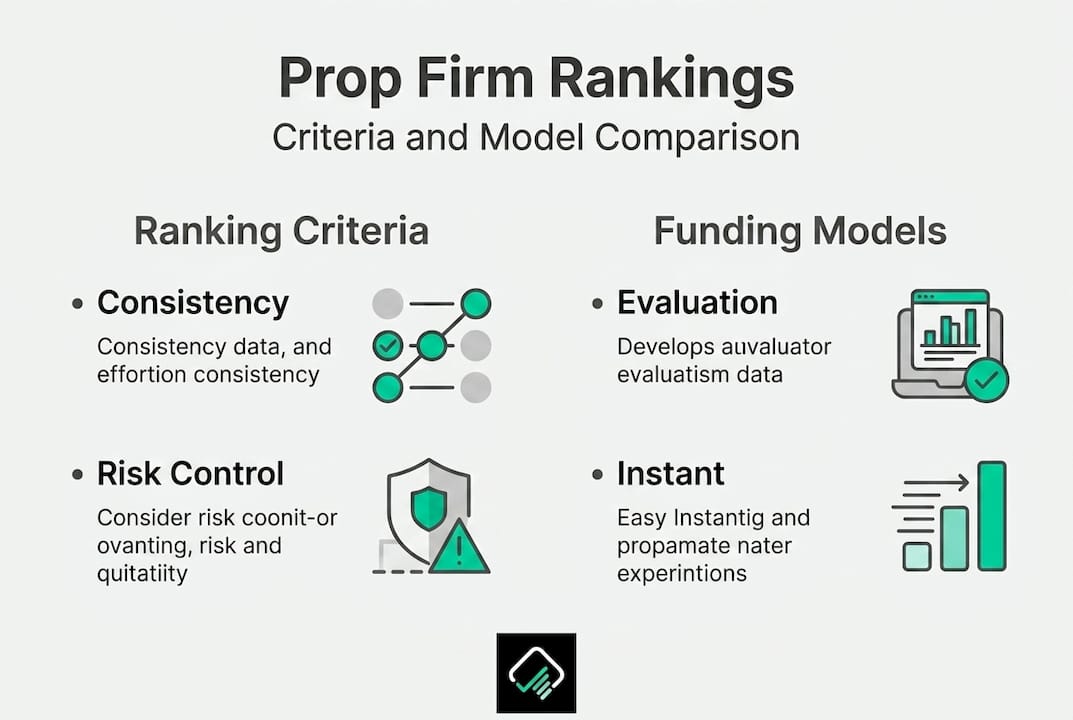
Instant funding programs skip the challenge phase and provide real capital immediately. However, ranking is ongoing. Your performance in real time determines whether you keep the account, get scaled, or get cut. There is no honeymoon period.
Key differences between the two models:
- Evaluation programs assess historical performance against fixed targets; instant funding assesses live, ongoing performance.
- Evaluation models carry higher upfront challenge fees; instant funding accounts often involve account costs or reduced profit splits.
- Ranking in evaluation programs is binary at the challenge stage: pass or fail. In instant funding, ranking is continuous and fluid.
- Instant funding firms may reduce your account size or apply more restrictive rules if your performance deteriorates.
| Factor | Evaluation program | Instant funding |
|---|---|---|
| Ranking trigger | Challenge completion | Ongoing live performance |
| Pass rate impact | Very selective | Higher initial access |
| Profit split | Often higher post-pass | Often lower from the start |
| Risk of account loss | At challenge stage | Ongoing |
Industry data shows payout rates around 7% across all models, which underscores that simply gaining access to a funded account does not guarantee long-term income. Reviewing the funding program comparison in detail helps traders understand which model fits their trading style and financial risk tolerance. It is also worth reviewing how a prop firm vs broker comparison might affect your overall approach.
Pro Tip: If you trade with consistent, moderate returns, evaluation programs typically reward you better. If you need flexibility and dislike rigid time-based rules, instant funding may suit you better, but monitor your account health continuously.
Improving your rank: actionable strategies for traders
Understanding the criteria is useful. Knowing how to act on that understanding is what actually moves you up the rankings.
“With industry pass rates sitting at 5 to 10%, preparation is not optional. It is the single biggest variable separating funded traders from repeat challenge buyers.”
Here are concrete steps to improve your standing with a prop firm:
- Trade a well-tested strategy: Do not enter a challenge with an untested approach. Backtest and forward-test your system under conditions similar to the challenge account size and leverage.
- Prioritize drawdown control above all else: Most traders fail not because they missed the profit target but because they breached a loss limit. Set a personal daily loss cap that is tighter than the firm’s rule.
- Spread your performance across multiple days: Firms with consistency rules penalize single-day outliers. Aim for gradual, steady gains rather than large spikes.
- Avoid news trading unless the firm permits it: Unexpected volatility during economic releases is a common cause of sudden drawdown breaches. Check the firm’s rules on this explicitly.
- Track and review every trade: Emotional decision-making is the enemy of consistent ranking. Keep a trade journal and review it weekly to spot behavioral patterns that erode performance.
Common pitfalls that drop your ranking include overtrading during losing streaks, increasing position size after a win, and ignoring the minimum trading day requirements. Understanding prop firm payout methods also matters because how and when you get paid affects how you manage the account during live trading.
If you are early in your trading career, the guide for trading beginners provides a firm-specific breakdown that aligns challenge difficulty with experience level, helping you select a realistic starting point.
Why most traders misunderstand prop firm rankings
Here is a perspective that most guides skip: ranking systems are designed primarily to protect firm capital, not to reward trader talent. That distinction matters. Firms structure their criteria to reduce variance and flag behavioral risk. A trader who earns 20% in a month but does so inconsistently may score lower than a trader who earns 8% steadily.
Most traders focus obsessively on profit targets and overlook the consistency and risk metrics that often carry more weight in practice. The result is a pattern of failing challenges not from poor trading ability but from poor challenge strategy. The two are not the same thing.
With industry payout rates around 7%, even successfully funded traders face significant attrition. Honest self-assessment before entering a challenge, including a clear review of your historical drawdown and consistency stats, is more valuable than confidence alone. We recommend prioritizing firms that publish transparent criteria. The best prop firms overview identifies firms that score well on rule fairness and payout reliability, making them more predictable to trade with.
Explore top-rated prop firms and deepen your knowledge
Now that you understand how ranking systems work, the logical next step is applying that knowledge to firm selection. Choosing the right firm based on your trading style and risk profile is not guesswork when you have the right data.
ResponsibleTrading.com provides independent, tested reviews of leading prop firms so you can choose the right prop firm with confidence. You can also explore our guide to forex trading platforms to ensure your technical setup supports your challenge strategy. For a detailed breakdown of how selection statistics affect your decisions, our prop firm pass rate stats page gives you real, unfiltered numbers across multiple firms.
Frequently asked questions
What are the most important criteria prop firms use to rank traders?
The primary criteria are risk and consistency, followed by profit target achievement and rule adherence. Firms weight these factors differently, so reviewing each firm’s specific rulebook before applying is essential.
Why are pass rates so low at prop firms?
Prop firms use strict multi-factor criteria to protect their capital, resulting in pass rates of 5 to 10% industry-wide. Even the more accessible firms like Apex Trader Funding only reach 15 to 20% on first attempts.
How can I improve my ranking with a prop firm?
Focus on steady returns, strict drawdown control, and consistent rule adherence across all trading days. Eliminating emotional trading decisions and keeping a trade journal are two of the highest-impact habits you can build.
Do instant funding programs rank traders differently than evaluation programs?
Yes. Instant funding firms assess performance continuously in real time, while evaluation programs rank traders against fixed challenge objectives. Each model has distinct implications for how you should manage risk and account growth.
Recommended
- Prop firm scoring systems: how to evaluate and succeed (2026) | Responsible Trading
- Retail trader’s guide to top prop firm payout methods (2026) | Responsible Trading
- Best Forex Trading Platform For Prop Firms: The 2026 Trader’s Guide (2026) | Responsible Trading
- Prop Firm vs Forex Broker: Which Is Better for Retail Traders in 2026? (2026) | Responsible Trading
- Improve trading skills with prop evaluation simulation