
Many traders reach their profit targets only to hit a wall when attempting their first withdrawal. The rules governing funded account payouts are more layered than most expect, and a single missed requirement can delay payment for weeks or trigger an outright denial. Funded trading withdrawals differ structurally from standard broker withdrawals in ways that matter enormously to your bottom line. This guide walks you through every stage of the process, from eligibility checks to payment rail selection, so you can collect profits confidently and avoid the common mistakes that cost traders real money.
Table of Contents
- What makes a funded trading withdrawal different?
- Preparation: Eligibility, buffers, and review checks
- Step-by-step: Withdrawing profits from a funded trading account
- Processing timelines, payment rails, and withdrawal issues
- The uncomfortable truth about prop firm withdrawals
- Take your funded trading further
- Frequently asked questions
Key Takeaways
| Point | Details |
|---|---|
| Understand eligibility rules | Profit, buffer, and consistency requirements must be met before requesting withdrawal. |
| Check firm-specific steps | Withdrawal triggers, lockouts, and timing vary by prop firm—read the process closely. |
| Account for processing times | Expect 3–8 business days for payout completion, depending on review and payment rails. |
| Avoid common mistakes | Do not trade after request or submit with incorrect banking details to prevent delays. |
| Verify fees and payout methods | Check if crypto network fees or bank charges apply to avoid surprises at withdrawal. |
What makes a funded trading withdrawal different?
Most traders assume that hitting a profit target automatically releases their funds. With a standard retail broker, that logic broadly holds. With a prop firm, it does not. Funded-trader withdrawals are initiated from the firm’s trader dashboard after the account meets payout eligibility, including profit targets, drawdown compliance, and minimum trading-day or consistency requirements. The payout button does not even appear until every single condition is satisfied simultaneously.
This structural difference exists because prop firms are not holding client capital in the traditional sense. Most operate on a simulated or demo account model for the challenge and funded phases. FTMO-style firms explicitly frame their accounts as demo or simulated products in their terms and conditions, which has legal implications for how profits are calculated, verified, and disbursed. Knowing this upfront helps you understand why the eligibility review step is non-negotiable.
The core eligibility requirements at most firms fall into four categories:
- Profit target: You must hit the required percentage gain, typically 8 to 10 percent on phase-one challenges and 5 percent on phase two.
- Minimum trading days: Most firms require between four and ten active trading days before a payout can be requested.
- Maximum drawdown: Both daily and overall drawdown limits must remain unbreached throughout the entire trading period.
- Consistency rules: Some firms cap the percentage of total profit that can come from a single trading day, usually between 30 and 50 percent.
Understanding these rules before you start trading is critical. You can explore how trading strategies for funded accounts interact with these eligibility conditions to plan your approach from day one. Reading a dedicated FTMO review also gives you a practical sense of how one of the industry’s most established firms applies these rules in practice.
| Requirement | Standard broker | Prop firm funded account |
|---|---|---|
| Profit target | None | Yes, firm-specific % |
| Minimum trading days | None | 4 to 10 days typical |
| Drawdown compliance check | None | Mandatory before payout |
| Consistency rule | None | Often 30 to 50% cap per day |
| Dashboard payout button | Immediate | Unlocks only when all rules met |
Preparation: Eligibility, buffers, and review checks
Once you’ve understood the profile of funded trading withdrawals, let’s detail what you must have in place before starting a payout. A typical withdrawal timeline involves an eligibility review followed by payment-rail processing, and that review phase can add several business days on top of whatever the firm’s official processing window states. Rushing the request without full preparation simply extends the wait or triggers a denial.
The most overlooked preparation step involves the profit buffer concept. Some firms, particularly those modeled on platforms like Take Profit Trader, use a buffer or safety-net mechanism for funded accounts. TPT’s profit-buffer system means some withdrawal eligibility depends on buffer status rather than simply having accumulated profits. In practice, this means a trader with $1,000 in profits may still be ineligible if the buffer threshold has not been cleared or maintained over a required period.
Here is a simplified sample of how eligibility requirements compare across firm types:
| Requirement | Aggressive firm type | Conservative firm type | Buffer-model firm type |
|---|---|---|---|
| Minimum profit | 8% | 10% | Varies + buffer % |
| Min. trading days | 4 days | 10 days | 30 days |
| Daily drawdown | 5% | 4% | 3% |
| Consistency cap | None | 40% per day | 25% per day |
| Payout schedule | Weekly | Biweekly | Monthly |
Before you click the withdrawal button, run through this checklist:
- Verify profit percentage is above the required threshold, not just at it. A small buffer of 0.5 to 1 percent above the minimum can protect against last-minute fluctuations.
- Confirm the exact number of trading days logged. Some platforms count days differently based on whether a trade was opened or closed.
- Check for open positions. Most firms require a flat (zero open trade) account at the time of withdrawal request.
- Review consistency rules to ensure no single day accounts for more than the allowed portion of total profit.
- Read the current terms carefully. Firms do update their rules, and the version at withdrawal time is what governs your request.
Pro Tip: Look for what traders call “hidden” rules buried in addendum sections of the terms. These can include maximum position size restrictions at the time of payout, minimum number of trading instruments used, or minimum lot size requirements. Missing any one of these can put your withdrawal in review limbo.
You can find a detailed breakdown of these mechanics in our guide to payout methods and buffers, which covers how different firm structures affect your actual take-home amount.
Step-by-step: Withdrawing profits from a funded trading account
Now that you’re eligible and have checked all requirements, here’s how to actually unlock and request your withdrawal step by step.
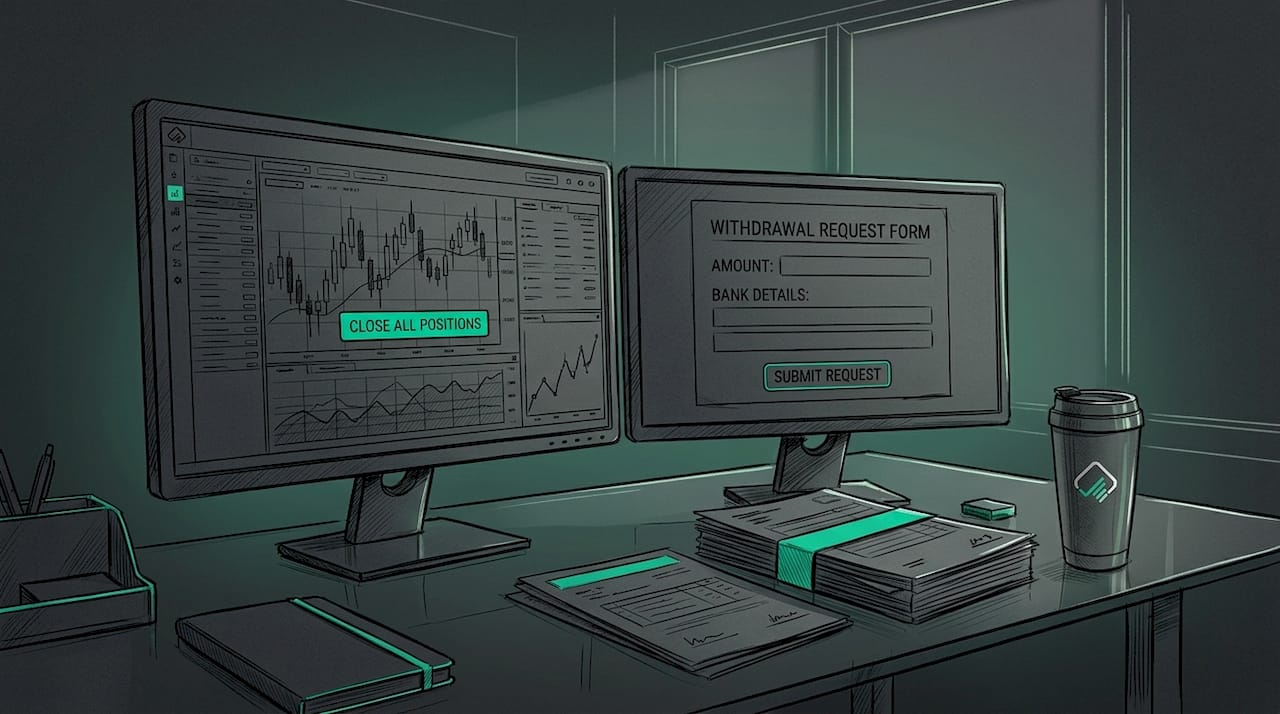
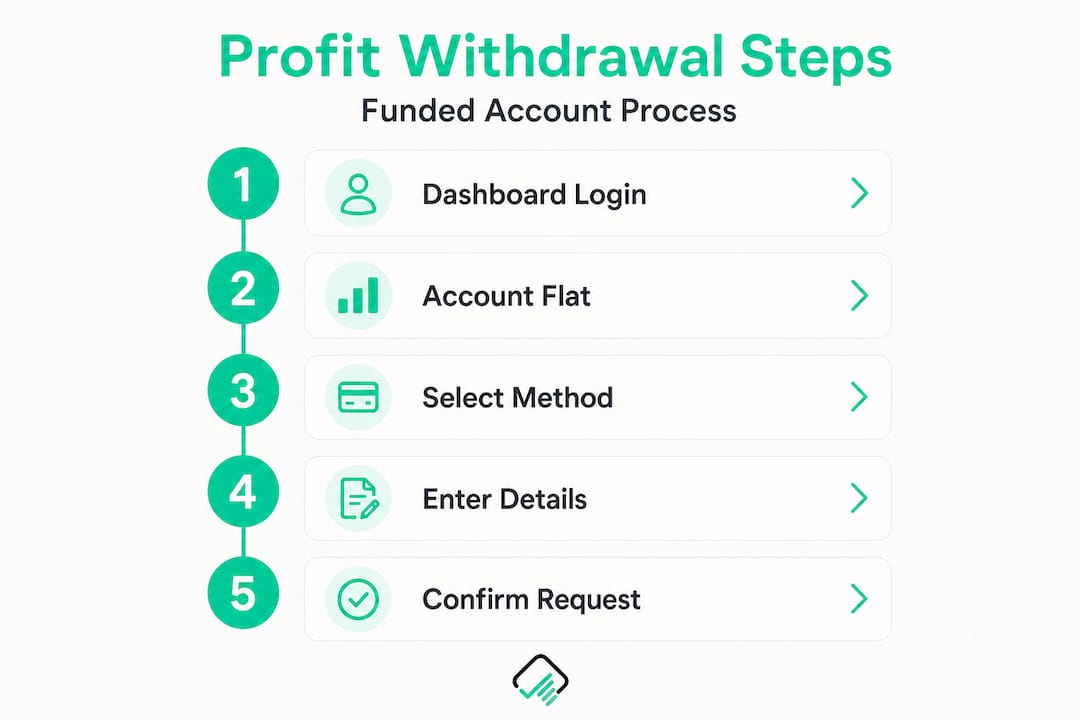
Step 1: Log into the firm’s trader dashboard. Every prop firm with a legitimate payout system runs withdrawals through a dedicated portal, not through email or chat. Navigate to the payout or withdrawal section and confirm the button is active. If it’s grayed out, return to your eligibility checklist.
Step 2: Verify your account is flat. Close all open trades and pending orders before submitting. Many firms will automatically reject requests made while positions are open, and some flag this behavior for compliance review.
Step 3: Select your payment method. Most firms offer at least two options: crypto/non-custodial transfers or bank/e-wallet transfers. Read the specific payout calendar for each method, as processing days differ. InstantFTMO terms state that payouts are processed as non-custodial crypto transfers within 24 hours under normal conditions once the profit target is reached, which is notably faster than most bank options.
Step 4: Enter your payment details carefully. Wallet addresses, IBAN numbers, and e-wallet emails must be entered exactly. A single incorrect character on a crypto wallet address is irreversible. Double-check, then check again.
Step 5: Submit and confirm the request. Most dashboards send a confirmation email. Save this. It serves as your timestamp if a dispute arises later.
Step 6: Understand what happens next. After submission, your account status may change. Funded-trader payout workflows involve the firm reviewing your trading behavior and confirming eligibility before releasing funds. This is not instant. Budget one to three business days for the internal review alone.
Step 7: Do not trade until you’re cleared. This is where many traders unknowingly create problems. Some firms process withdrawals in scheduled batches and your account can become read-only or restricted after submission. Trading during this period may trigger a review or denial, even if you don’t break any rules while doing so.
Important: Only request a payout when you are fully prepared to pause trading. Trading after a withdrawal request has been submitted can trigger a compliance review that delays or voids the payout entirely at many firms.
Understanding the funded trader workflow at the firm level before you even start trading puts you ahead of most applicants.
Processing timelines, payment rails, and withdrawal issues
After submitting your request, understanding processing times and possible complications is your last step to success. A typical withdrawal timeline runs from initial eligibility review through to payment-rail processing, with the full cycle often adding several business days beyond what firms advertise in their marketing materials.
Payment method selection has a direct impact on how fast you actually receive funds:
- Bank transfer (SWIFT/SEPA): Typically 3 to 7 business days. Affected by regional banking rules, weekends, and holidays. Usually no crypto wallet required, but fees can be significant for international transfers.
- E-wallet (Wise, Skrill, PayPal): Often faster than traditional bank wires, typically 1 to 3 business days. Varies by region and platform limits.
- Non-custodial crypto (USDT, BTC, ETH): Can be processed within 24 hours at firms that support it, but network fees apply and wallet address accuracy is non-negotiable.
Each rail has tradeoffs. Crypto is fast but technically unforgiving. Bank transfers are familiar but slow. Choose based on your needs and comfort level, not just speed.
Troubleshooting common withdrawal problems requires a systematic approach. Operational issues can arise when firms interpret trading behavior through compliance lenses, flagging what they internally describe as windfall or erratic trading patterns. If your payout is stuck in review, do the following:
- Check your email for any compliance communication from the firm. Many firms send automated notices when a review is triggered.
- Log into the dashboard and look for a status indicator on your payout request.
- Review your trading history for any day where a large percentage of your total profit was earned in a very short time, as this is a common trigger.
- Contact support with your transaction reference number and the specific date you submitted the request.
Pro Tip: Always double-check your wallet address or bank details before submission, and submit requests early in the week. Requests submitted Friday afternoon can sit unreviewed until Monday, adding two to three days to your wait. Holiday periods around Christmas, New Year’s, and regional bank holidays can extend timelines by five or more business days.
For a detailed look at how specific firms handle these steps, see our FundingPips review and the direct FTMO vs FundingPips comparison, both of which include verified payout timeline data.
The uncomfortable truth about prop firm withdrawals
With the mechanics and common snags laid out, it’s time for an honest look at what really matters when chasing your payouts. The industry rarely advertises this openly: reaching the profit target is the beginning of the eligibility conversation, not the end of it.
Many experienced traders are surprised to learn that prop firm trader failure rates are driven not just by blown challenges but also by withdrawal complications that occur even after funded status is achieved. Payout denials at the funded stage are far more common than the industry acknowledges publicly.
Here is what most traders underestimate. Firms retain the right to interpret consistency, erratic trading, and windfall gains through their own internal definitions. These definitions are rarely published in plain language. A trader who earns 60 percent of their monthly profit in one news event trade may have technically passed every listed rule and still face a review that delays their payout by weeks.
Rules can also shift mid-challenge or be clarified in ways that disadvantage you retroactively. Prop firms update their terms periodically, and while most changes take effect for new users, the ambiguity around how they apply to existing funded accounts creates real risk. Proactive rule tracking, meaning reading the terms once per month and noting any updates, is a practice that consistently separates traders who get paid from those who don’t.
The single most important mindset shift for withdrawal success is this: trade for certainty, not speed. Playing conservatively in the days before a payout request, avoiding aggressive lot sizes, and keeping your daily profit distribution as even as possible all reduce your compliance exposure.
“The difference between being paid or not comes down to understanding what the firm can withhold on compliance grounds. Always play for certainty, not speed.”
This is not pessimism about the industry. Legitimate firms do pay, consistently and on time. But those payouts go to traders who have taken the time to understand the rules with the same rigor they apply to their trading setups.
Take your funded trading further
Choosing the right firm and understanding its withdrawal mechanics are two sides of the same coin. If the withdrawal process covered here has clarified what you need to prioritize, the next step is ensuring you’re working with a firm and a platform that actually supports consistent payouts.
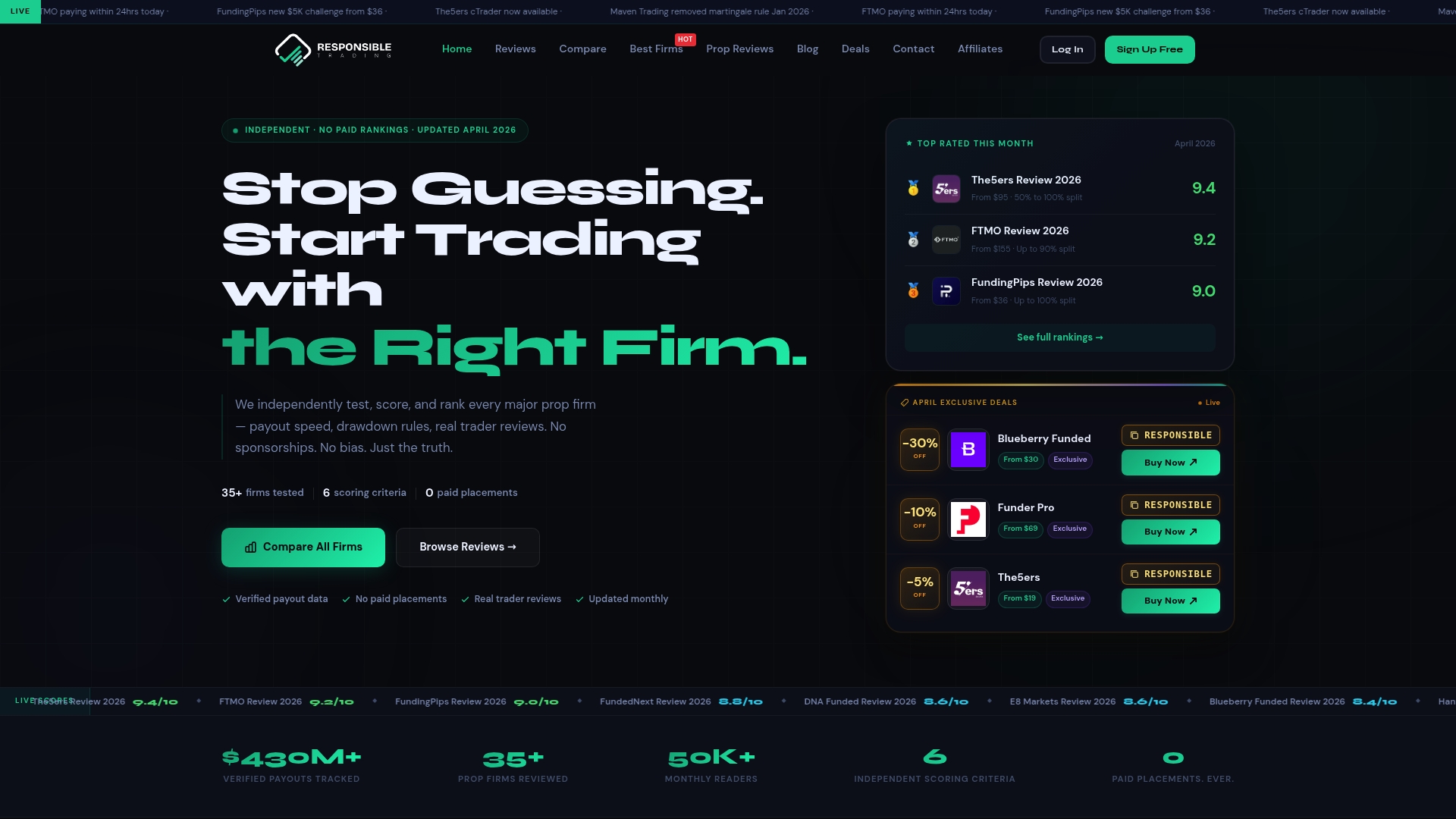
At ResponsibleTrading.com, we track verified payout data, review challenge structures, and analyze withdrawal timelines so you can make firm decisions based on evidence rather than marketing claims. Explore our rankings of best prop firm trading platforms to find options matched to your trading style. If you’re still in the challenge phase, our passing prop firm challenges blueprint shows you how to trade within rules that set you up for a smooth first payout. And our dedicated payout method guide breaks down every payment rail in detail so you can choose the right one for your situation.
Frequently asked questions
How long does it take to withdraw from a funded trading account?
Withdrawals typically take 3 to 8 business days, including an internal eligibility review followed by payment-rail processing, with crypto options generally being faster than bank transfers.
What could cause a withdrawal to be denied or delayed?
Common causes include unmet buffer or consistency rules, trading after a request is submitted, incorrect payment details, or a compliance review. Having the minimum profit target alone is often not enough if buffer or eligibility ratios have not been met.
Are there fees associated with funded trading withdrawals?
Yes. Crypto payouts often carry network fees, while bank and e-wallet transfers may include processing charges that vary by provider and region. Always verify the fee structure before selecting your payout method.
Can you withdraw profits multiple times per month from most prop firms?
It depends on the firm’s payout schedule. Withdrawals are often processed in scheduled batches or cycles, such as weekly or biweekly, so multiple payouts in a single month are possible only if the firm’s rules explicitly allow it and each request meets full eligibility.
Recommended
- Funded Account Trading Strategies That Actually Work in 2026 (2026) | Responsible Trading
- How to Scale a Funded Trading Account in 2026: A Practical Roadmap (2026) | Responsible Trading
- Master the funded trader workflow: step-by-step success guide (2026) | Responsible Trading
- What is an instant funding account? Fast-track your trading (2026) | Responsible Trading