

Many traders enter prop firm challenges believing that higher leverage automatically produces bigger profits. That assumption is one of the most common and costly mistakes in proprietary trading. Leverage is a tool, and like any tool, its value depends entirely on how you use it. Understanding how prop firms apply leverage, why they cap it, and how to match it to your strategy is not optional knowledge. It is the foundation of passing a funded challenge and building a sustainable trading career.
Table of Contents
- Understanding leverage in prop trading
- Common leverage ratios and how they affect your trades
- Risk management: Why leverage limits exist
- How to choose the right leverage for your trading style
- A practical perspective: What most traders miss about leverage in prop trading
- Next steps: Make leverage work for your trading
- Frequently asked questions
Key Takeaways
| Point | Details |
|---|---|
| Leverage defined | Leverage lets you trade larger positions than your deposit by using prop firm capital. |
| Leverage caps | Most prop firms limit leverage from 1:30 to 1:100 to control risk and protect traders. |
| Risk management matters | Picking the right leverage and following firm rules helps you trade safely and keep your funded account. |
| Choose wisely | Adjust your leverage to fit your trading style and personal risk comfort for long-term success. |
Understanding leverage in prop trading
Leverage allows you to control a position larger than your actual capital. If a prop firm offers 1:100 leverage, a $1,000 margin deposit controls a $100,000 position. That sounds attractive, but the exposure cuts both ways. A 1% move against you on a $100,000 position wipes out your entire $1,000 margin.
Prop trading firms operate differently from standard retail brokerages. When you trade through a prop firms vs brokers comparison, one key difference stands out immediately: prop firms are risking their own capital, not just yours. That changes everything about how leverage is managed. A retail broker earns spread and commission regardless of whether you win or lose. A prop firm shares in your profits but also absorbs losses beyond your funded account buffer.
Because of this, prop firms set firm leverage caps. Prop firm leverage benchmarks show that FTMO caps leverage at 1:100, The5ers limits it to 1:30, and firms like Goat Funded Trader balance opportunity with drawdown controls. These caps are not arbitrary. They reflect each firm’s internal risk model and the asset class being traded.
Here is what leverage caps typically look like across common trading instruments:
- Forex major pairs: 1:30 to 1:100 depending on the firm
- Forex minor and exotic pairs: Often reduced to 1:20 or lower
- Indices and commodities: Typically capped at 1:10 to 1:20
- Cryptocurrencies: Usually the most restricted, often 1:2 to 1:5
- Stocks and equities: Commonly limited to 1:5 to 1:10
Pro Tip: New traders frequently confuse available leverage with recommended leverage. Just because a firm offers 1:100 does not mean you should use all of it. Most experienced traders use a fraction of available leverage on any single trade.
If you want to explore high leverage prop firms specifically, it is worth comparing not just the headline ratio but also how each firm enforces drawdown rules alongside that leverage.
Common leverage ratios and how they affect your trades
Now that you know why leverage is capped, let’s break down what those ratios mean in practice.
| Prop firm | Max leverage (forex) | Drawdown type | Account size range |
|---|---|---|---|
| FTMO | 1:100 | 5% daily / 10% total | $10K to $200K |
| The5ers | 1:30 | Equity-based trailing | $5K to $100K |
| Goat Funded Trader | 1:100 | 5% daily / 8% total | $25K to $200K |
The difference between 1:30 and 1:100 is significant in real trading. Consider a trader with a $50,000 funded account trading EUR/USD.
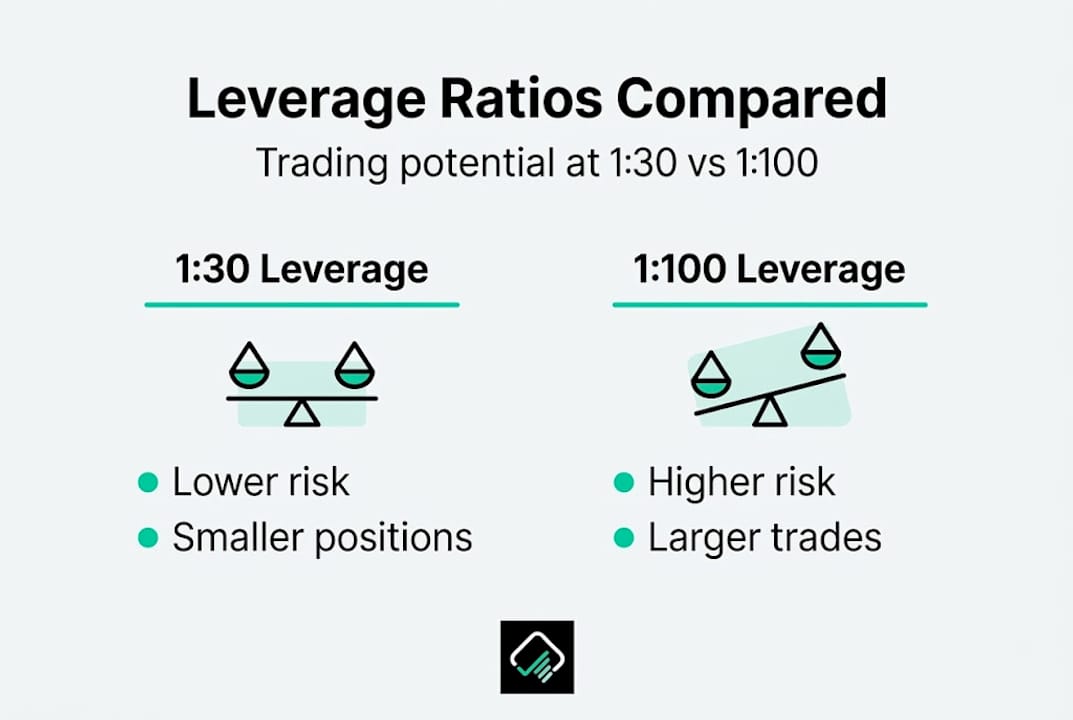
At 1:30 leverage, the trader can open a maximum position of $1,500,000 notional. A standard lot is $100,000, so the trader can hold up to 15 standard lots. At 1:100 leverage, that same account controls up to $5,000,000 notional, or 50 standard lots.
In practice, no disciplined trader uses maximum position size. But the ratios matter because they determine how much flexibility you have when scaling into positions or managing multiple trades simultaneously.
Here is how leverage directly affects your trade outcomes:
- Position sizing: Higher leverage lets you take larger positions with the same margin, increasing both gains and losses per pip
- Margin requirements: Lower leverage requires more margin per lot, reducing the number of simultaneous trades you can hold
- Drawdown sensitivity: At 1:100, a 0.5% adverse move on a full position equals a 50% margin loss; at 1:30, the same move equals roughly a 15% margin loss
- Psychological pressure: Larger positions amplify emotional responses to market fluctuations, which affects decision quality
According to prop firm leverage benchmarks, the industry standard for forex at most funded firms sits between 1:30 and 1:100, with the majority of serious traders operating comfortably in the 1:10 to 1:30 range regardless of what the maximum allows.
Statistic callout: Traders who use more than 50% of their available leverage on a single trade are statistically more likely to breach daily drawdown limits within the first two weeks of a funded account.
Prop firms also adjust leverage based on account tier. A $10,000 challenge account may receive full leverage, while a scaled $200,000 account might see reduced ratios to protect larger capital pools. This is standard practice and worth checking in the terms before you fund. The best platforms for leverage in prop trading also factor into execution quality, since slippage at high leverage can quickly erode gains.
Risk management: Why leverage limits exist
With leverage ratios clear, it is crucial to understand why these limits exist and how they are enforced.
Unrestricted leverage creates a scenario where a single bad trade can wipe out not just a trader’s account but also cause meaningful losses to the firm’s capital pool. Prop firms manage dozens or hundreds of funded traders simultaneously. If leverage were unlimited, one volatile news event could cascade into losses across multiple accounts at once.
The three most common risk management processes at prop firms work together to contain this exposure:
- Daily drawdown limits: Most firms set a maximum daily loss of 4% to 5% of account balance. Once breached, the account is closed or suspended. This prevents a single session from causing catastrophic loss regardless of leverage used.
- Maximum drawdown (total loss limit): A firm-wide ceiling, typically 8% to 10% of the starting account balance, after which the trader’s funding is revoked. This is the “hard floor” that leverage limits help protect.
- Margin call and position liquidation: If open positions consume too much margin, the platform automatically closes trades. This is a last-resort protection that kicks in when a trader ignores the first two controls.
“Leverage without drawdown controls is like driving without brakes. Prop firms install both because neither alone is sufficient to protect the capital at risk.” This reflects the core philosophy behind how top-tier firms structure their risk frameworks.
Understanding these rules is not just compliance knowledge. It is strategic. Traders who know exactly where their drawdown floors sit can size positions more precisely and avoid the panic-driven mistakes that cause most challenge failures. Reviewing prop trading mistakes shows that leverage misuse consistently ranks among the top three reasons traders fail funded challenges.
A full breakdown of prop firm rules across leading platforms will show you how these controls vary by firm, which matters when you are choosing where to apply.
Pro Tip: Before starting any challenge, calculate your maximum position size based on your daily drawdown limit, not your available leverage. If your daily limit is $500 on a $10,000 account, and you trade EUR/USD with a 20-pip stop loss, your maximum lot size is 1.25 standard lots regardless of whether the firm offers 1:30 or 1:100 leverage.
How to choose the right leverage for your trading style
Now that you understand risk controls, it is time to personalize your approach. Selecting the right leverage is not a one-size-fits-all decision. It depends on your strategy, experience level, and how you respond to drawdown pressure.
| Trading style | Recommended leverage range | Typical hold time | Key risk factor |
|---|---|---|---|
| Scalper | 1:50 to 1:100 | Seconds to minutes | High frequency amplifies errors |
| Day trader | 1:20 to 1:50 | Minutes to hours | News volatility exposure |
| Swing trader | 1:5 to 1:20 | Days to weeks | Overnight gap risk |
| Position trader | 1:2 to 1:10 | Weeks to months | Extended drawdown periods |
Scalpers often need higher leverage because their profit targets per trade are small, sometimes 3 to 5 pips. To make those trades meaningful, position size must be larger. However, the speed of scalping also means errors compound quickly. A string of losing scalps at 1:100 can breach a daily limit within an hour.
Swing traders face a different challenge. Holding positions overnight exposes them to gap risk, where price opens significantly above or below the previous close. Lower leverage gives swing traders more breathing room to absorb these moves without hitting margin calls.

Day traders fall in the middle. They benefit from moderate leverage to capture intraday moves while maintaining enough margin buffer to stay in trades through normal volatility.
Choosing the right prop firm also means matching the firm’s leverage offering to your style. A swing trader who applies to a firm with strict overnight holding restrictions will find leverage almost irrelevant if they cannot hold positions long enough to use it effectively.
Key factors to balance when selecting your leverage:
- Account size relative to target profit: Smaller accounts need efficient leverage to hit percentage-based profit targets
- Stop loss distance: Wider stops require lower leverage to stay within drawdown limits
- Win rate and risk-reward ratio: A high win rate strategy can tolerate lower leverage; a lower win rate strategy needs tight risk per trade
- Emotional tolerance: Higher leverage increases the dollar value of each fluctuation, which affects decision-making under pressure
Common mistakes traders make with leverage selection:
- Defaulting to maximum available leverage without calculating actual risk per trade
- Ignoring asset-specific leverage caps when switching between forex and indices
- Failing to recalculate position size after account balance changes during a challenge
- Treating leverage as a fixed setting rather than adjusting it based on current market volatility
Reviewing prop firm funding rules across multiple firms will clarify how leverage interacts with profit targets and drawdown thresholds at each specific platform.
A practical perspective: What most traders miss about leverage in prop trading
Here is the honest reality that most leverage guides skip over. The traders who consistently pass funded challenges and build long-term income from prop trading are almost never the ones using maximum leverage. They are the ones who treat leverage as a precision instrument rather than an accelerator.
The excitement of a large funded account, say $100,000, combined with 1:100 leverage creates a psychological pull toward oversizing. The numbers feel abstract. Losing $2,000 on a trade feels distant when you are looking at a $100,000 balance on screen. But that $2,000 may represent 40% of your daily drawdown limit. One more trade like that and your account is suspended.
What separates sustainable prop traders from those who cycle through failed challenges is not strategy sophistication. It is position discipline. The best traders we observe through leveraged prop firm reviews consistently risk 0.5% to 1% of account equity per trade, regardless of available leverage. They use leverage to achieve their target position size efficiently, not to maximize exposure.
There is also a less-discussed emotional component. When leverage amplifies a losing trade, the natural response is to either cut too early or hold too long hoping for a reversal. Both responses damage your trading statistics over time. Lower leverage reduces the emotional intensity of each trade, which leads to more consistent execution.
The traders who treat leverage as a shortcut to fast profits tend to fail quickly and repeatedly. Those who view it as a capital efficiency tool, one that helps them meet position sizing requirements without tying up unnecessary margin, tend to build the kind of track record that leads to scaled funding and long-term income.
Next steps: Make leverage work for your trading
Understanding leverage is the first step. Applying it correctly across a real funded challenge is where the work happens.
At Responsible Trading, we provide the resources you need to move from theory to practice. Our in-depth guides on best forex platforms for prop trading help you identify platforms that pair strong leverage options with reliable execution. When you are ready to select a firm, our choose your prop firm guide walks you through matching leverage, drawdown rules, and profit share terms to your specific strategy. For a full view of which firms are currently rated highest across all criteria, explore the top-ranked prop firms on our platform, where every review is backed by real challenge data and verified payout records.
Frequently asked questions
What is leverage in prop trading?
Leverage in prop trading lets you control larger positions by borrowing firm capital, meaning you can trade a position size far greater than your deposited margin, with leverage benchmarks at top firms ranging from 1:30 to 1:100.
Why do prop firms limit leverage?
Leverage limits help prop firms manage overall risk and protect both the firm’s capital and the trader’s funded account from losses that exceed acceptable thresholds.
What leverage do top prop firms usually offer?
Leading prop firms like FTMO and The5ers offer leverage ranging from 1:30 up to 1:100 on forex pairs, with lower caps applied to indices, commodities, and crypto.
Is higher leverage always better for traders?
Higher leverage increases both profit potential and loss exposure on every trade, so it is not the right choice for every trader or every market condition, particularly in volatile sessions.
How do I pick the right leverage for my trading strategy?
Match your leverage to your stop loss distance, account size, and trading style. Lower leverage suits beginners and swing traders, while scalpers with disciplined risk controls may use higher ratios effectively.
Recommended
- Best Forex Prop Firms 2026: Tight Spreads, High Leverage, and Real Payouts (2026) | Responsible Trading
- Avoid these prop trading mistakes: a practical guide (2026) | Responsible Trading
- Leveraged Prop Firm Review 2026 — 7.2/10 | Responsible Trading
- Copy trading in prop firms: how it works in 2026 (2026) | Responsible Trading