

Many traders enter the prop trading space with a working knowledge of charts and strategies but quickly realize that unfamiliar terminology creates costly confusion. Words like drawdown, evaluation, and profit split sound straightforward, yet their specific meanings inside funding programs carry real financial consequences. Prop trading primarily involves firms providing traders with capital to trade financial markets using the firm’s money, not the trader’s own savings. Grasping this distinction, along with the full vocabulary that surrounds it, is what separates traders who navigate funding programs efficiently from those who stumble at the first obstacle.
Table of Contents
- What is proprietary trading? Core concepts defined
- Key prop trading terminology you must know
- Retail vs institutional prop trading: Key differences and jargon
- Applying prop trading terminology: Program selection, performance, payouts
- Our perspective: What most guides miss about prop trading terminology
- Get actionable insights for your prop trading journey
- Frequently asked questions
Key Takeaways
| Point | Details |
|---|---|
| Prop trading basics | Prop trading lets you trade with firm capital, sharing profits and removing personal capital risk after evaluation. |
| Essential terminology | Understanding terms like evaluation, profit split, drawdown, and reset is vital for navigating prop firm programs. |
| Retail vs institutional | Retail prop trading uses paid evaluations and resets; institutional desks focus on hiring quants for capital allocation and ROI targets. |
| Program selection | Mastering terminology empowers you to compare programs, clarify payouts, and optimize your trading results. |
What is proprietary trading? Core concepts defined
Proprietary trading, often called prop trading, occurs when a firm deploys its own capital in financial markets through traders it selects, funds, and monitors. The firm absorbs market risk and shares a portion of any profits generated. This model differs fundamentally from the traditional brokerage relationship, where the trader risks personal funds and the broker earns commissions regardless of performance.
Understanding how the prop firm vs broker relationship works is essential before committing to any funding program. In a retail brokerage account, you deposit your own money, take on full downside exposure, and pay spreads or commissions. In a prop firm model, you typically pay a one-time evaluation fee, pass a performance test, and then trade the firm’s capital.
The core mechanics of prop trading models include:
- Firm capital: The firm provides the trading account balance, often ranging from $10,000 to $200,000 or more.
- Profit sharing: Profits generated are split between the trader and the firm according to a predefined ratio.
- Evaluation structure: Traders must meet specific performance targets before accessing live funded capital.
- Drawdown limits: Maximum loss thresholds are set to protect the firm’s capital from excessive risk.
- Payout cycles: Funded traders request withdrawals on a fixed schedule, often weekly or monthly.
A critical point that many traders overlook when comparing the broker vs prop firm models is the risk transfer. Once you pass evaluation, your personal capital is no longer at stake during live trading.
“The key distinction from retail: no personal capital risk post-evaluation.” This single fact changes the risk calculus for every decision a funded trader makes.
Terminology is central here because each term in a prop firm’s rulebook defines a specific condition that can determine whether you keep your account or lose it. Misreading what “daily drawdown” means versus “trailing drawdown” can end a funded account instantly.
Key prop trading terminology you must know
Now that the basics are clear, let’s cover the core vocabulary every prop trader needs to operate confidently inside any funding program.
- Prop firm: A company that provides traders with capital in exchange for a share of profits.
- Funding program: The specific plan offered by a prop firm, including account size, rules, and payout terms.
- Evaluation (or challenge): A paid performance test traders must pass to receive a funded account.
- Profit split: The percentage division of profits between the trader and the firm.
- Drawdown: The maximum allowable loss from a peak balance or starting balance before the account is closed.
- Payout: The withdrawal of earned profits from the funded account to the trader.
- Reset: Paying a fee to restart a failed evaluation or funded account under the same program terms.
- Consistency rule: A requirement that no single trading day generates an outsized portion of total profits.
- Instant funding: A program type where traders receive a funded account without completing a multi-step evaluation.
Profit splits typically range from 70/30 to 90/10 between the trader and firm. To put that in real dollars: on a $100,000 account generating $5,000 in monthly profit, a 90% split means the trader takes home $4,500. A 70% split returns only $3,500. Understanding this difference matters before you choose a program.
The concept of a prop profit split also interacts with fees. A firm advertising 90% splits but charging high reset fees may deliver lower earnings after fees than a firm with an 80% split and no reset costs. This is where precise vocabulary gives you a real analytical edge.
Pro Tip: Before joining any program, map out the exact payout formula: account size multiplied by profit percentage, then multiplied by your split ratio, minus any platform or withdrawal fees. This number tells you your actual take-home, not the headline figure. Review prop scoring systems to see how leading platforms are ranked against these criteria.
Retail vs institutional prop trading: Key differences and jargon
Understanding terminology is not enough. You must also grasp how context shapes language and opportunity across two very different segments of the prop trading world.
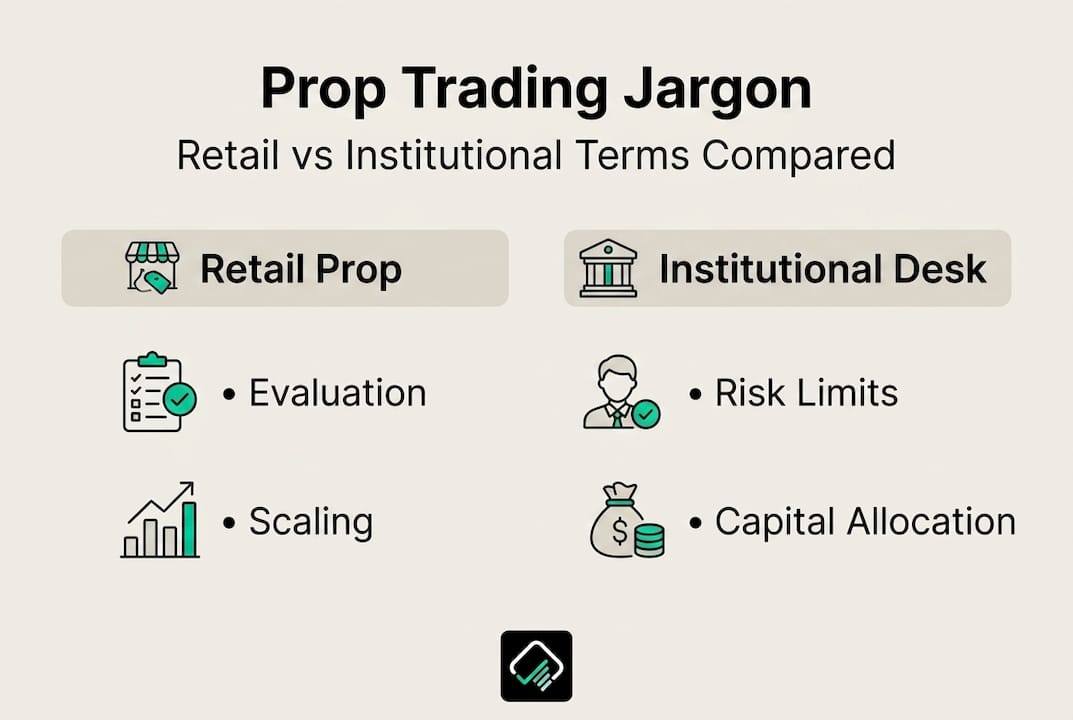
Retail prop trading firms like FTMO and Topstep offer paid evaluations to the general public. Institutional prop trading desks, such as those at Jane Street or Citadel, hire quantitative analysts and allocate firm capital through an entirely different process. The jargon used in each environment reflects those structural differences.
Retail prop trading terms:
- Evaluation: A paid challenge with defined profit targets and loss limits.
- Reset: Paying a fee to restart after failing an evaluation or funded account.
- Funded account: The live account a trader receives after passing evaluation.
- Payout: A withdrawal from the funded account balance.
Institutional prop trading terms:
- Desk: A team of traders focused on a specific asset class or strategy.
- Capital allocation: The amount of firm capital assigned to a specific trader or desk.
- Quant: A quantitative analyst who develops algorithmic or statistical trading strategies.
- ROI target: A required return on invested capital, typically 10 to 15 percent per quarter at institutional desks.
Retail prop firms employ paid evaluations with pass rates of just 5 to 10 percent. That figure is striking and important. It means the vast majority of traders who attempt evaluations do not receive funded accounts on their first attempt.

| Feature | Retail prop trading | Institutional prop trading |
|---|---|---|
| Capital source | Firm funds traders publicly | Internal firm capital |
| Entry method | Paid evaluation or challenge | Quant hiring process |
| Pass rate | 5 to 10 percent | Competitive recruitment |
| Profit sharing | Fixed split (70 to 90 percent) | Salary plus bonus structure |
| ROI target | Varies by program | 10 to 15 percent per quarter |
| Risk to trader | Evaluation fee only | Career and reputational risk |
The language difference between these two segments matters practically. When a retail program says “capital allocation,” it usually means the funded account size. When an institutional desk says it, the meaning involves complex internal budgeting processes. Knowing which context you are operating in prevents misreading program terms. You can explore top trading platforms to see how retail platforms align with these distinctions, and review scoring system KPIs that help compare firms on objective criteria.
Applying prop trading terminology: Program selection, performance, payouts
Once you understand the jargon, it’s time to apply it for better decision making and real outcomes.
Terminology directly affects how you compare funding programs. Two programs offering similar account sizes can have drastically different real-world value based on drawdown type, payout frequency, and reset policy. A trader who understands these terms can filter out unfavorable programs quickly.
Key factors to evaluate using terminology:
- Drawdown type: Is it static (fixed from initial balance) or trailing (moves with peak balance)? Trailing drawdown is stricter and requires more careful position sizing.
- Profit target: The percentage gain required to pass an evaluation phase, typically 8 to 10 percent for phase one.
- Minimum trading days: Some programs require a minimum number of active trading days before a payout request.
- Payout frequency: Weekly payouts offer faster compounding; monthly payouts require more patience.
- Reset policy: Does the firm offer discounted resets for funded accounts, or do you pay full evaluation fees again?
Retail prop success requires positive expectancy above fees and costs. That means your average winning trade, weighted by frequency, must exceed your average losing trade plus all program costs. This is not optional math. It is the foundation of sustainable funded trading.
| Program feature | Typical range | What to look for |
|---|---|---|
| Profit split | 70 to 90 percent | Above 80 percent with low fees |
| Evaluation fee | $50 to $600 | Refundable on first payout |
| Payout frequency | Weekly to monthly | Weekly for active traders |
| Drawdown limit | 5 to 10 percent | Static preferred for news traders |
| Reset fee | 20 to 100 percent of evaluation | Discounted or waived options |
Understanding profit after commissions requires factoring in spreads, swap fees, and any platform costs charged by the prop firm’s liquidity provider. These costs quietly erode profitability and are rarely highlighted in marketing materials.
Studying challenge failure reasons reveals that most traders fail not because of poor strategy but because of misunderstood rules. Daily drawdown violations, consistency rule breaches, and trading during restricted news windows are common traps. Verifying a firm’s track record through payout verification resources adds another layer of protection before you invest your evaluation fee.
Our perspective: What most guides miss about prop trading terminology
Most terminology guides do a reasonable job of defining words. What they rarely address is how firms use that same language strategically in their marketing to obscure unfavorable conditions.
For example, “up to 90% profit split” sounds excellent. But that figure often only applies after a scaling milestone that most traders never reach. The baseline split of 75 or 80 percent is what the majority of funded traders actually receive. Reading the fine print with precise vocabulary knowledge is the only defense against this kind of framing.
After tracking the prop firm industry through hundreds of evaluations and payout reviews, one pattern consistently stands out. Traders who fail do not usually fail because of bad strategy. They fail because they did not fully understand the specific operational definition of a term in the program they chose.
A thorough review of profit splits across firms shows that headline numbers and real-world outcomes regularly diverge. The traders who succeed treat the rulebook as a technical document, not a summary. That mindset, more than any trading edge, determines funded account longevity.
Get actionable insights for your prop trading journey
Mastering prop trading terminology gives you a critical foundation, but building real confidence requires going deeper into firm-specific rules, platform performance, and payout histories.
ResponsibleTrading.com provides independent, data-driven reviews that go beyond surface definitions. Whether you are comparing evaluation structures, researching best forex trading platforms, or learning how to choose a prop firm that matches your trading style, the platform delivers verified insights sourced from real trader experiences. If you want to understand exactly why prop firm challenges fail and how to avoid those traps, start with the guides built specifically for traders navigating this space.
Frequently asked questions
What is a prop trading firm?
A proprietary trading firm provides traders with capital to trade markets using the firm’s money, sharing profits based on performance according to a predefined split ratio agreed upon before trading begins.
How does profit split work in prop trading?
Profit splits range from 70/30 to 90/10, with the larger share going to the trader after successfully completing an evaluation phase and meeting any minimum trading day requirements.
What is an evaluation in retail prop trading?
An evaluation is a paid performance test with defined profit targets and drawdown limits; retail pass rates are typically 5 to 10 percent, making rule clarity and preparation essential for success.
What is the main difference between retail and institutional prop trading?
Retail prop trading uses paid evaluations and reset fees to onboard traders publicly, while institutional prop desks hire quantitative analysts and allocate capital with strict quarterly ROI targets of 10 to 15 percent.
How can understanding terminology improve trading outcomes?
Knowing exact definitions of drawdown types, payout rules, and consistency requirements helps traders select suitable programs and avoid the rule violations that cause most funded account failures.
Recommended
- Funded Account Trading Strategies That Actually Work in 2026 (2026) | Responsible Trading
- How to Choose the Right Prop Firm for Your Trading Strategy (Step-by-Step Guide) (2026) | Responsible Trading
- Prop firm scoring systems: how to evaluate and succeed (2026) | Responsible Trading
- How to Scale a Funded Trading Account in 2026: A Practical Roadmap (2026) | Responsible Trading
- A New Approach to Prop Trading in 2026: Why Structured Development Matters