

Most retail traders assume the biggest barrier to trading success is finding a good strategy. It’s not. The more common problem is capital. A trader with a $5,000 personal account needs a 20% return just to make $1,000, and that kind of pressure breeds poor decisions. Understanding why use prop funded accounts comes down to one core inversion: rather than risking your own money to prove you can trade, you prove you can trade first, then access real institutional capital. This guide walks through exactly how that works, what the benefits are, and what separates traders who succeed with funded accounts from those who don’t.
Table of Contents
- What are prop funded accounts and how do they work?
- Why do traders choose prop funded accounts? Key benefits explained
- Understanding evaluation and risk management in prop funded accounts
- How scaling plans boost prop funded account growth and income
- Common mistakes to avoid and pro tips for funded account success
- The real reason prop funded accounts transform trading careers
- Explore prop funded account options and solutions today
- Frequently asked questions
Key Takeaways
| Point | Details |
|---|---|
| Access to capital | Prop funded accounts provide traders with institutional-level capital without risking personal money. |
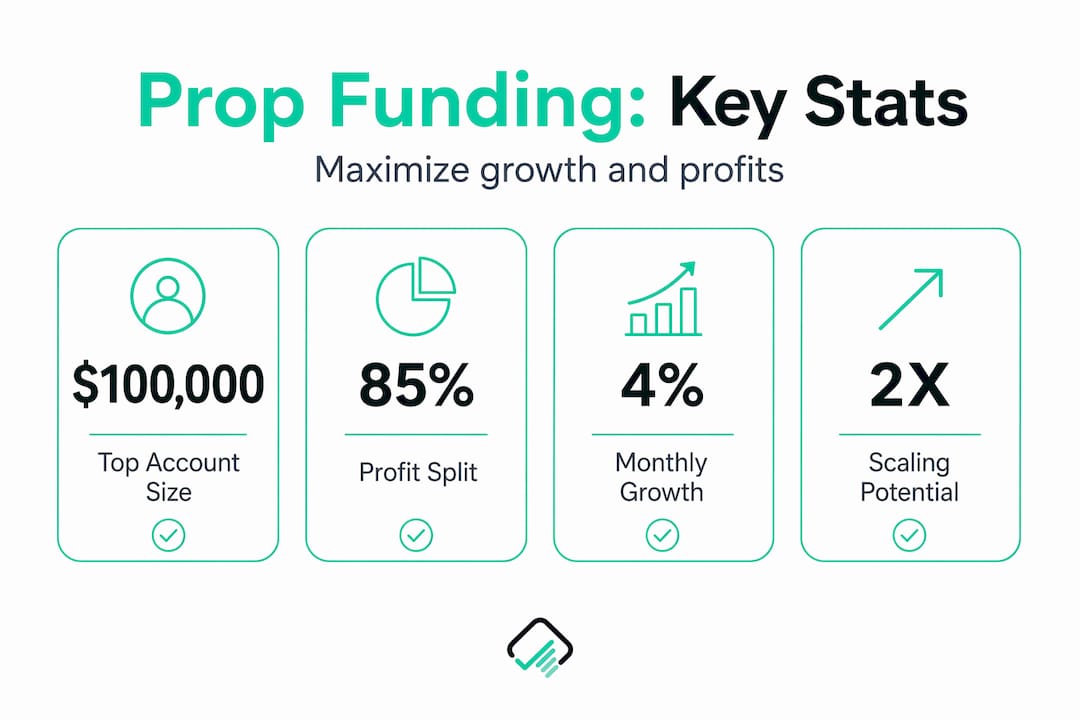
| High profit splits | Traders can keep a majority of profits, typically between 80% and 90%. |
| Risk controls | Clear evaluation and drawdown rules protect both trader and firm from substantial losses. |
| Scaling potential | Consistent profits unlock scaling plans that boost account size and trading income. |
| Psychological benefits | Trading firm capital reduces fear and promotes better decision-making for long-term success. |
What are prop funded accounts and how do they work?
A prop funded account is an arrangement between a trader and a proprietary trading firm. The firm provides real capital after the trader completes an evaluation phase, commonly called a “challenge.” The trader does not put up their own money to trade the live account. They only pay a one-time evaluation fee, typically between $100 and $600 depending on account size.
Here’s how the mechanics work in practice:
- Evaluation phase: Traders must hit a profit target (usually 8-10% of account value) while staying within daily and maximum drawdown limits. This phase typically runs a minimum of 30 trading days.
- Capital access: Once passed, the trader receives access to a funded account ranging from $25,000 to over $2 million, depending on the firm and tier selected.
- Risk controls: Traders operate under predefined rules, including maximum position sizes, daily loss limits, and prohibited trading windows (like holding positions over major news events, depending on the firm).
- Profit splits: Access to significant trading capital without risking personal savings changes the way skilled traders approach the market. Most firms offer profit splits of 80-90% in the trader’s favor once funded.
The fee structure is one of the most misunderstood parts. It’s not a deposit. It’s an entry cost to the evaluation process. If you fail, you typically lose the fee and must restart. If you pass, the fee cost becomes negligible relative to the earning potential of a $100,000+ account.
Why do traders choose prop funded accounts? Key benefits explained
After understanding what prop funded accounts are, the natural next question is why so many traders actively prefer them over self-funded accounts. The advantages of prop firm funding are concrete and measurable, not just theoretical.
Here are the primary reasons traders choose prop funded accounts:
- Profit potential scales fast. Traders keep 80-90% profit splits on funded accounts, with some firms offering 90/10 splits and even paying out the first $5,000 earned at 100% to the trader after evaluation. On a $100,000 account, a 5% monthly gain at 90% payout equals $4,500 in the trader’s pocket, with no personal capital at risk.
- No personal capital at risk on the funded account. Once you pass the evaluation, you trade the firm’s money. Your personal risk is capped at the evaluation fee.
- Defined rules force discipline. Traders who lack formal risk structure on personal accounts often oversize positions or revenge trade after losses. Firm rules prevent this and build consistent habits.
- Rapid career scaling is possible. Prop funded accounts accelerate career growth for skilled traders by providing institutional-scale opportunities within months via evaluations, rather than years of compounding a small personal account.
- Reduced psychological pressure. Trading with the firm’s capital removes the emotional burden of watching personal savings fluctuate, which statistically improves decision quality.
Pro Tip: If you’re comparing funded account programs, don’t just look at the profit split percentage. Look at the withdrawal policy, minimum payout thresholds, and how drawdown is calculated. Those details matter far more than a headline payout number.
Understanding evaluation and risk management in prop funded accounts
With the benefits outlined, it’s important to understand where most traders actually stumble. Evaluation mechanics and risk rules are not just formalities. They define whether a trader keeps or loses a funded account.

Evaluation phases require hitting 8-10% profit targets within 3-5% daily drawdown and 5-10% maximum drawdown limits over a minimum of 30 days. These numbers sound straightforward. In practice, they demand that every trade decision account for both closed and open equity.
Here’s where traders consistently go wrong:
- Equity-based drawdown misunderstood. Many traders fail funded accounts not from poor strategy but by misunderstanding equity-based drawdown calculations that include open positions. If your account is down $2,000 on open trades but your closed P&L is flat, you may still be in drawdown violation territory.
- Drawdown types vary by firm. Static drawdown is fixed from starting balance. Trailing drawdown rises with your equity peak. Daily loss limits reset each day. Each type demands a different position sizing approach.
- Speed kills. Traders who try to hit profit targets as fast as possible tend to oversize and then get stopped out by daily loss limits on a single bad day.
| Drawdown type | How it works | Impact on strategy |
|---|---|---|
| Static max drawdown | Fixed from starting balance | Consistent risk per trade throughout challenge |
| Trailing drawdown | Rises as equity rises | Risk must reduce as profits increase |
| Daily loss limit | Resets daily at a fixed percentage | Never risk more than 50% of daily limit in one trade |
Pro Tip: During evaluation, never risk more than 0.5-1% of account value per trade. It feels slow, but the math strongly favors reaching the profit target without a single disqualifying loss. Understanding prop firm drawdown rules before starting any evaluation is not optional.
How scaling plans boost prop funded account growth and income
Once you understand evaluation and risk rules, the income picture becomes more compelling. Passing an evaluation is not the ceiling. It’s the starting point.
Scaling plans increase capital by 25-100% after three months of consistent profits without rule breaches, allowing growth from $50,000 to $200,000 or more. Here’s why that matters practically:
- A 4% monthly gain on a $50,000 account at 85% payout = $1,700 per month
- The same 4% monthly gain on a $200,000 account = $6,800 per month
- The percentage gain required is identical. The dollar outcome is four times larger.
Scaling plans reward exactly the behavior that makes traders successful: consistency, rule adherence, and measured risk. They do not require you to take bigger risks. They reward you for not doing so.
| Account size | 4% monthly gain | At 85% payout | Annual income estimate |
|---|---|---|---|
| $50,000 | $2,000 | $1,700 | $20,400 |
| $100,000 | $4,000 | $3,400 | $40,800 |
| $200,000 | $8,000 | $6,800 | $81,600 |
This income trajectory is why questions like “is prop trading worth it?” increasingly get answered with yes by traders who have gone through the process systematically. The key phrase is “gone through it systematically.” Random attempts rarely produce these outcomes.
To scale a funded trading account effectively, consistent monthly performance reports and clean rule adherence are not optional. They are the criteria firms use to approve capital increases.
Common mistakes to avoid and pro tips for funded account success
To maximize benefits and avoid common failures, it helps to study where other traders have gone wrong before you start your own funded account journey.
The first major mistake is chasing single-day wins. Topstep’s combine pass rate sits at 16.8%, improving to 51.8% eventual funding when traders deliberately pace profits to meet consistency rules. The traders who pass are not the ones who gain 5% in a single day. They’re the ones who hit 0.5-0.8% per day across many sessions.
Common mistakes that lead to funded account failure:
- Oversizing positions during evaluation compared to what the drawdown rules actually allow
- Ignoring open trade equity when calculating proximity to daily or max drawdown limits
- Trading through major news events in violation of firm rules, even when the trade would have been profitable
- Withdrawing before minimum payout thresholds are met, which resets or delays payouts
- Assuming funded account rules match evaluation rules without re-reading the funded account agreement
“Reduce position risk by 30-50% on funded accounts versus evaluation to prioritize survival and payouts over speed.”
Pro Tip: When you first receive a funded account, spend two weeks trading at half your normal position size. Get paid once. That first payout confirms the firm’s reliability and helps you build confidence in the account structure before scaling up.
To improve your odds of passing a prop firm challenge, treat the evaluation like a job interview, not a trading competition. The goal is not to impress anyone with big numbers. The goal is to demonstrate you will not blow up the firm’s capital.
The real reason prop funded accounts transform trading careers
Beyond mechanics and benefits, there is a deeper truth about why prop funded accounts change the trajectory of trading careers. It’s not just about access to money.
Trading firm capital reduces psychological pressure, leading to clearer decision-making and 30-40% higher long-term account retention under daily caps. That retention stat points to something important. When traders stop fearing personal loss, they stop making defensive errors. They stop exiting winning trades too early because they’re afraid of giving back gains on their personal savings. They stop averaging down on losers because they can’t emotionally accept being wrong. The capital structure removes the emotional static that ruins most retail trading.
There is also a professional structure effect. Clear risk rules, daily reporting, and profit targets create the same accountability framework that institutional desk traders operate under. Personal accounts have none of this. Most retail traders operating solo have no external structure, no accountability, and no rule set that forces consistency. Prop funding provides all three.
That said, this model is not a shortcut for unprepared traders. A skill gap does not disappear because the capital is larger. If anything, underprepared traders fail faster with larger accounts because the rules are stricter and the consequences of sloppy risk management are immediate. The advantages of prop firm funding are real, but they reward traders who already have an edge. They are not a substitute for developing one.
The honest answer to whether prop funded accounts are worth pursuing is: yes, if you have already demonstrated a consistent edge on a personal account over at least six months. If you haven’t, build that record first. Then the funded account model becomes genuinely powerful.
Explore prop funded account options and solutions today
If this guide has helped clarify the case for prop funded accounts, the next step is finding the right firm and program for your trading style and strategy.
Responsible Trading provides independent, data-backed reviews of the leading prop trading firms in 2026, covering payout speed, drawdown fairness, profit splits, and firm credibility. Whether you are looking for the best forex trading platform to trade on within a funded program, need practical guidance on trading challenge tips to improve your evaluation pass rate, or want to stay current on prop trading trends 2026 shaping the industry this year, all of those resources are available in one place. Start with the reviews, compare the firms that match your style, and make an informed decision with real data behind it.
Frequently asked questions
What is a prop funded trading account?
A prop funded trading account allows traders to trade with a firm’s capital after passing an evaluation, letting them keep most profits without risking their own money. It is an arrangement where proprietary trading firms provide real capital after a formal evaluation phase.
How much profit can traders keep with a prop funded account?
Most prop firms offer 80-90% profit splits, with some offering up to 90% plus the first $5,000 earned at 100%. Profit splits of 80-90% are now standard across the industry in 2026.
What risk limits are typical in prop firm evaluations?
Traders usually must hit 8-10% profit targets within daily drawdown limits of 3-5% and maximum drawdown of 5-10%, often measured over at least 30 days. Evaluation phases require these targets to be met with both open and closed equity factored in.
Can prop funded accounts help traders grow their income faster?
Yes, scaling plans increase capital by 25-100% after consistent profits, allowing traders to manage larger accounts and significantly boost income potential within months. Scaling plans allow growth from $50,000 to $200,000 or more accounts over as little as three months.
Why do many traders fail prop firm challenges?
Many fail due to misunderstanding drawdown rules that include equity from open trades, improper position sizing, or chasing large single-day wins instead of consistent profits. Many traders fail not from poor strategy but from misreading how equity-based drawdown calculations work in practice.
Is trading a prop funded account suitable for beginners?
Prop funded accounts work best for traders who have already developed a consistent strategy. Beginners may risk losing their evaluation fee repeatedly without solid foundational skills. It is not advisable to enter a prop firm evaluation expecting the structure alone to improve undeveloped trading skills.