

Passing a prop firm challenge is only half the battle. Many traders invest weeks preparing their strategy, clear the evaluation phase, and then lose their funded account within the first three months. The reason is rarely a flawed trading system. More often, it comes down to skill gaps in psychological discipline, risk management, and performance tracking. This article breaks down the specific, practical competencies that separate traders who stay funded from those who cycle through repeated evaluations, so you can build a durable foundation before your next challenge attempt.
Table of Contents
- Core skills you need to become a successful funded trader
- Psychological discipline: The true edge in funded trading
- Performance metrics: How to validate your trading edge
- Risk management mastery: Protecting your account and progress
- Process journaling: Turning daily actions into sustainable results
- Why psychology—and not strategy—decides funded trader survival
- Take your funded trading skills to the next level
- Frequently asked questions
Key Takeaways
| Point | Details |
|---|---|
| Discipline is essential | Strict rules and emotional control prevent most account losses. |
| Metrics guide success | Profit Factor, R:R, and expectancy reveal your true edge. |
| Risk buffers save accounts | Setting limits below prop firm rules keeps you safe from drawdowns. |
| Journaling ensures progress | Tracking process and emotions delivers consistency and improvement. |
| Low win rate can work | Strong risk/reward outperforms chasing high win percentages. |
Core skills you need to become a successful funded trader
Success in funded trading is not purely about finding the right strategy. It requires a structured set of competencies that work together. Traders who treat funded accounts like personal retail accounts almost always breach rules they never anticipated becoming a problem.
Here is the skill set that consistently separates funded traders who last from those who do not:
- Psychological discipline: Maintaining rule-based behavior under pressure, especially after losses or early wins
- Risk management and position sizing: Adapting lot sizes to funded account rules and personal buffer limits
- Performance metric tracking: Using objective data to validate your edge rather than relying on gut feel
- Prop firm rule adherence: Understanding evaluation phases, daily loss limits, and maximum drawdown thresholds specific to each firm
- Process journaling: Documenting emotional states and rule adherence daily, not just profit and loss
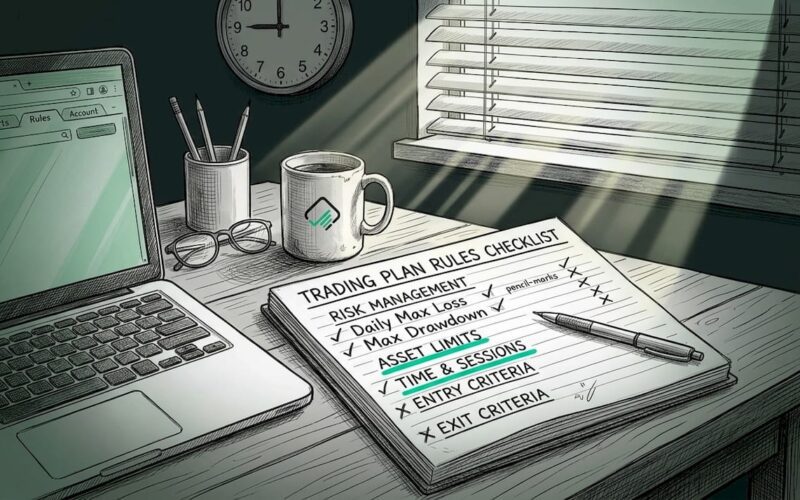
Each of these skills addresses a specific failure point that shows up repeatedly in funded trader behavior. Following a solid prop firm trading checklist gives you a practical starting framework, but building the underlying habits is what produces lasting results. For deeper application, reviewing trading strategies for funded accounts provides context for how these skills connect to live performance, and the funded trader workflow outlines how to organize these skills into a repeatable daily structure.
Psychological discipline: The true edge in funded trading
Among all skills, psychological discipline stands out as the most decisive factor. Here’s how to build and safeguard it step-by-step.
Most traders underestimate how differently they behave once real capital and firm rules are on the line. The pressure of a live funded account creates conditions where even experienced traders revert to destructive habits. Psychological discipline prevents common failures like revenge trading, overtrading, and scaling too quickly. Practical rules like the 2-strike stop and setting personal loss buffers below firm limits are what keep those habits in check.
The 2-strike stop rule works as follows: if you take two losing trades in a session, you stop trading for the day regardless of how much room remains under the firm’s daily limit. This simple rule interrupts the behavioral loop that leads to revenge trading. The personal loss buffer adds another layer. If the firm’s daily loss limit is 5%, you set your personal limit at 3.5%. That gap is your psychological safety zone.
Early underperformance in the first two to three days of a new funded account is actually a recommended approach. Trading at 50% of your normal position size during those early sessions lets you acclimate to the account without putting rules at risk before you find your rhythm.
“Treat early leads as a reason to conserve, not accelerate. A profitable start is capital to protect, not permission to increase risk.” This mindset directly counters the overconfidence effect that causes many funded traders to breach drawdown limits right after their best sessions.
Here is a step-by-step approach to building psychological discipline:
- Define your personal daily loss limit before each session, set at 70% or less of the firm’s stated limit
- Apply the 2-strike rule: two losing trades triggers a mandatory session end
- Trade at 50% position size for the first two to three days of any new funded account
- Journal after every session, focusing on emotional state and rule adherence, not just trade outcomes
- Review journal entries weekly to identify behavioral patterns before they compound
Pro Tip: Use a pre-session checklist that takes less than five minutes. Confirm your position size limit, daily loss cap, and mental state before placing a single trade. This routine activates deliberate decision-making rather than reactive behavior.
Avoiding the patterns documented in prop trading mistakes and common mistakes in prop trading is easier when discipline is already structured into your routine, not bolted on after a breach. For further context on prop firm risk management, external benchmarks reinforce why rule-based approaches outperform instinct-driven trading in funded environments.
Performance metrics: How to validate your trading edge
Once psychological discipline is in place, you need to quantify your edge. Let’s decode essential performance metrics.
Many traders believe they have an edge because they feel profitable over time. But feelings are not data. Validated edge requires objective metrics that hold up across a meaningful sample size of trades. Without these numbers, you cannot determine whether a losing streak is normal variance or evidence that your strategy has broken down.
Key performance metrics for funded traders include Profit Factor above 1.3, positive expectancy, Sharpe and Sortino ratios, and the Return/Drawdown ratio. Each metric provides a different lens on your trading performance.
| Metric | Benchmark | What it measures |
|---|---|---|
| Profit Factor | Above 1.3 | Gross profit divided by gross loss |
| Risk/Reward Ratio | Above 1:2 | Average win size vs. average loss size |
| Expectancy | Positive | Average profit per trade across full sample |
| Sharpe Ratio | Above 1.0 | Return per unit of risk |
| Sortino Ratio | Above 1.5 | Downside risk adjusted return |
| Return/Drawdown | Above 2:1 | Total return relative to maximum drawdown |
Profit Factor is the most practical starting point. A value above 1.3 means your gross profits are at least 30% higher than your gross losses. This provides a baseline indication that your strategy produces more than it costs, even when individual trades vary. Below 1.0 means the strategy is net losing. Between 1.0 and 1.3, the edge is thin and may not survive real-world conditions like slippage and spreads.
Expectancy tells you the average dollar value you can expect per trade over a large sample. A positive expectancy of $10 per trade means that across 100 trades, you should net approximately $1,000 before variable costs. This metric requires accurate data, which is why manually tracking your trade count matters more than relying on platform statistics that may include demo or incomplete records.
One frequently overlooked insight: a low win rate does not disqualify a strategy. Empirical data shows that win rates can remain below 50% as long as the risk/reward ratio exceeds 1:2 or 1:3 and the Profit Factor stays above 1.3. This is why validating your edge through numbers removes the psychological distortion that causes traders to abandon solid strategies during normal drawdown periods.
The prop firm challenge risk blueprint connects these metrics directly to challenge evaluation criteria, and prop firm account management resources expand on how to apply these benchmarks during live funded trading.
Risk management mastery: Protecting your account and progress
With edge validation complete, risk management is the linchpin ensuring you stay funded. Here’s how to optimize it for prop firm realities.
Risk management in a funded account operates differently than in personal retail trading. In retail trading, a bad day affects only your own capital. In a funded account, a bad day can violate firm rules and trigger an account termination that ends your access to the capital entirely. The stakes of each decision are categorically different.

Here is a practical comparison of risk approaches across different stages:
| Stage | Position size | Daily loss limit | Notes |
|---|---|---|---|
| Evaluation phase | 100% planned size | Firm’s stated limit | Optimize for rule compliance |
| First 2-3 days funded | 50% planned size | Personal buffer (70% of firm limit) | Acclimate to live funded pressure |
| Stable funded phase | 75-100% planned size | Personal buffer maintained | Scale up only after consistent sessions |
| Drawdown recovery | 50% or less | Tighten personal buffer further | Reduce size until equity stabilizes |
Psychological discipline prevents the most common risk management failure: scaling up too fast after early success. Traders who generate strong early returns often increase position size rapidly, compressing their safety margin precisely when they are most vulnerable to overconfidence-driven mistakes. Staying at a reduced position size for the first few funded sessions counters this pattern directly.
Buffer setups are not just a safety net. They are a performance tool. When your personal daily loss limit sits 1.5% below the firm’s stated limit, you have room to recover a bad session without breaching a rule. That space reduces the anxiety of each trade, which itself improves decision quality.
Pro Tip: Set a hard stop on your trading platform at your personal buffer limit, not the firm’s limit. Automating the buffer removes the temptation to override it manually during high-emotion moments.
For a structured approach to growing your account responsibly over time, scaling a funded trading account provides a practical roadmap. Understanding prop firm rules for risk management in detail ensures you never mistake a firm’s stated maximum for your actual operating limit.
Process journaling: Turning daily actions into sustainable results
Finally, to tie all skills together and drive consistent improvement, process journaling is your accountability system.
Most traders who journal focus exclusively on their profit and loss. That approach misses the point. P&L is an outcome. What produces that outcome is your process: the decisions you made, the rules you followed or broke, and the emotional state you were in when you made those choices. Journaling the process gives you the data to improve the outcome.
Expert guidance consistently emphasizes tracking emotions and process adherence over pure P&L. This distinction is critical because two traders can have identical P&L on a given day while one followed their rules precisely and the other got lucky breaking them. Only the first trader is building a sustainable system.
“Journal the process, not just the result. A profitable day built on poor process is a liability. A losing day built on strong process is data.”
Effective journal prompts to use after every session include:
- Did I follow my pre-session checklist before placing any trades?
- Did I trigger the 2-strike rule today, and if so, did I stop trading?
- What was my emotional state when I entered each trade?
- Did I adjust my position size for any reason outside my stated plan?
- Did I exit any trades early due to impatience or fear, rather than based on my rules?
Behavioral tilt, which is the gradual erosion of discipline over multiple sessions, is extremely difficult to detect in real time. It shows up clearly in journal data over a one to two week review. Catching a pattern of early exits or increasing position sizes before a formal breach occurs is how journaling prevents account termination rather than merely documenting it.
Linking your journal practice to a broader funded trader workflow creates the accountability structure that sustains funded status over months rather than weeks.
Why psychology—and not strategy—decides funded trader survival
Stepping back, let’s look at what really separates the few who thrive from the many who fail.
The conventional view is that trading success is primarily a strategy problem. Find the right setup, refine your entry and exit rules, and results will follow. This is broadly wrong for funded trading specifically, and the data supports it.
Research on funded account retention shows that 40-50% of funded accounts are lost within the first 90 days. The cause is not strategy failure. It is the psychological transition from evaluation to permanent funded rules. During evaluation, a reset is possible. During a live funded account, a breach ends the relationship. That shift in consequence changes how traders behave, often without them realizing it.
The traders who survive this transition share a common trait: they treat process compliance as the primary measure of daily success, not profit. They know their edge works statistically. They accept that individual days will be negative. What they protect is the system. The prop firm challenge failure rate data reinforces this point. The majority of failures trace back to loss of discipline at critical junctures, not to strategies that stopped working.
The practical implication is clear. Before your next challenge or funded account attempt, invest more preparation time in your psychological rules and journaling system than in strategy refinement. Most traders already have a viable edge. What they lack is the behavioral infrastructure to express it consistently under pressure.
Take your funded trading skills to the next level
Developing the skills covered in this article is a process that benefits significantly from the right resources and tools. Understanding which prop firms align with your trading style and risk tolerance is as important as the skills themselves.
At Responsible Trading, we provide independent, data-backed evaluations of prop firms scored across six objective criteria: trustworthiness, payout reliability, rule fairness, customer support, value, and overall merit. Whether you are selecting a platform or refining your approach, our best forex trading platform for prop firms reviews give you verified comparisons based on real-world testing. Use the funded trader workflow guide to structure your daily practice, and explore our tools to choose the right prop firm that fits your specific risk parameters and performance goals.
Frequently asked questions
What performance metrics matter most for funded traders?
Profit Factor above 1.3, positive expectancy, and a risk/reward ratio above 1:2 are the most critical metrics for maintaining a funded account and validating a sustainable trading edge.
How do psychological routines help prop traders?
Structured routines like daily journaling and the 2-strike stop rule prevent emotional trading failures such as revenge trading and overtrading, which are the leading behavioral causes of funded account breaches.
Is a high win rate required to pass prop firm challenges?
No. Empirical benchmarks confirm that win rates can stay below 50% as long as the risk/reward ratio exceeds 1:2 and the Profit Factor remains above 1.3, making edge quality more important than raw win frequency.
Why do most funded traders fail in the first 90 days?
Research shows that 40-50% of funded accounts are lost within 90 days primarily due to psychological routine lapses during the transition from restartable evaluation accounts to permanent funded rules where a single breach ends access.
Recommended
- Master the funded trader workflow: step-by-step success guide (2026) | Responsible Trading
- 7 Reasons 90% of Traders Fail Prop Firm Challenges (And How to Fix Each One) (2026) | Responsible Trading
- Funded Account Trading Strategies That Actually Work in 2026 (2026) | Responsible Trading
- How to Scale a Funded Trading Account in 2026: A Practical Roadmap (2026) | Responsible Trading