


Talented retail traders lose prop trading challenges every week, not because they can’t trade, but because they misread what the evaluation actually measures. A prop trading challenge is far more than a profit race. It is a structured, rules-based assessment designed to identify traders who can manage risk consistently under real market conditions. This guide covers exactly what these challenges are, how the scoring criteria work, which formats are available, and what you should do whether you pass or fail. If you want external capital without putting your own savings at risk, understanding this process is the most important step you can take.
Table of Contents
- What is a prop trading challenge?
- How prop firms assess traders: Key criteria explained
- Types of prop trading challenges: One-step, two-step, and instant funding
- What happens if you pass or fail a prop trading challenge?
- Why most traders misunderstand prop trading challenges
- Ready to take a prop trading challenge? Start smart with these resources
- Frequently asked questions
Key Takeaways
| Point | Details |
|---|---|
| Challenges evaluate more than profits | Passing a prop trading challenge requires following rules and risk controls, not just earning profits. |
| Know each challenge’s criteria | Different prop firms use unique assessment criteria, so review rules and structure in detail before joining. |
| Choose the right format | One-step, two-step, and instant funding challenges offer different paths that suit various trader profiles. |
| Learn from setbacks | Failing a challenge is common and valuable for building skills to succeed on future attempts. |
| Preparation boosts chances | Careful study, planning, and using expert resources dramatically increase your odds of getting funded. |
What is a prop trading challenge?
A prop trading challenge is an assessment program run by a proprietary trading firm (commonly called a prop firm) to evaluate whether a trader deserves access to the firm’s capital. Prop trading challenges are offered by proprietary trading firms as a way to identify skilled traders for funding. Rather than hiring traders as employees, these firms outsource risk identification to the market itself: if you can pass their rules-based test, you earn the right to trade their money.
The appeal for retail traders is obvious. Most individual traders lack the capital to generate meaningful returns from their own accounts. A prop challenge gives you access to accounts ranging from $10,000 to $200,000 or more, funded entirely by the firm, in exchange for a share of profits. To understand what prop firms are at a foundational level, think of them as performance-based investors: they back traders who prove their process.
The structure of most challenges follows a standardized format:
- A defined profit target, typically between 8% and 10% of the account
- A maximum drawdown limit, which is the maximum loss allowed from the account peak
- A daily loss limit to prevent single-session blow-ups
- A minimum number of trading days to prevent lucky streaks from distorting results
- A consistency requirement, ensuring no single trade generates a disproportionate share of total profit
Most retail traders fail not because they lack skill, but because they underestimate how strictly the rules are enforced. A single rule violation, even while the account is profitable, results in immediate disqualification.
You can compare reputable prop firms side by side to understand the range of structures and requirements before you commit to a specific challenge.
How prop firms assess traders: Key criteria explained
Prop firms commonly assess traders using criteria such as maximum drawdown, profit targets, consistency, and rule adherence. These are not arbitrary checkboxes. Each criterion maps to a real-world trading behavior that firms care about when putting their capital on the line.
Here is a typical comparison of criteria across standard prop firm challenges:
| Criterion | Typical requirement | Why it matters |
|---|---|---|
| Profit target | 8 to 10% | Confirms upside potential |
| Max drawdown | 8 to 10% | Limits firm’s exposure |
| Daily loss limit | 4 to 5% | Prevents impulsive recovery trading |
| Min trading days | 4 to 10 | Filters lucky outliers |
| Consistency rule | No single day over 30% of profit | Measures repeatable process |
Understanding these criteria helps you prioritize correctly. The step-by-step workflow from challenge registration to funded status looks like this:
- Sign up and pay the challenge fee. Most fees are refundable upon first payout.
- Trade the evaluation account within the stated profit and loss boundaries for the required number of days.
- Submit your results to the firm for review. Most platforms do this automatically.
- Receive approval or rejection. Some firms provide a brief review period; others process instantly.
- Sign the trader agreement outlining profit split, payout schedule, and withdrawal rules.
- Begin trading live capital under the same or similar risk rules used in the challenge.
Risk management is as important as profitability for most prop firm challenges. In practice, this means that a trader who earns 9% profit but breaches the daily loss limit even once has failed. The firm is not buying a profit record; it is buying evidence of controlled, repeatable behavior.
You can use the prop trading rules checklist to audit your current habits before you start, identifying any patterns that could trigger a rule violation mid-challenge.

Pro Tip: Track your challenge metrics daily in a spreadsheet alongside your trading journal. Many traders are surprised to discover their average daily drawdown is closer to the limit than they realized when they review historical data before the challenge.
Avoiding common prop trading mistakes often comes down to preparation and rule awareness rather than advanced strategy. Traders who study the rules in detail before placing their first trade consistently perform better than those who focus solely on market analysis.
Types of prop trading challenges: One-step, two-step, and instant funding
The prop firm industry offers three primary challenge structures. Each one serves different trader profiles, and choosing the wrong format for your style can cost you money and time.
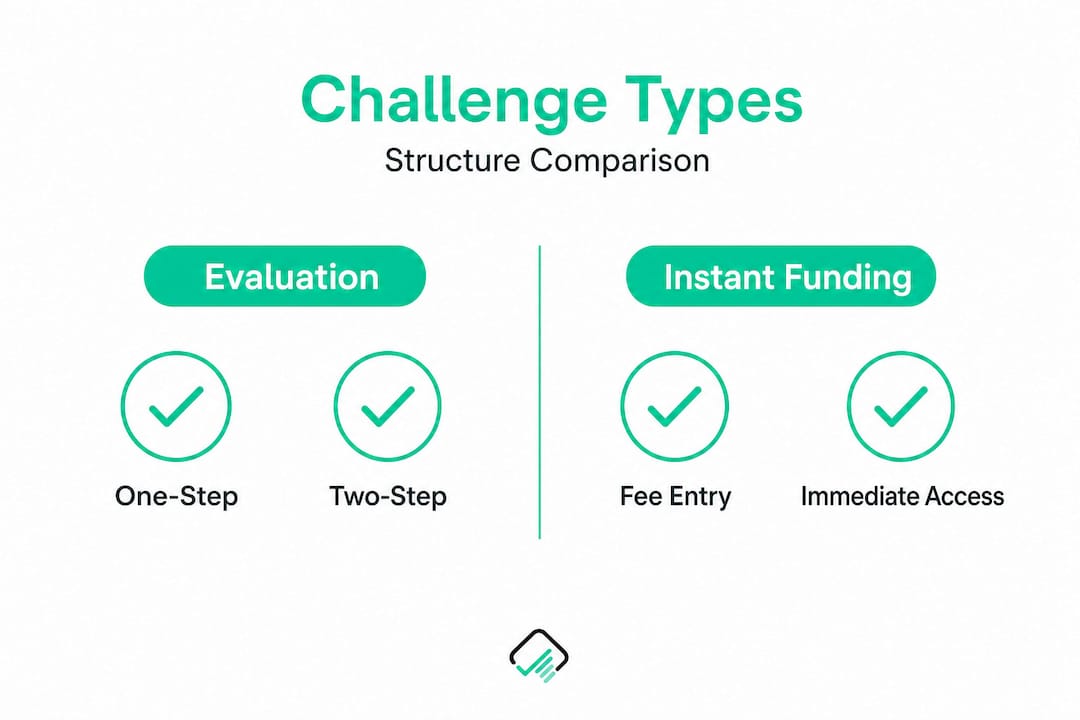
One-step challenges require traders to hit a profit target within a single evaluation phase. These programs are often marketed as simpler or faster, but they frequently carry stricter drawdown rules to compensate for the reduced evaluation period. A trader must demonstrate full risk discipline in one continuous window rather than across two stages.
Two-step challenges split the evaluation into two sequential phases. Phase one usually carries a higher profit target, such as 8%, while phase two reduces the target to around 5% to confirm consistent execution. This format is the most widely available and is often considered the industry standard. It rewards traders who can repeat their process under slightly different conditions.
Instant funding accounts allow traders to access capital immediately upon paying a fee. Instant funding accounts allow for a fast-track to trading firm capital, while standard challenges typically require passing rigorous assessments. The trade-off is a higher upfront cost and a lower initial profit split, which scales upward as the trader proves performance.
Here is a data summary of how these formats compare:
| Challenge type | Typical cost | Profit target | Funding probability | Best for |
|---|---|---|---|---|
| One-step | $100 to $250 | 8 to 10% | Moderate | Experienced traders |
| Two-step | $50 to $200 | 8% then 5% | Moderate to high | Most retail traders |
| Instant funding | $200 to $500 | None | High (immediate) | Traders avoiding evaluation |
Which format suits you depends on several personal factors:
- One-step challenges suit traders with a proven track record who want to reduce time spent in evaluation phases.
- Two-step challenges benefit traders who are still refining consistency, as the lower Phase 2 target provides more room to confirm their edge.
- Instant funding accounts work for traders who have already passed challenges elsewhere and want to avoid repeating the evaluation process.
- Lower-cost challenges are worth exploring if you are entering the prop firm space for the first time. You can find prop challenges under $100 that provide a real evaluation environment at minimal financial risk.
Before trading any funded account, reviewing the funded trader workflow helps you understand what operational expectations exist beyond just hitting profit targets.
What happens if you pass or fail a prop trading challenge?
The outcome of a prop trading challenge, whether positive or negative, carries clear next steps. Most traders focus almost entirely on passing, but knowing the post-challenge process on both sides prepares you better for either outcome.
If you pass:
- The firm notifies you via email or platform dashboard, typically within 24 to 72 hours of completing the evaluation.
- You receive a trader agreement to review and sign. Read this carefully, paying attention to profit share percentages, payout schedules, and scaling conditions.
- Your live trading account is activated. You trade real capital under the same or similar risk rules used during the challenge.
- You request your first payout after meeting the minimum threshold, which is often $100 or the equivalent in your currency.
- Over time, consistent performance may qualify you for account scaling, increasing the capital you manage and your total payout potential.
If you fail:
- Review your trade log immediately to identify the specific rule that was broken. Was it the daily loss limit, the maximum drawdown, or a consistency violation?
- Categorize the failure: was it a process breakdown (a rule you know but ignored) or a knowledge gap (a rule you misunderstood)?
- Refine your risk parameters and backtested strategy before reapplying.
- Consider retaking the same challenge level or dropping to a smaller account to rebuild confidence in a lower-pressure environment.
Many traders fail their first prop firm challenge, but understanding the process improves success rates on subsequent attempts. This is consistent with what experienced traders report: the first challenge teaches you more about your own behavior under pressure than almost any other form of practice.
Understanding how to pass prop firm challenges with a structured approach makes a measurable difference. Traders who enter with a written plan, defined entry rules, and pre-set daily stop losses outperform those trading reactively.
Pro Tip: After any failed challenge, write a one-page failure report before you buy another challenge. Identify the specific rule that caused the breach, the trade that triggered it, and one concrete change to your process. Buying another challenge without this step typically produces the same result.
Why most traders misunderstand prop trading challenges
The conventional advice around prop firm challenges tends to focus on strategy: which trading system to use, which markets to trade, and what technical indicators to apply. This advice, while not useless, misses the more significant issue.
Prop trading challenges are behavioral evaluations. The profit target exists not because the firm needs 8% from you in three weeks, but because reaching it while staying within all risk limits simultaneously demonstrates self-regulation. A trader who hits 15% profit but breaches the drawdown rule twice is not a better candidate than one who earns 9% cleanly. The firms know this.
The “challenge mindset” is a consistent pattern we observe: traders treating the evaluation as a one-time performance rather than a preview of how they would manage firm capital long-term. This framing leads to overtrading near the end of a challenge period, revenge trading after a losing day, and over-sizing positions to hit the profit target faster. Each of these behaviors is exactly what prop firms are designed to screen out.
The harder truth is that success in these challenges is less about trading genius and more about process and psychological resilience. The traders who consistently pass are not necessarily the most technically skilled. They are the ones who treat every trading day inside the challenge the same way they treat every trading day outside of it. Consistency of process is the product being evaluated.
Avoiding prop trading pitfalls starts with reframing what the challenge actually is. It is not a contest. It is an audition for a long-term role as a funded trader. That shift in perspective changes how you prepare, how you trade each session, and how you respond when a losing day threatens your progress.
Ready to take a prop trading challenge? Start smart with these resources
Knowing the theory behind prop trading challenges is valuable. Acting on it with the right tools makes the difference between passing and failing.
At Responsible Trading, we publish independently reviewed resources for every stage of the challenge process. Whether you are picking your first firm, building your risk framework, or retaking a challenge after a previous attempt, our guides are grounded in real testing data and trader-submitted outcomes. Start with a detailed risk management blueprint built specifically for prop firm assessments, or review our curated breakdown of 7 challenge rules that experienced traders consistently follow. You can also compare execution environments with our guide to best forex trading platforms to ensure your setup supports clean, rule-compliant trading.
Frequently asked questions
How hard is it to pass a prop trading challenge as a retail trader?
Many traders fail their first prop challenge due to strict rules and risk controls, but structured preparation and a thorough understanding of the assessment criteria significantly improve success rates on repeat attempts.
What is the typical cost of joining a prop trading challenge?
Costs vary widely across the industry, and prop firm challenges under $100 are available for traders starting out, while premium or larger account challenges can run considerably higher depending on the funding level offered.
What happens if you break a prop firm’s challenge rule?
Breaking any trading rule during a challenge, even while the account is profitable, typically results in immediate disqualification. Risk management is equally important as hitting profit targets in virtually every prop firm program.
Do instant funding accounts still require a challenge?
No, instant funding accounts allow traders to access firm capital without completing a time-based evaluation, though the trade-off is typically a higher fee and potentially stricter ongoing performance rules.
Recommended
- What is a Prop Firm? The Complete Beginner’s Guide for 2026 (2026) | Responsible Trading
- How to Pass a Prop Firm Challenge in 2026: A Risk Management Blueprint (2026) | Responsible Trading
- Best Prop Firm Challenges Under $100 in 2026: Get Funded Without Breaking the Bank (2026) | Responsible Trading
- Prop trading terminology: 9 key concepts for funded success (2026) | Responsible Trading