

Many talented traders spend months refining their strategies, only to fail a prop firm challenge within the first week. The reason is rarely poor trading skill. It is almost always a gap in understanding the funded trader process workflow. Knowing your entry signals is one thing. Knowing how to navigate application rules, daily drawdown limits, verification steps, and scaling policies is another. This guide walks you through the entire workflow from start to finish, covering each stage in practical detail, the most costly mistakes traders make, and how to build the kind of disciplined process that funded accounts reward consistently.
Table of Contents
- Understanding the funded trader process workflow
- Step-by-step: Navigating the prop firm challenge
- Tools and resources for funded trader success
- Verification, payouts, and scaling: What comes after passing
- Troubleshooting and optimizing your funded trader workflow
- Our take: The real difference-makers in the funded trader process
- Take your funded trading to the next level
- Frequently asked questions
Key Takeaways
| Point | Details |
|---|---|
| Workflow understanding is critical | Knowing the entire funded trader process boosts your odds of passing and scaling. |
| Preparation beats prediction | Discipline and detailed prep matter more than forecasting market moves. |
| Leverage the right tools | Using journals, analytics, and risk management technology sets you apart. |
| Continuous improvement required | Long-term funded success comes from consistently optimizing your trading workflow. |
Understanding the funded trader process workflow
The funded trader process is a structured path that takes a trader from initial application to managing real capital on behalf of a prop firm. At its core, the workflow exists so firms can assess whether a trader can generate consistent returns while managing risk responsibly. Understanding each stage before you begin is what separates prepared traders from those who are surprised by rules they never read.
The major stages in most programs follow this sequence:
- Application: You select a challenge size, pay the fee, and agree to the firm’s terms.
- Evaluation challenge: You trade a simulated account to hit a profit target without breaching drawdown or other rules.
- Verification (Phase 2): Some firms add a second, lower-target phase to confirm consistency.
- Live funded account: You trade a real or simulated account with the firm’s capital and receive a profit share.
- Scaling: If you perform consistently, many firms increase your account size over time.
Different prop firms use variations of this workflow, so reading each firm’s rulebook carefully is non-negotiable. Some offer instant funding with no evaluation phase, while others require two or three phases before granting access to capital. Instant funding programs carry higher fees or lower profit splits in exchange for skipping the challenge. Evaluation programs are more common and generally offer better long-term terms.
Here is a quick comparison of the two main program types:
| Feature | Evaluation program | Instant funding |
|---|---|---|
| Challenge required | Yes (1 to 2 phases) | No |
| Upfront cost | Lower | Higher |
| Profit split | 80% to 90% | 60% to 80% |
| Time to funded | 2 to 6 weeks | Immediate |
| Rule complexity | Higher | Moderate |
Before choosing a firm, reviewing a detailed prop firm comparison helps you match the right program structure to your trading style. Some traders perform better under the pressure of a defined target window, while others need the flexibility of open-ended programs. Knowing which type fits your psychology is just as important as understanding the rules themselves. Firms that use automated trading tools in their evaluation infrastructure are also worth noting, as they can flag unusual trading patterns quickly.
Step-by-step: Navigating the prop firm challenge
With the key stages in mind, let’s break down exactly what you need to do at each step of the challenge process. Over 90% of traders fail prop firm challenges, mostly due to workflow errors rather than strategy failures. That statistic alone should shift how you approach preparation.
Here is a numbered breakdown of the challenge process:
- Sign up and read the rules in full. Print or save the rulebook. Highlight the daily drawdown limit, maximum drawdown, profit target, and minimum trading days.
- Backtest your strategy on the challenge account size. Use strategy backtesting tools to confirm your approach fits within the firm’s risk parameters.
- Set your daily risk limit before you open any trades. Most experienced traders cap daily risk at 0.5% to 1% of account size, well below the firm’s limit.
- Establish a daily routine. Log in at the same time, review your watchlist, check economic calendar events, and only trade during your proven high-probability windows.
- Document every trade immediately after closing it. Record entry, exit, reason, outcome, and emotional state.
- Review your journal at the end of each session. Identify patterns in your losses and wins before the next trading day.
Pro Tip: Use a structured trade journal template with fields for setup type, risk-to-reward ratio, and rule compliance. Reviewing this data weekly reveals patterns that are invisible in the moment.
Warning: Over-leverage is the single fastest way to fail a challenge. A single oversized position during a volatile news event can wipe out several days of gains in minutes. Treat position sizing as a rule, not a suggestion.
Finding affordable prop firm challenges also matters, because lower fees allow you to attempt multiple challenges without significant financial pressure, which itself reduces the emotional trading errors that cause most failures.
Tools and resources for funded trader success
To increase your odds of success, you need the right set of tools and know-how to use them. The use of automated risk management and analysis tools is growing among funded traders, and for good reason. These tools remove human error from the most critical parts of the workflow.

Here is an overview of the key tool categories:
| Tool type | Purpose | Examples |
|---|---|---|
| Trade journal | Track performance and rule compliance | Edgewonk, TraderSync |
| Risk calculator | Size positions correctly | MyFXBook, custom spreadsheets |
| Market simulator | Practice setups before live challenge | TradingView paper trading |
| Dashboard tracker | Monitor drawdown and profit in real time | MetaTrader stats panel |
| News calendar | Avoid high-impact event risk | Forex Factory, Investing.com |
Must-have study resources for traders preparing for a challenge include:
- Firm-specific rule guides: Many firms publish detailed FAQs. Read them twice.
- Trading psychology resources: Books like Trading in the Zone address the discipline gaps that cause most failures.
- Community forums: Discord servers and Reddit communities for specific firms often share real-time rule clarifications.
- Funded account trading strategies: Reviewing what works specifically within prop firm constraints saves significant trial and error.
Pro Tip: Automate as much risk management as possible. Set hard stop-loss orders on every trade and use your platform’s daily loss limit feature if available. Removing manual decisions under pressure is one of the highest-leverage improvements you can make.
For traders looking to grow beyond the initial account, understanding scaling your funded account from the beginning helps you build toward larger capital allocations from day one. Also, reviewing risk management fundamentals gives you a broader framework for managing volatility across different market conditions.
Verification, payouts, and scaling: What comes after passing
After passing the challenge, many traders wonder what really comes next. Let’s break down what you should expect and how to maximize your growth.
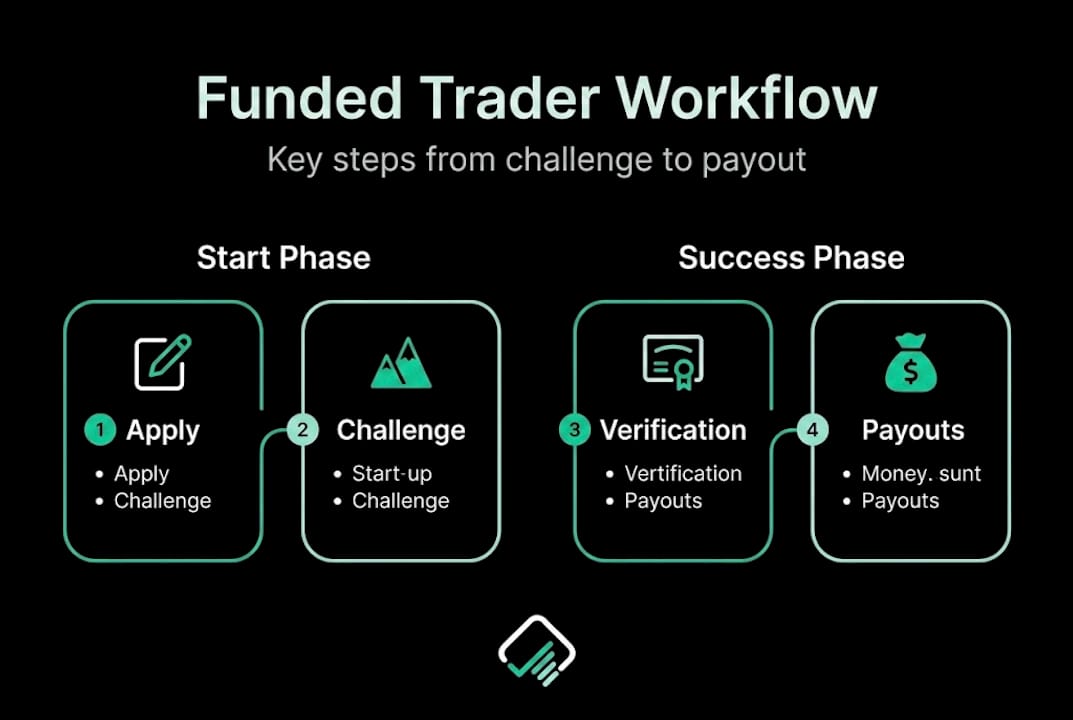
The verification stage typically involves submitting identity documents, proof of address, and sometimes a tax identification number. This Know Your Customer (KYC) process is standard and usually takes one to five business days. Some firms also require you to sign a trader agreement before activating your live account.
Payouts vary significantly between firms. Most operate on a bi-weekly or monthly schedule, and many now offer on-demand withdrawals after a minimum profit threshold is met. Profit splits typically range from 75% to 90% in the trader’s favor, though this can increase under scaling programs.
Key requirements to maintain funding include:
- Stay within daily and maximum drawdown limits at all times.
- Meet minimum trading day requirements each month.
- Avoid prohibited strategies such as high-frequency scalping, news trading (where banned), or copy trading from external signals.
- Request payouts within the firm’s specified window to avoid forfeiting profits.
Here is a simplified comparison of scaling structures across program types:
| Scaling trigger | Account increase | Typical timeline |
|---|---|---|
| 10% profit over 3 months | 25% account increase | Quarterly |
| Consistent monthly profit | Up to 2x account size | 6 to 12 months |
| Profit split upgrade | Increases to 90% | After first payout |
Scaling strategies can maximize profitability once the initial challenge is passed, but only if you maintain the same disciplined process that got you funded. Reviewing effective funded account strategies alongside your firm’s scaling policy helps you plan your growth path realistically. For additional context on performance tools that support this phase, top trading tools reviews offer useful comparisons.
Troubleshooting and optimizing your funded trader workflow
Even after you’ve received funding, ongoing improvements are essential for maintaining your edge. Continuous refinement is a key differentiator for long-term funded trading success. Most traders who lose funded accounts do so not because the market changed, but because their process degraded.
Here is a numbered workflow optimization checklist:
- Audit your trade journal weekly. Look for patterns in losing trades, such as time of day, asset class, or emotional triggers.
- Review your drawdown usage monthly. If you are consistently reaching 70% or more of your daily limit, your position sizing needs adjustment.
- Reassess your strategy quarterly. Market conditions shift. A strategy that worked in Q1 may need modification by Q3.
- Check firm rule updates regularly. Prop firms occasionally update their terms. Missing a rule change can cost you your account.
- Simulate new setups before trading them live. Never test an untested approach on a funded account.
Pro Tip: Review journaled trades weekly rather than just after losses. Wins can hide bad process. A trade that hit target but used poor entry logic is a future loss waiting to happen.
Common workflow breakdowns include drifting away from defined setups during slow markets, increasing position size after a winning streak, and skipping journal entries during busy sessions. Each of these seems minor in isolation but compounds quickly. Staying connected to proven trading strategies and periodically reviewing automated investing tools can help you stay systematic rather than reactive.
Our take: The real difference-makers in the funded trader process
Conventional wisdom in the prop trading space focuses heavily on strategy. Find the right setup, master the right indicator, and the funded account will follow. Our experience reviewing dozens of firms and tracking trader outcomes tells a different story.
Trading is roughly 80% process and 20% prediction. The traders who pass challenges consistently are not necessarily the most technically gifted. They are the most disciplined reviewers of their own mistakes. They treat the challenge like a business operation, not a performance. They know why most traders fail and build their workflow specifically to avoid those failure points.
One underappreciated factor is firm-specific rule literacy. Knowing a firm’s exact drawdown calculation method (trailing versus static) can be the difference between passing and failing on a single trade. This kind of knowledge is not glamorous, but it is decisive. The traders who treat rule mastery as equal in importance to market knowledge are the ones who stay funded.
Take your funded trading to the next level
The workflow insights covered here give you a clear roadmap for approaching prop firm challenges with greater precision and confidence. But knowing the process is only the starting point.
ResponsibleTrading.com provides in-depth, independently tested reviews of the top prop firms, side-by-side comparisons, and strategy guides built specifically for traders at every stage of the funded journey. Whether you are still choosing the right prop firm, looking for the best forex trading platforms to support your challenge, or ready to sharpen your approach to passing prop firm challenges, the platform has the data-backed resources to guide your next move.
Frequently asked questions
What is the typical funded trader process workflow?
It generally includes application, completing a trading challenge, verification, then live account management with the prop firm. Workflow stages are standard across most major firms, though specific rules and phase counts vary.
How do traders document their progress during the challenge stage?
Traders typically use detailed trade journals and analytics tools to record performance and track rule compliance. Journaling is critical for identifying behavioral patterns that affect challenge outcomes.
What happens if a funded trader breaks a firm’s rules?
Breaking rules usually leads to losing the funded account and any future payouts. Staying within the rulebook is mandatory for maintaining access to firm capital.
Do all prop firms offer instant funding?
No, some offer instant funding while others require completing a multi-phase evaluation process. Differences between instant and evaluation programs affect cost, profit split, and time to funding significantly.
Recommended
- How to Scale a Funded Trading Account in 2026: A Practical Roadmap (2026) | Responsible Trading
- Funded Account Trading Strategies That Actually Work in 2026 (2026) | Responsible Trading
- How to Choose the Right Prop Firm for Your Trading Strategy (Step-by-Step Guide) (2026) | Responsible Trading
- 7 Reasons 90% of Traders Fail Prop Firm Challenges (And How to Fix Each One) (2026) | Responsible Trading
- How to build trading skills: a step-by-step guide
- Step by Step Trading Workflow for Automated Crypto Success