

Most retail traders who attempt prop firm challenges fail within the first two weeks, and the leading cause is not poor strategy selection or bad market timing. It is uncontrolled risk that blows the daily loss limit. Understanding what is risk management in prop trading means more than knowing the rules exist. It means knowing exactly how daily loss limits and maximum drawdown thresholds are enforced, how they are calculated in real time, and how to build trading habits that keep you on the right side of those limits consistently.
Table of Contents
- Understanding risk management rules in prop trading
- How prop trading risk limits are calculated and monitored
- Effective risk management strategies for passing prop firm challenges
- Comparing prop firm drawdown rules: daily vs maximum drawdown
- Why mastering risk management beats chasing high win rates in prop trading
- Explore resources to master prop trading risk management
- Frequently asked questions
Key Takeaways
| Point | Details |
|---|---|
| Strict loss limits | Prop firms enforce strict daily and maximum loss limits to protect capital and enforce trader discipline. |
| Equity-based drawdowns | Drawdowns are calculated on equity including open positions, requiring real-time risk monitoring. |
| Conservative position sizing | Risking under 1% per trade and limiting daily losses increases chances of passing evaluations. |
| Psychological discipline | Managing emotions through journaling and hard rules is vital to stick within risk limits. |
| Different drawdowns | Daily and maximum drawdown limits serve distinct purposes and need separate management tactics. |
Understanding risk management rules in prop trading
Risk management in prop trading refers to the structured set of rules, calculations, and personal disciplines that govern how much capital you are permitted to lose, and how you control your exposure to reach profit targets without violating those boundaries. Unlike retail trading where the only consequence of loss is your own account balance shrinking, prop trading introduces a second layer: the firm’s capital is at stake, and they enforce strict account rules to protect it.
Prop firms use two primary loss limits to enforce this protection:
-
Daily loss limit: This is the maximum amount your account equity can decline within a single trading day. Once you hit this threshold, you are locked out of trading for the day or the account is immediately closed, depending on the firm’s policy. Typical daily loss limits fall between 3% and 5% of the starting account balance or starting equity for that day.
-
Maximum drawdown limit: This caps the total losses you can sustain from your account’s peak equity across the full evaluation or funded period. Most prop firms set this between 8% and 12% of the initial account balance. Breaching the maximum drawdown results in permanent account termination.
-
Account termination policy: Violating either limit at most firms means immediate account closure with no appeal. Positions are closed at market price, which can deepen losses further. This is not a warning system. One breach ends the challenge.
Understanding why traders fail prop challenges often comes down to underestimating how quickly these limits can be reached, especially when emotional trading takes over after an early loss.
How prop trading risk limits are calculated and monitored
Knowing the limits is one thing. Knowing how those limits are actually measured is where many traders get caught off guard.
Most prop firms do not calculate your losses based on your account balance, the figure reflecting only closed trades. They calculate based on your account equity, which includes the unrealized profit or loss on any open positions at that moment. This is an important distinction. You can have a positive closed balance from earlier trades, open a new position that moves against you, and breach your daily loss limit entirely through a floating (unrealized) loss, even without closing that position.
Here is how this affects your real-time risk exposure:
- Floating losses count immediately. If your daily loss limit is 4% and your account is $100,000, you have a $4,000 daily loss budget. An open trade sitting at a $3,900 unrealized loss has nearly consumed your entire daily limit.
- You cannot “wait it out.” Some traders assume they can hold through a loss and recover. The firm’s risk system doesn’t wait. If equity crosses the threshold, the account terminates.
- Daily resets vary by firm. For example, FTMO calculates equity losses including open positions and resets the daily limit at 00:00 CET each day. Knowing your firm’s exact reset time is essential, especially if you trade across midnight.
- Position sizing must account for open drawdown. If you already have a trade running at a 1% unrealized loss and you open a second trade, both losses stack toward the same daily limit.
Understanding your prop trading challenge rules in detail before you start trading is the difference between a calculated approach and an accidental breach.
Pro Tip: Set up a simple equity tracker or use your platform’s account equity display as a live dashboard. Check it before every new trade entry, not after.
Effective risk management strategies for passing prop firm challenges
Once you understand how the limits work and how they are measured, you can build a trading approach that keeps you well inside those boundaries. The most effective risk management strategies for prop trading are not complex. They are disciplined.
Here are the core practices that successful prop traders consistently apply:
- Risk 0.25% to 1% per trade. On a $100,000 account, that means risking between $250 and $1,000 per trade. This range gives you room to take multiple losing trades in a day without touching your daily limit.
- Set a personal daily loss cap below the firm’s maximum. If the firm allows a 5% daily loss, set your own hard stop at 2% to 3%. This buffer protects you on high-volatility days when losses can accelerate faster than expected.
- Maintain a minimum 1:2 risk-to-reward ratio. This means targeting at least twice the profit of what you risk on each trade. At a 40% win rate, a 1:2 ratio still produces net profit over time. You do not need to be right most of the time.
- Limit yourself to 2 to 3 quality setups per day. Overtrading is one of the most common failure patterns. More trades means more exposure, more commissions, and more emotional decisions under pressure.
- Journal every trade including your emotional state. Reviewing past trades helps identify patterns where discipline broke down. Journaling emotions, not just entries and exits, builds self-awareness that rules alone cannot provide.
- Close all positions before major news events. Economic releases like Non-Farm Payrolls or central bank rate decisions can spike spreads and trigger stop-outs at prices far worse than expected. Flat is a valid position.
These habits support the importance of risk management in trading at a behavioral level. The numbers matter, but the behavior behind them matters more.
Pro Tip: Before the trading session starts, write down your maximum loss for the day in dollar terms. Make it a firm rule to close the platform and walk away if that number is hit. Having it in writing makes it harder to override.

Avoiding common prop trading mistakes often comes down to these exact practices, applied consistently rather than selectively.
Comparing prop firm drawdown rules: daily vs maximum drawdown
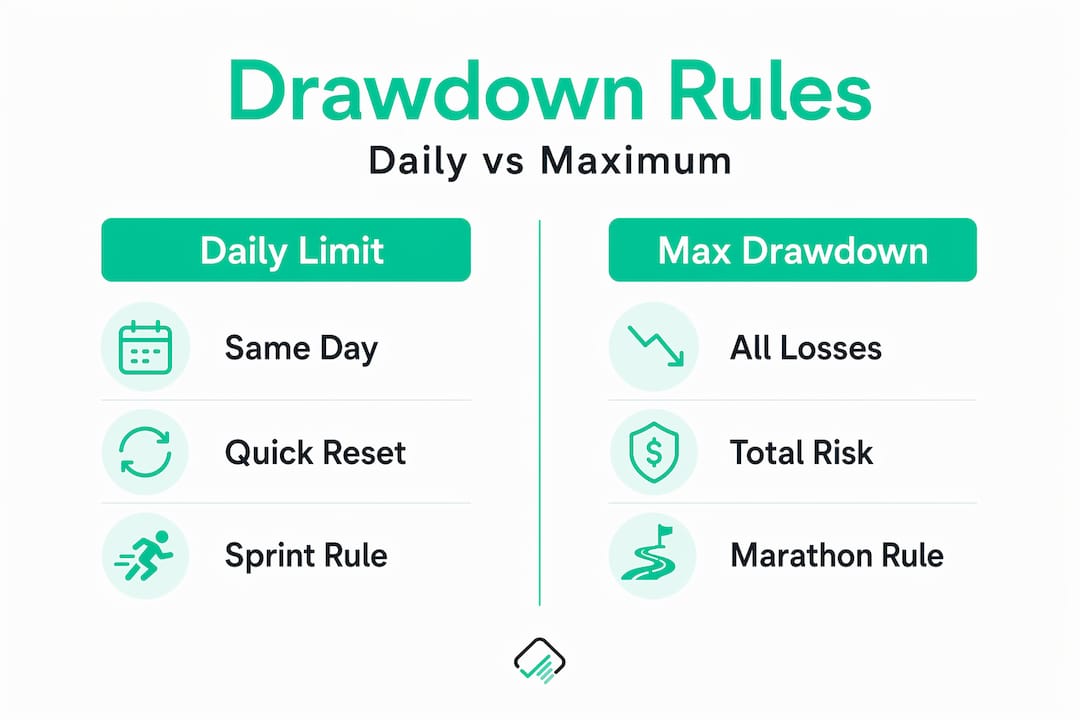
The daily loss limit and the maximum drawdown limit serve different protective functions. Traders who treat them as interchangeable often manage one well while inadvertently violating the other.
| Feature | Daily drawdown | Maximum drawdown |
|---|---|---|
| Scope | Losses within a single trading day | Total losses from peak equity across account lifetime |
| Reset frequency | Resets daily at a set time | Does not reset; accumulates continuously |
| Typical limit | 3% to 5% of account | 8% to 12% of account |
| Risk type | Rapid large single-day loss | Slow capital erosion over multiple days |
| Management tactic | Stop trading after personal daily limit hit | Scale down position size during losing streaks |
Daily drawdown limits reset daily, while maximum drawdown accumulates throughout the full challenge period. This means a trader who hits 2% daily loss four days in a row has consumed 8% of their maximum drawdown allowance, even though no single day felt catastrophic.
Practical tactics for managing both simultaneously:
- After consecutive losing days, reduce your per-trade risk immediately. If your maximum drawdown is at 5% and growing, this is not the time to trade larger to “make it back.”
- Track your maximum drawdown in parallel with your daily limit. Many traders only monitor the daily limit and miss how close they are to the overall threshold.
- Understand whether your firm uses a static or trailing maximum drawdown. A trailing drawdown moves with your equity peak, meaning gains raise the floor. A static drawdown stays anchored to the starting balance. The difference significantly affects how you use leverage and size positions.
Managing both limits requires separate awareness. The daily limit is a sprint rule. The maximum drawdown is a marathon rule.
Why mastering risk management beats chasing high win rates in prop trading
There is a widespread belief among newer traders that passing a prop challenge requires a high win rate. It does not. What it requires is not losing too much on the trades that go wrong.
Consider two traders with the same 50% win rate. Trader A risks 2% per trade with a 1:2 risk-reward ratio. Trader B risks 4% per trade chasing a 1:1 ratio. Trader A comfortably grows the account. Trader B can hit three losses in a row and lose 12%, which often exceeds the maximum drawdown limit before a single profit target is reached.
The more uncomfortable insight is this: most account violations are not caused by bad strategies. They happen because traders abandon their own rules under emotional pressure. Eight in ten breaches occur when a trader knowingly ignores the risk limits they already set, usually after a string of losses that triggers a desire to recover quickly.
This is why risk assessment in proprietary trading has as much to do with psychology as it does with position sizing. Discipline is not a personality trait you either have or lack. It is a system. You build it through hard stops, journaling, pre-defined exit rules, and taking breaks after loss days. The traders who pass challenges consistently are not those who predict markets best. They are those who never let one bad day end the evaluation.
Understanding the role of risk management in prop firms means accepting that the rules exist not to restrict you, but to force the behavior that makes trading sustainable.
Explore resources to master prop trading risk management
Responsible Trading provides detailed, independently tested resources built specifically for traders navigating prop firm challenges. Whether you are preparing for your first evaluation or looking to refine your approach after a failed attempt, the guides below offer practical, data-backed information for 2026 trading conditions.

Access a step-by-step risk management blueprint designed around real prop firm rules and common failure patterns. Review the analysis of why most traders fail challenges and identify where your own process may need adjustment. For platform selection, explore the best forex trading platforms evaluated for prop traders specifically, covering execution quality, risk tools, and compatibility with major prop firm environments.
Frequently asked questions
What is the difference between daily loss limit and maximum drawdown in prop trading?
The daily loss limit caps how much you can lose within a single trading day and resets every day, while maximum drawdown limits the total losses from your account’s highest equity point over time and accumulates without resetting.
Why do prop firms calculate drawdowns based on equity rather than balance?
Using equity, which includes open positions’ profit and loss, provides a real-time risk picture. Equity-based calculations help prop firms prevent breaches before losses are realized, whereas balance only reflects closed trades and could mask large floating losses.
How much should I risk per trade to succeed in prop trading?
Successful prop traders typically risk between 0.25% and 1% of their account per trade, which allows room for multiple losing trades without triggering daily or maximum drawdown limits.
What happens if I breach a prop firm’s daily loss limit?
Breaching the daily loss limit typically results in immediate account termination or evaluation failure without appeal, with open positions closed at market price, which can deepen losses further.
How can I maintain discipline to avoid violating prop trading risk rules?
Journaling trades and emotional states, using hard stop-loss orders, and setting personal loss caps below the firm’s maximum all help. Structured psychological habits like taking breaks after loss days specifically reduce the impulse to break risk rules under pressure.