


Most traders who fail prop firm evaluations don’t lack skill. They lack structure. Without a clear, repeatable process for managing risk, following rules, and tracking performance, even capable traders make avoidable errors under evaluation pressure. A trader evaluation checklist fills that gap. It converts vague intentions into concrete, trackable actions that you apply consistently across every session. This guide breaks down exactly what belongs on your checklist, how to build one tailored to your style, and how to use it when comparing prop firm offers.
Table of Contents
- Core elements of a trader evaluation checklist
- Step-by-step: Assembling your personalized evaluation checklist
- Risk management and rule adherence: The backbone of prop firm evaluations
- Evaluating prop firm offers and comparing funding programs
- The uncomfortable truth most guides miss: Consistency matters more than complexity
- Next steps: Unlock your funded trading potential with expert resources
- Frequently asked questions
Key Takeaways
| Point | Details |
|---|---|
| Checklist essentials | Risk management, profit targets, rules, and scaling are must-haves for any trader evaluation. |
| Stepwise preparation | Build a personal checklist in logical steps tailored to your trading style. |
| Risk controls are key | Consistent risk management is the most important determinant for passing evaluations. |
| Compare funding offers | Use your checklist to objectively review and select the best prop firm program. |
| Consistency wins | Applying your checklist consistently is more effective than creating a complex framework. |
Core elements of a trader evaluation checklist
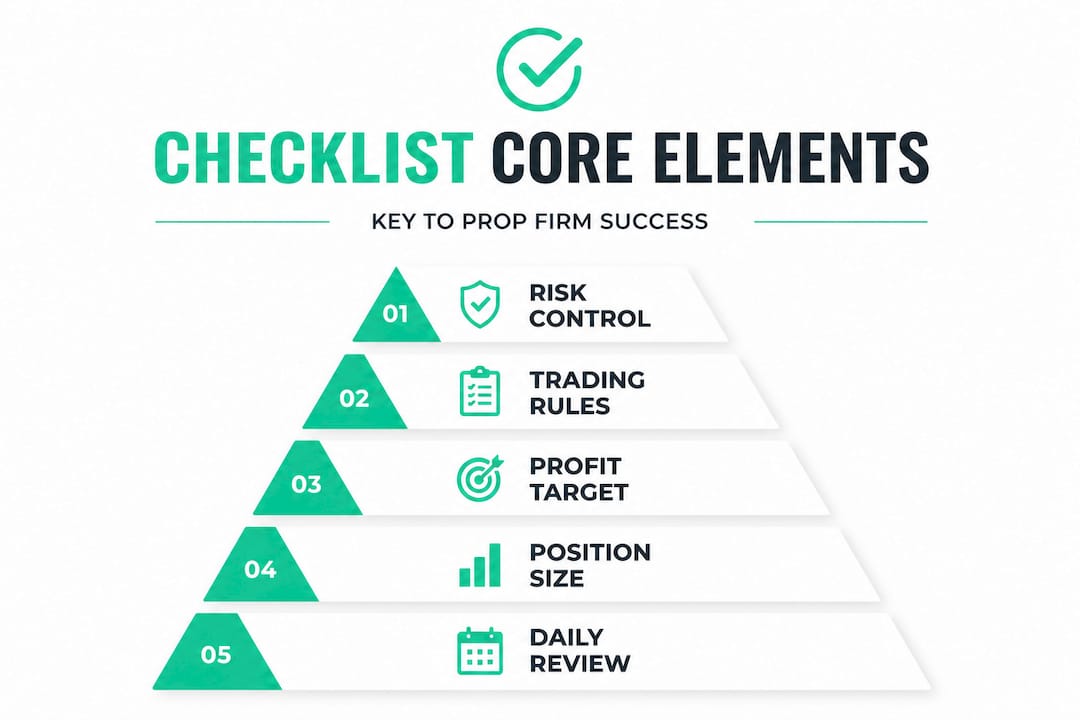
A trader evaluation checklist is only as effective as its structure. Without covering the right categories, you risk overlooking areas that prop firms specifically test. According to trading rules for success, trader evaluation checklists should cover risk management, trading rules, profit targets, and account scaling. These four pillars form the backbone of any reliable evaluation framework.
Each category serves a distinct function. Risk management keeps your account within the firm’s drawdown limits. Trading rules ensure your strategy aligns with the firm’s specific guidelines. Profit targets keep you focused on reaching the required threshold without overtrading. Account scaling addresses what happens after you pass, including how your capital grows and what conditions apply to larger allocations.
Here is how these elements compare in terms of evaluation impact:
| Checklist element | Primary function | Evaluation weight |
|---|---|---|
| Risk management | Controls drawdown and daily loss | Very high |
| Trading rules | Ensures compliance with firm policy | Very high |
| Profit targets | Tracks progress toward pass threshold | High |
| Account scaling | Plans post-pass capital growth | Moderate |
| Trade journaling | Identifies patterns and rule violations | Moderate |
| Session discipline | Manages trading hours and frequency | Moderate |
When choosing a prop firm, understanding which checklist elements matter most to that specific firm gives you a measurable advantage. Some firms weight drawdown violations heavily. Others focus on consistency scores. Mapping your checklist to a firm’s actual scoring criteria is not optional; it is essential.
Your checklist should also include trading-style-specific items. A scalper needs to track average trade duration and spread sensitivity. A swing trader must account for overnight holding policies and weekend gap risk. Build your checklist around the type of trading you actually do, not a generic template that may not apply to your strategy.
Key areas every checklist must address include:
- Maximum daily loss limit: Know the number before you open a single trade
- Total drawdown ceiling: Track this after every session, not just when it feels relevant
- Profit target progress: Log your current account balance versus the pass threshold
- Rule compliance review: Run through firm-specific rules before and after each trading day
- Position sizing verification: Confirm lot sizes align with current account equity and risk rules
- News and event restrictions: Check whether the firm prohibits trading around high-impact news events
Each item on this list represents a real failure point in evaluations. Traders who ignore even one category frequently find it is that category that causes a disqualification.
Step-by-step: Assembling your personalized evaluation checklist
With the core elements identified, the next step is building your own checklist in a format you will actually use. Passing a prop firm challenge becomes significantly more likely when you organize your preparation into clear, sequential steps. A checklist that lives in your head is not a checklist. Write it down, digitize it, or use a spreadsheet.
Follow this sequence to build your checklist from the ground up:
-
Define your risk parameters first. Set your personal daily loss limit below the firm’s maximum. If the firm allows a 4% daily drawdown, cap your own at 2.5%. This buffer prevents a bad session from ending your evaluation.
-
List every firm-specific rule. Read the firm’s terms carefully and note every restriction. Common rules include minimum trading days, profit consistency requirements, and limits on holding trades over weekends.
-
Set your profit target milestones. Break the overall profit target into weekly or daily sub-goals. This prevents the temptation to rush toward the target in the final days of an evaluation.
-
Build your trade entry criteria. Document the exact conditions required before you enter a trade. This might include confirmation of trend direction, minimum risk-to-reward ratio, and session timing requirements.
-
Create your pre-session routine. Include reviewing your current drawdown status, checking for scheduled news events, confirming your position size formula, and revisiting your profit target progress.
-
Set up your post-session review. After each session, log every trade, note any rule deviations, and calculate your remaining buffer before the maximum drawdown limit.
-
Define your scaling plan. If the firm offers account scaling after achieving funded status, document the conditions so you know exactly what performance is required.
Common prop trading mistakes include skipping post-session reviews and failing to document rule violations. Both habits create blind spots that compound over time.
Pro Tip: Start with a minimal checklist of five to seven core items. Once you have applied it consistently for two full evaluations, add complexity only where you identified genuine gaps. Overcomplicated checklists often get abandoned under pressure.
Risk management and rule adherence: The backbone of prop firm evaluations
A checklist without tight risk controls is largely decorative. Risk management and rule adherence are the primary factors that determine whether a trader passes or fails a prop firm evaluation. Every other checklist item exists in service of these two pillars.

Daily loss limits deserve particular attention. Many traders know their firm’s maximum daily drawdown but fail to set a personal hard stop well below that ceiling. If your firm allows a 5% daily loss and you hit 4.8% before deciding to stop, you are one bad trade away from disqualification. Set your personal stop at 60 to 70 percent of the firm’s limit and treat it as absolute.
Max drawdown, sometimes called trailing drawdown, is the metric that ends most evaluations prematurely. It measures cumulative losses from the account’s peak, not just from the starting balance. If your account grows and then pulls back, that pullback counts toward your drawdown limit even if you are still above your starting equity. Understanding this mechanic is critical to checklist accuracy.
Position sizing is the tool that ties everything together. Even a strong trading strategy becomes a liability if position sizes are inconsistent. Use a fixed percentage of current equity per trade, typically 0.5 to 1 percent, and recalculate after every session as your balance changes.
Key risk controls every evaluation checklist must include:
- Hard daily loss limit: A personal figure set below the firm’s maximum
- Trailing drawdown tracker: Updated daily based on peak account balance
- Per-trade risk cap: A fixed percentage of current equity, not a fixed dollar amount
- Correlation check: Avoid holding multiple positions in correlated pairs simultaneously
- Emotional state filter: A rule that prevents trading after two consecutive losing trades in a session
- Rule violation log: A running record of every time you deviated from your plan
“Strict risk management is not just a checklist item; it’s what separates funded traders from hopefuls.”
Experienced traders know that funded account trading strategies work best when risk controls are pre-committed, not decided in the moment. Review your funded trading strategies before each evaluation phase to make sure your approach matches the account conditions you are trading under.
Pro Tip: Keep a dedicated rule violation log in a simple spreadsheet. After four to six weeks, patterns emerge. You may discover that most violations happen on Fridays, or after a strong profitable streak. Data like this allows you to preemptively adjust your checklist rather than reacting after a disqualification.
Addressing common trading mistakes early in the checklist building process saves significant time and frustration. Most errors in evaluations are behavioral, not technical.
Evaluating prop firm offers and comparing funding programs
Your checklist is not only a trading tool. It is also a comparison instrument for evaluating which prop firm offers are worth your time and money. Prop firm challenge terms vary significantly, and comparing offers without a structured framework leads to poor decisions.
When vetting a firm, your checklist should include these assessment criteria:
- Challenge fee and refund policy: Does the firm refund the fee upon passing? Is the fee proportionate to account size?
- Profit split: What percentage do you retain after passing? The industry range runs from 70 to 90 percent for most credible firms.
- Payout speed and frequency: How quickly does the firm process withdrawals? Look for verified payout data, not just marketing claims.
- Scaling plan terms: What conditions trigger a capital increase, and how large are the increments?
- Rule strictness and consistency requirements: Some firms require that no single trading day account for more than a set percentage of total profits.
- Firm reputation and verified reviews: Cross-reference Trustpilot, Discord communities, and Reddit trader forums for real payout experiences.
Here is a comparison framework for evaluating two sample firms side by side:
| Comparison factor | Firm A | Firm B |
|---|---|---|
| Challenge fee (100K account) | $549 | $399 |
| Profit split (funded) | 80% | 75% |
| Max daily drawdown | 5% | 4% |
| Max total drawdown | 10% | 8% |
| Minimum trading days | 4 | 10 |
| Payout frequency | Bi-weekly | Monthly |
| Fee refund on pass | Yes | No |
Understanding how prop firms rank traders by internal criteria helps you assess whether your trading profile fits their preferred trader archetype. Firms that emphasize consistency scores, for example, tend to evaluate traders differently than firms that only care about hitting the profit target.
Red flags in funding programs include vague or frequently changing rule sets, missing or unverified payout testimonials, and excessively low challenge fees paired with strict drawdown limits. Research on why traders fail evaluations consistently points to a mismatch between the trader’s strategy and the firm’s specific rules, a problem that thorough upfront comparison prevents.
The uncomfortable truth most guides miss: Consistency matters more than complexity
Most traders approach checklist building the wrong way. They spend hours constructing elaborate frameworks with dozens of items, conditional sub-rules, and complex scoring systems. Then they abandon the checklist by week two because it takes longer to complete than an actual trade.
The real insight from watching traders succeed and fail across evaluations is this: a simple checklist applied consistently outperforms a detailed checklist applied occasionally. A seven-item checklist that you complete before and after every session is worth more than a thirty-item checklist you consult twice a week.
Traders who simplify, track, and repeat tend to identify their failure patterns faster. One trader might notice through daily logging that their only rule violations occur during the first thirty minutes of the London session. Another might find that their drawdown spikes on days following a large profit day, a pattern sometimes called “euphoric overtrading.” Neither insight is visible without consistent data collection, and neither is possible with a checklist you only use when you feel like it.
The prop trading mistakes guide reinforces this point repeatedly. The most damaging mistakes are not strategic failures. They are consistency failures. Traders who skip their pre-session risk check, who forget to update their drawdown tracker, who execute a trade before confirming it meets their entry criteria: these are the traders who fail evaluations they should have passed.
Edit your checklist every four weeks. Remove items you never actually use. Add items based on mistakes you actually made. Keep the list alive and functional rather than treating it as a static document. A checklist that evolves with your trading is a tool. A checklist that never changes is a ritual with no practical value.
Next steps: Unlock your funded trading potential with expert resources
Building a strong trader evaluation checklist is the first move. The next is backing it with reliable information about the firms and programs you are considering. Understanding key terminology for prop traders is essential before you enter any evaluation, since misunderstanding a rule due to unfamiliar language is a preventable and costly mistake.

For traders ready to move from preparation to action, detailed firm-level reviews provide the data needed to make confident decisions. The Eightcap review is one example of a structured, evidence-based assessment that covers fees, rules, payout reliability, and trader feedback. Reviewing multiple firms through the same analytical lens is exactly how your checklist translates into real-world decisions. Explore the full prop firm reviews library to compare verified data across firms and find the program that fits your trading profile, risk tolerance, and funding goals.
Frequently asked questions
What are the must-have items on a trader evaluation checklist?
The essentials include solid risk management rules, strict trading guidelines, clear profit targets, and account scaling criteria. A comprehensive evaluation checklist addresses all four categories to give you full coverage across the areas prop firms actually evaluate.
How can I personalize my trader evaluation checklist?
Customize it around your actual trading style and strategy, focusing on your documented strengths and your known weak points. Organizing it into actionable steps increases your likelihood of applying it consistently under the pressure of a live evaluation.
What risk management measures should prop traders track?
Track daily loss limits, max drawdown relative to your account peak, per-trade position sizing, and your overall rule compliance rate. Risk management adherence is the single most cited factor in evaluation outcomes, making it the highest priority on any checklist.
How do trader evaluation checklists help when comparing prop firm offers?
They provide an objective, structured basis for comparing fees, payout policies, drawdown rules, scaling terms, and overall firm credibility side by side. Since prop firm challenge terms vary widely, applying a consistent framework prevents emotional or incomplete decision-making when selecting a program.
Recommended
- Trading rules checklist for prop firm success (2026) | Responsible Trading
- How to Pass a Prop Firm Challenge in 2026: A Risk Management Blueprint (2026) | Responsible Trading
- Prop firm scoring systems: how to evaluate and succeed (2026) | Responsible Trading
- Challenge Simulator – Responsible Trading