


Most retail traders assume the biggest barrier to trading success is skill. In reality, it’s capital. Without a substantial account balance, even a disciplined trader with a proven strategy can struggle to generate meaningful returns. Funded accounts change that equation entirely. Through proprietary trading firms, traders can access capital that would otherwise take years to accumulate, provided they can demonstrate consistent, rule-compliant trading. This guide covers what funded accounts are, how they work in practice, the key differences between program types, and exactly what you need to know before applying.
Table of Contents
- What is a funded account?
- How do funded accounts work?
- Types of funded accounts and key differences
- Pros and cons of funded accounts for traders
- How to choose and succeed with a funded account
- The truth about funded accounts: Lessons most traders learn the hard way
- Take the next step with responsible trading resources
- Frequently asked questions
Key Takeaways
| Point | Details |
|---|---|
| Funded account basics | A funded account lets you trade with a firm’s capital instead of your own after passing their evaluation. |
| How they work | Traders usually complete a challenge or assessment to prove their skills before getting funded. |
| Types and models | There are instant and evaluation-based funded accounts, each with unique requirements and benefits. |
| Pros and cons | Funded accounts offer significant capital leverage but come with strict rules and potential fees. |
| Succeeding as a funded trader | Key to success is choosing the right program and adapting your trading strategy for consistent performance. |
What is a funded account?
A funded account is a trading account where the capital belongs to a proprietary trading firm, commonly called a prop firm, rather than the trader. The trader earns a share of any profits generated, while the firm absorbs the financial risk on the underlying capital. It is not a loan, and it is not a brokerage account. The trader never deposits the capital they are trading with.
The basic structure works in three stages. First, the trader completes an evaluation, often called a challenge, to prove their trading ability under simulated or live conditions. Second, upon passing, the trader receives access to a funded account with a pre-set capital amount, typically ranging from $10,000 to $200,000 or more depending on the firm. Third, profits generated in that account are split between the trader and the firm, with common splits ranging from 70/30 to 90/10 in favor of the trader.
Key terms you need to understand before applying:
- Drawdown limit: The maximum loss allowed before the account is terminated. This can be calculated on a daily basis, a total basis, or both.
- Profit target: The minimum percentage gain required to pass an evaluation phase.
- Profit split: The percentage of profits the trader retains versus what the firm keeps.
- Scaling plan: A structured program some firms offer that increases a trader’s capital allocation as they demonstrate consistent performance.
- Payout cycle: How often a trader can withdraw their share of profits, which varies widely by firm.
Understanding what instant funding accounts are is particularly useful, as some programs skip the traditional evaluation entirely and give traders immediate access to capital in exchange for stricter ongoing conditions.
Pro Tip: Many beginners focus exclusively on profit targets during evaluations but ignore drawdown rules. Violating a drawdown limit ends the account immediately, regardless of how close you are to a profit target. Understand both sides of the rulebook before you trade a single position.
The core benefit for retail traders is simple: you can trade at a scale that would otherwise be out of reach. A trader with $1,000 in personal savings can access a $100,000 funded account, earn on that full balance, and keep most of the profits, all without risking their own capital beyond the evaluation fee.
How do funded accounts work?
The process of going from applicant to funded trader follows a fairly consistent structure across most prop firms. While specific rules vary, the general workflow is predictable once you understand the stages involved. Mastering the funded trader workflow is one of the most important steps toward long-term success in prop trading.
Here is a step-by-step breakdown of how most funded account programs work:
- Choose a firm and program. Research available prop firms and select a program that matches your trading style, preferred instruments, and risk tolerance. Pay close attention to drawdown rules, profit targets, and fee structures before committing.
- Pay the evaluation fee. Most programs require an upfront fee to enter the challenge phase. This fee typically ranges from $50 to $600 depending on the account size and firm. It is not a deposit on your funded account; it covers access to the evaluation environment.
- Complete the evaluation phase. Trade on a simulated or demo account under live market conditions. You must hit a profit target, usually between 8% and 10%, without breaching daily or overall drawdown limits. Some firms require two phases before funding.
- Pass verification. After completing the primary evaluation, many firms require a second, lower-target phase to confirm your results were not a fluke. This phase often has a reduced profit target of around 5%.
- Receive your funded account. Once all evaluation criteria are met, the firm provides access to a live or simulated funded account with real capital backing. You can now trade within the firm’s rules and earn your profit share.
- Request payouts. After a minimum trading period, which varies by firm, you can request withdrawal of your profit share. Common payout cycles run every 14 to 30 days, though some firms allow bi-weekly or even on-demand payouts.
What happens if you breach a rule? Most firms immediately terminate the funded account. You lose access to the capital, and if you want to try again, you typically need to pay another evaluation fee. Some firms offer a reset option for an additional cost, which restores the account to its starting balance.
Pro Tip: The evaluation phase is where most traders fail, and not because of poor strategy. Overtrading during a losing streak is the most common reason traders breach drawdown limits. Set a maximum daily loss rule for yourself that sits comfortably below the firm’s limit, then respect it without exception.

Types of funded accounts and key differences
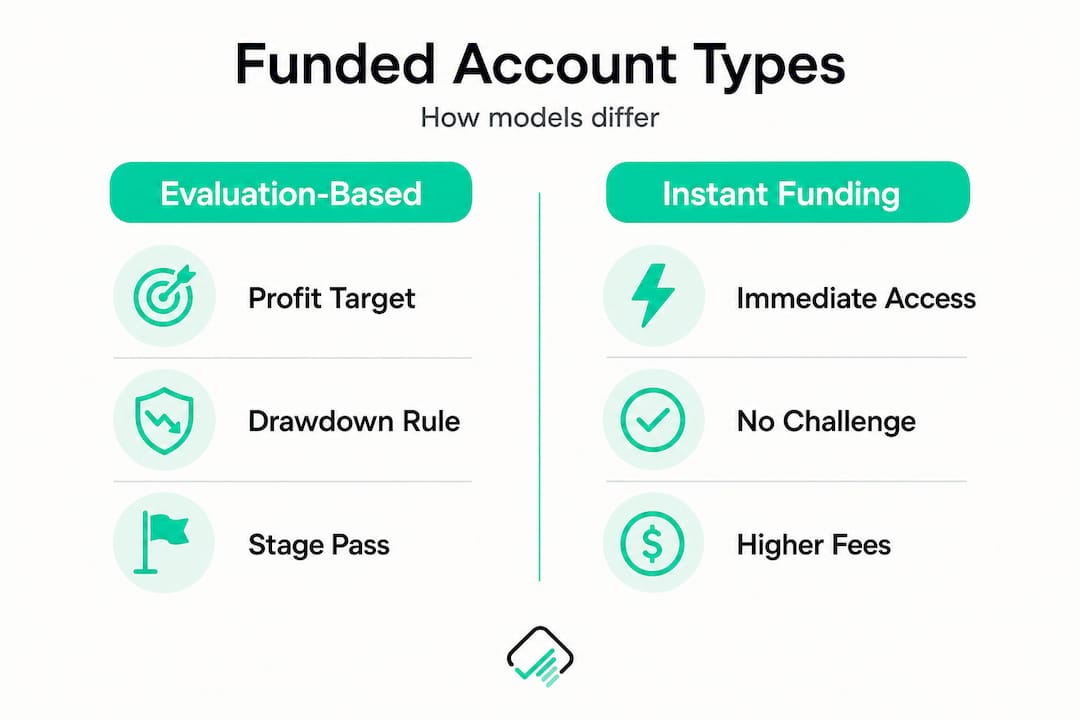
Not all funded accounts follow the same model. The three primary categories are evaluation-based programs, instant funding programs, and broker-integrated funding solutions. Each carries different tradeoffs in terms of speed to access, cost, and ongoing conditions.
The comparison between funded accounts vs brokers reveals meaningful structural differences that affect how you trade day to day.
| Feature | Instant funding | Evaluation-based | Traditional broker |
|---|---|---|---|
| Time to access capital | Immediate | Days to weeks | Immediate |
| Upfront cost | Higher fee or profit split | Evaluation fee | No mandatory fee |
| Capital at risk | Firm’s capital | Firm’s capital | Trader’s own capital |
| Drawdown rules | Strict, often tighter | Defined per challenge | None imposed by broker |
| Profit split | 50-80% to trader | 70-90% to trader | 100% to trader |
| Scalability | Limited | Often includes scaling | Dependent on trader capital |
Instant funding programs allow traders to skip the evaluation phase entirely and begin trading funded capital right away. The tradeoff is typically a lower initial profit split or stricter ongoing rules. These programs work best for experienced traders who are confident in their consistency and want to avoid the evaluation process.
Evaluation-based programs are the most common model. They require traders to prove their skills before receiving capital, which filters out underprepared applicants. The upside is that passing traders usually access more favorable profit splits and clearer scaling paths.
When each model is preferred:
- Instant funding is best for experienced traders with a verified track record who want to avoid evaluation delays.
- Evaluation-based programs suit traders still refining their strategy who benefit from the structured feedback and lower entry cost.
- Broker accounts remain appropriate when a trader has sufficient personal capital and wants full control over trading decisions without firm-imposed rules.
Pros and cons of funded accounts for traders
Funded accounts offer genuine advantages, but they also carry real drawbacks. A balanced perspective helps you set realistic expectations before you commit to a program.
| Pros | Cons |
|---|---|
| Access to large capital without personal risk | Upfront evaluation fees |
| Profit share on institutional-sized accounts | Strict rules can limit strategy flexibility |
| Risk is borne by the firm, not the trader | Payout delays and restrictions |
| Evaluation process builds disciplined habits | Psychological pressure to perform consistently |
| Scaling potential as performance improves | Account termination on rule breach |
The advantages extend beyond just capital access. Many traders report that working within evaluation rules forces them to adopt better risk management habits. Position sizing, drawdown awareness, and consistency become priorities rather than afterthoughts.
Traders who benefit most from funded accounts:
- Retail traders with a tested strategy but limited personal capital
- Forex and CFD traders familiar with leverage and position sizing
- Disciplined traders who can follow rules under real market pressure
- Traders looking to scale their income without raising external investment
Traders who may struggle with funded accounts:
- Those who rely on discretionary, high-variance trading styles that frequently hit large drawdowns
- Beginners who have not yet developed a consistent, rule-based approach
- Traders who are not comfortable with external performance monitoring
“The most dangerous moment in funded trading is right after you pass the evaluation. A common mistake is relaxing risk discipline once real capital is in play, which is precisely when the rules matter most. Sustainable funded trading demands the same habits that got you funded, every single session.”
Understanding scaling strategies for funded accounts becomes critical as you progress. Scaling is not automatic. It requires sustained performance over time and meeting specific milestones set by each firm. Pairing scaling plans with sound funded account trading strategies is the most direct path to growing your allocation.
How to choose and succeed with a funded account
Selecting the right program requires more than comparing profit splits. The rules, payout structure, and firm credibility all factor into whether a funded account will work for your specific situation.
Follow this process when evaluating and applying for a funded account:
- Define your trading style and instruments. Confirm the firm supports your preferred markets, whether that’s forex pairs, indices, commodities, or futures. Not all firms cover every asset class.
- Compare drawdown rules carefully. Look for firms with trailing drawdown versus static drawdown. Trailing drawdown is more restrictive because the maximum loss threshold rises as your account grows, meaning a profitable day can actually tighten your safety margin.
- Check payout speed and track record. Review independent sources such as Trustpilot, Discord trading communities, and trader forums. Look for consistent payout reports, not just marketing claims. Slow or inconsistent payouts are a major red flag.
- Read the fine print on fees. Some firms charge monthly data fees, platform access fees, or reset fees on top of the initial evaluation cost. Calculate your true break-even point before applying.
- Start at a moderate account size. It may be tempting to go straight for a $200,000 account, but starting with a $25,000 or $50,000 account reduces the pressure and lets you get familiar with the firm’s rules before trading at maximum scale.
- Adapt your strategy to the firm’s rules. If your strategy uses wide stop losses that occasionally hit 3% to 4% daily drawdown, it will not survive a firm with a 2% daily limit. Adjust your position sizing and stop placement to fit within the rules before you start.
Pro Tip: One of the most common mistakes new applicants make is testing a completely new strategy during the evaluation. Use a strategy you have already validated in personal trading or on demo accounts. The evaluation is not the place to experiment.
When does scaling to bigger accounts make sense? Only after you have completed at least two to three payout cycles with consistent results. Firms often have formal scaling funded accounts pathways that increase your allocation by 25% to 50% after hitting performance targets over a defined period. Moving too fast into larger accounts before your process is stable often results in rule violations and account termination.
The truth about funded accounts: Lessons most traders learn the hard way
Passing an evaluation is a technical achievement. Sustaining funded trading over months or years is an entirely different challenge. This distinction is one that most new traders underestimate, sometimes significantly.
The psychological dimension of funded trading is routinely underestimated. When the capital you are managing belongs to a firm and the rules are externally imposed, the emotional stakes change. Losing a $100,000 funded account, even if it costs you only the evaluation fee in personal capital, carries a psychological weight that affects decision-making. Many traders develop a fear of being stopped out that leads them to hold losing positions longer than their strategy dictates, which is precisely the behavior that causes drawdown breaches.
There is also a performance trap that catches experienced traders. The evaluation process, by design, rewards conservative and consistent trading. Once funded, some traders shift toward more aggressive behavior in an attempt to reach payout thresholds faster. This change in behavior is statistically one of the most common reasons funded accounts are lost within the first month of activation.
Sustainable success in prop trading comes down to process, not performance. Firms reward traders who respect their rules consistently over a long period. The successful funded account strategies that hold up over time are almost never the most complex or the most aggressive. They are the strategies that protect capital first and generate returns second.
Another lesson that takes time to learn: not all prop firms are created equal. The funded account industry is relatively unregulated, and some firms have faced credibility issues around delayed payouts, retroactive rule changes, or unclear account termination policies. Independent review platforms exist precisely to help traders avoid poor-quality programs before paying evaluation fees.
Take the next step with responsible trading resources
Choosing the right funded account program is easier when you have access to objective data and real trader feedback rather than relying on marketing alone.
At Responsible Trading, we test and evaluate prop firms directly, cross-referencing payout data, rule fairness, and platform quality so you get an unbiased view of each program. Whether you are looking for the best forex trading platforms for prop firms or need to map out your path through a structured funded trader workflow guide, our resources are built specifically to help traders make informed decisions. Use our comparison tools and firm rankings to find a program that matches your strategy, your risk tolerance, and your income goals.
Frequently asked questions
How do I qualify for a funded trading account?
You typically need to pass an evaluation or challenge set by a prop firm, proving consistent profitability and risk management across a defined trading period. The exact criteria vary by firm, but most require hitting a profit target without breaching drawdown limits.
How is a funded account different from a regular broker account?
A funded account gives you access to the firm’s capital after you meet their performance criteria, while a broker account requires you to trade your own money. The key difference between funded accounts and broker accounts is who bears the capital risk.
Do I keep all the profits in a funded account?
No. Most funded accounts use a profit split structure, meaning you keep a defined percentage of profits while the firm retains the rest. Common splits favor the trader at 70% to 90%.
Are funded accounts available for all types of trading?
Most funded accounts cover forex, CFDs, and futures. However, not every firm supports every asset class, so verifying instrument availability with specific prop firms before applying is important.
What risks should I know before applying for a funded account?
Key risks include upfront evaluation fees, strict trading rules, payout restrictions, and the psychological pressure of managing firm capital. Reviewing the full risk profile of any program before committing is strongly recommended.
Recommended
- Master the funded trader workflow: step-by-step success guide (2026) | Responsible Trading
- Funded Account Trading Strategies That Actually Work in 2026 (2026) | Responsible Trading
- Prop firm rules explained: Your guide to funding success (2026) | Responsible Trading
- Prop trading terminology: 9 key concepts for funded success (2026) | Responsible Trading