


Getting banned from a prop firm is rarely the dramatic event most traders imagine. You don’t have to be caught cheating or running some sophisticated scheme. Sometimes it’s a single trade placed during a restricted news window. Sometimes it’s a trading pattern that a firm’s risk engine flags as suspicious, even if every individual decision you made was technically within bounds. Retail traders consistently underestimate how many ways a funded account can be terminated, and that gap in knowledge costs real money, often right at the moment of a trader’s first significant win.
Table of Contents
- The real reasons prop firms ban traders
- Common rule violations that trigger bans
- Are profitable traders really banned just for winning?
- Regulatory challenges and compliance crackdowns
- How to avoid getting banned: Practical strategy design
- The uncomfortable truths firms (and traders) won’t tell you
- Ready to navigate prop firm rules and win responsibly?
- Frequently asked questions
Key Takeaways
| Point | Details |
|---|---|
| Ban triggers | Most bans are due to risk and rule violations, not just high profitability. |
| Prohibited strategies | HFT, latency arbitrage, and hedging across accounts are common causes for bans. |
| Regulatory influence | Increased regulation leads firms to enforce bans and compliance more aggressively. |
| Strategy design | Clear, compliant risk management and avoiding exploit-like behavior minimize ban risk. |
| Transparency matters | Choose firms with clear rules and proven payout reliability for best outcomes. |
The real reasons prop firms ban traders
Prop firms ban or disqualify traders primarily to protect their capital, their liquidity providers, and the commercial viability of their business model. This is worth stating plainly, because many traders enter these programs assuming bans are reserved for outright fraud or obvious rule violations. The reality is broader than that.
Prop firm rules function as guardrails rather than simple agreements. They are designed to prevent behaviors that would make the firm’s risk model unsustainable. According to an analysis of rule violations and consequences, firms treat bans as protection against reckless risk or actions that threaten their operating structure. When a trader’s behavior creates asymmetric exposure or exploits the mechanics of a simulated evaluation, the firm’s response is typically immediate termination.
The common misconception is that firms only punish extreme behavior. In practice, firms enforce rules with varying levels of strictness, and some policies exist precisely because they protect against methods that exploit platform limitations rather than actual market risk. Understanding that logic is the first step to staying funded.
Common reasons for disqualification include:
- Exceeding daily loss limits, often a hard stop that triggers automatic termination
- Violating maximum drawdown thresholds, including trailing drawdown rules that move against you even on winning days
- Using prohibited trading strategies, including high-frequency approaches or latency-based execution
- Trading during restricted hours, such as major news events
- Account misuse, including sharing credentials or opening positions outside permitted instruments
“Prop firms use bans and disqualifications as risk and platform guardrails to protect firm capital, liquidity providers, and the business model.” — AlphaExCapital
Use the trading rules checklist to audit your approach before you start any new challenge, and always watch for red flags in prop firms that signal unclear or inconsistently enforced policies.
Common rule violations that trigger bans
Now that you understand the underlying logic, here are the specific actions and mistakes that most frequently lead to bans, often without the trader realizing what triggered the decision.
-
Exceeding daily or overall loss caps. This is the single most common cause of disqualification. Most firms set a daily loss limit somewhere between 4% and 5% of account value. Breach that line once and the account is closed, regardless of your overall performance.
-
High-frequency trading and latency arbitrage. Many bans are triggered by exploit-like trading behavior, such as HFT or latency arbitrage strategies, that break the assumptions built into a firm’s simulated evaluation environment. These approaches create asymmetric risk outcomes and are prohibited at virtually every major prop firm.
-
Hedging across accounts or copy trading. Firms prohibit cross-account hedging and coordinated behavior because these tactics can be used to extract payouts without genuine market exposure. A trader who opens a long position on one account and a short on another is neutralizing risk in a way that defeats the purpose of a funded challenge.
-
Trading during restricted windows. Many firms prohibit holding positions around high-impact news events. A trade that happens to be open when a major announcement drops may be flagged even if you placed it hours earlier with no news intent.
-
Inconsistency flags from risk engines. Automated systems monitor for statistically unusual win rates, position sizing anomalies, and execution timing. Patterns that look irregular can trigger manual review or automatic disqualification.
| Violation type | Frequency of bans | Reversible? |
|---|---|---|
| Daily loss limit breach | Very high | Rarely |
| HFT/latency arbitrage | High | No |
| Cross-account hedging | High | No |
| News window trading | Moderate | Sometimes |
| Copy trading detection | Moderate | No |
| Credential sharing | Low | No |
Pro Tip: Before running any systematic or algorithmic strategy through an evaluation, test it against the firm’s specific rule set using a challenge simulator. Even strategies that appear manual can trigger automated flags if execution frequency or pattern recognition crosses firm-specific thresholds.
Review the hidden prop firm rules guide for the fine print that most traders overlook, and familiarize yourself with the consistency rule requirements that govern how evenly distributed your profits need to be across trading days.
Are profitable traders really banned just for winning?
With the mechanics of rule breaches covered, it helps to address one of the most emotionally charged controversies in retail prop trading: do firms actually ban traders simply for being too profitable?
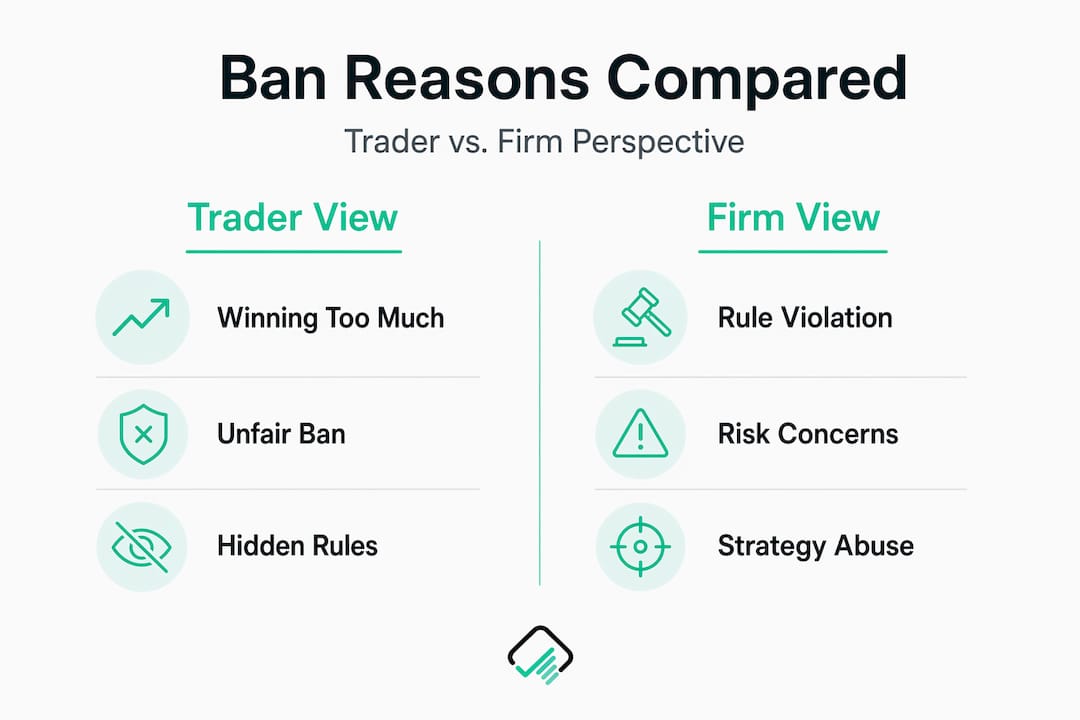
The short answer is that firms deny this framing entirely. Public forums, social media threads, and trader communities are full of stories claiming that unusually high returns triggered account termination. However, documented cases consistently show that the firm’s stated justification is almost always tied to how the profits were generated, not the dollar amount itself. The framing is invariably about a rule breach, an exploit, or a policy interpretation issue.
This matters because it shifts responsibility back to the trader in most documented cases. If the profit came from a strategy that violates the firm’s terms, the firm treats the payout as illegitimate, regardless of how the trader perceives it.
| Trader’s framing | Firm’s framing |
|---|---|
| “Banned for winning too much” | “Profits resulted from a prohibited strategy” |
| “Targeted after large withdrawal request” | “Account flagged for rule breach pre-withdrawal” |
| “No explanation given” | “Violation of terms cited in account closure” |
| “Rules were ambiguous” | “Policy applies as written in challenge agreement” |
That said, the gap between trader perception and firm communication is real. Some firms communicate ban rationale poorly or inconsistently, which creates genuine confusion and, in some cases, legitimate grievances. The absence of clear explanation doesn’t mean the firm acted fairly, but it also doesn’t confirm that profitability alone was the cause.
Check prop firm payout proof data before committing to any program, and consider the broader advantages of prop firm funding when evaluating whether the trade-off between capital access and rule complexity is worth it for your specific trading style.
Regulatory challenges and compliance crackdowns
Beyond internal firm policies, there is an external force driving stricter enforcement across the industry: regulatory scrutiny of retail prop trading is increasing globally.
Most retail prop firms operate in a regulatory gray area. They are not traditional brokers, and the legal classification of their services varies by jurisdiction. To reduce liability, many firms have responded by tightening rules, adding compliance monitoring, and enforcing bans more aggressively. A firm in a jurisdiction facing new oversight may suddenly enforce rules it previously applied loosely, catching experienced traders off guard.
“Retail prop firms operate under a regulatory gray area, and firms may tighten enforcement and banning to reduce legal, compliance, and oversight risk, including around how they handle payouts and disclosures.” — LuxAlgo
This regulatory dynamic has a practical implication for traders. Policies that were tolerated informally one quarter may be enforced strictly the next, with no individual notification. A trading approach you used successfully six months ago may now result in an immediate ban if the firm’s compliance posture has shifted. The safest response is to stay informed about both the firm’s rule updates and broader regulatory developments in the regions where they operate.
Pro Tip: Monitor the changelog or announcement sections of any prop firm you are enrolled with. Rule updates are often posted quietly, and firms typically apply new policies to all active accounts immediately rather than grandfathering existing traders.
How to avoid getting banned: Practical strategy design
With the rules and pitfalls clearly identified, here is how to design your trading approach to substantially reduce ban risk.
-
Build your strategy around the firm’s risk limits, not against them. Define your maximum daily loss, position sizing, and drawdown exposure before you open a single trade. Your risk per trade should sit far enough below the firm’s hard limits that a losing streak cannot reach the threshold in a single session.
-
Eliminate any strategy component that could be classified as an exploit. This includes any form of latency-based entry, news spike scalping in restricted windows, or execution timing that a risk engine could flag as systematic HFT-like behavior. If a strategy earns its edge from speed rather than market analysis, it almost certainly violates firm terms.
-
Understand how drawdown is calculated at your specific firm. Some firms use trailing drawdown, meaning your maximum drawdown floor rises as your account balance increases. A trader who grows their account quickly can find their drawdown threshold dangerously close to current equity without realizing it.
-
Avoid all cross-account activity. Even if you have accounts at the same firm for legitimate reasons, opening offsetting positions across those accounts will be detected and treated as hedging.
-
Stay current on rule revisions. Firms update their terms more often than most traders check. Subscribe to firm communications and review the terms before each trading cycle.
A critical nuance worth noting: backend risk calculations can classify outcomes in ways that disqualify trades which were technically compliant. Drawdown trailing, intraday exposure measures, and restricted news windows can result in a ban even when your intention was entirely within the rules. Intent is not what the system evaluates. Behavior and outcomes are.
Use the prop firm checklist to build a pre-trade routine that accounts for all known risk parameters before you enter any position.

The uncomfortable truths firms (and traders) won’t tell you
There is a version of this conversation that most educational resources avoid, and it is worth addressing directly. The prop firm industry has a structural incentive problem that neither side tends to acknowledge openly.
Firms profit substantially from challenge fees paid by traders who fail evaluations. The business model works precisely because most people do not pass. This creates an environment where rule enforcement is, in some cases, applied selectively or communicated poorly, not always as deliberate bad faith, but as a natural consequence of unclear documentation and under-resourced support teams. Traders, on the other hand, often enter these programs focused on the funded account at the end rather than the compliance requirements along the way.
Public commentary and legal analysis suggests that while bans are sometimes perceived by retail traders as revenue protection after the fact, available evidence generally frames enforcement as contract compliance and rule-breach illegitimacy rather than simple refusal to pay out winners. That framing may be accurate in most cases. But it does not excuse firms from communicating their rules clearly, enforcing them consistently, or explaining their decisions transparently.
The most practical takeaway is this: treat your trading relationship with a prop firm as a business contract, not a contest. Read the full terms before paying a challenge fee. If a rule is ambiguous, ask for clarification in writing before you trade the strategy in question. Choose firms with publicly documented track records for fair enforcement by consulting detailed prop firm reviews from independent sources. Prioritize transparency over marketing claims, and demand clear answers when something is unclear.
The traders who consistently stay funded are not necessarily the most talented. They are the ones who understand the operational environment they are trading in.
Ready to navigate prop firm rules and win responsibly?
If you want to steer clear of problematic firms and put this knowledge into action, here is where to start.
Responsible Trading provides independent, evidence-based reviews and comparison tools built specifically for retail traders navigating the prop firm landscape. Whether you are evaluating your first challenge or reassessing an existing firm relationship, you can explore best forex trading platforms reviewed for rule fairness and payout reliability. Use the prop firm reviews database to compare firms across trustworthiness, drawdown policies, and payout history. And read the detailed prop firm comparison guide to make a fully informed choice before you commit your challenge fee. Knowledge is the most effective ban prevention available.
Frequently asked questions
Can you get banned by a prop firm even if you follow the rules?
Yes, bans can happen due to technicalities, backend risk parameters, or patterns that appear suspicious even without an explicit rule breach. Backend risk calculations can classify technically compliant trades as disqualifying based on timing or behavioral patterns rather than intent.
Is it true that profitable traders are targeted for bans?
Firms consistently state that bans follow rule violations or exploitative practices, not profitability itself. Documented cases show firms frame high-profit bans as resulting from prohibited strategies or policy breaches rather than the size of the gains.
What are the riskiest strategies that often get traders banned?
High-frequency trading, latency arbitrage, hedging across accounts, and copy trading are the most common ban triggers. HFT and latency arbitrage break the assumptions of simulated evaluations, while cross-account hedging is treated as an attempt to extract payouts without real market exposure.
How do regulations impact who prop firms ban?
Increasing regulatory scrutiny causes firms to enforce rules more strictly to reduce legal exposure. Retail prop firms operate in a gray area that pushes them to tighten compliance policies, sometimes with little notice to active traders.