


Choosing the right prop trading firm is one of the most consequential decisions a retail trader makes, yet many approach it based on marketing claims alone. The reality is that two firms can offer identical challenge structures on paper while delivering wildly different experiences in practice. Trader reviews close that gap. They surface facts about payout reliability, rule enforcement, and support quality that no sales page will ever disclose. This guide explains how to read, interpret, and act on those reviews so you can select the firm that genuinely supports your trading strategy and profitability goals.
Table of Contents
- Why reviews matter in prop trading
- How to interpret review scores and payout benchmarks
- Spotting red flags and review manipulation
- Using reviews to tailor your trading strategy
- What most traders miss about reviews
- Unlock trusted prop trading insights with Responsible Trading
- Frequently asked questions
Key Takeaways
| Point | Details |
|---|---|
| Review scores validate trust | High ratings from thousands of traders indicate genuine firm reliability. |
| Payout benchmarks matter | Examining payout history helps predict your earning potential with a prop firm. |
| Beware review manipulation | Spotting suspicious review patterns protects you from unreliable firms. |
| Tailor strategy to reviews | Use detailed trader feedback to align your strategy with the best funding opportunities. |
| Cross-reference multiple sources | Comparing review platforms improves accuracy and reduces bias. |
Why reviews matter in prop trading
Prop trading firms operate in a space where marketing language is polished and promises are plentiful. A firm can advertise competitive profit splits and fast payouts without those claims being independently verified. This is where aggregated trader feedback becomes indispensable. Reviews represent real capital at risk, real challenges completed, and real payout experiences.
Prop firm reputation is built almost entirely through sustained trader feedback over time. A firm that consistently pays traders on time, communicates rule changes clearly, and resolves support tickets promptly will accumulate positive reviews organically. Firms that fail on any of these dimensions tend to generate clusters of negative feedback, often citing the same recurring issues.
The scale of review data available today is significant. Industry benchmarks show that FTMO holds a 4.8 out of 5 rating across more than 41,000 reviews, FundedNext sits at 4.5 out of 5 across 62,000 reviews, and FundingPips holds 4.5 out of 5 across 52,000 reviews. FTMO has distributed over $450 million in payouts, and Apex has surpassed $378 million. These figures do not come from firm marketing materials. They come from verified trader experiences.
“The volume and consistency of reviews tell you more about a firm’s operational reliability than any challenge comparison chart ever will.”
Consider what reviews actually validate. They confirm whether stated payout timelines hold up under real conditions. They reveal how support teams respond when a trader disputes a rule interpretation. They surface patterns in drawdown enforcement that may not be fully transparent in a firm’s written rules. For retail traders evaluating where to commit capital and months of effort, these are not peripheral details.
Key functions reviews serve in the selection process include:
- Payout verification: Traders report actual payout speeds, not advertised ones.
- Rule clarity confirmation: Feedback often reveals whether rules are applied consistently or arbitrarily.
- Support responsiveness: Repeated comments about slow or unhelpful support are reliable warning signals.
- Firm stability signals: Long review histories across multiple years indicate operational maturity.
Pro Tip: Before committing to any challenge fee, search the firm name alongside terms like “payout delay” or “account breach” on Reddit and Discord. Honest trader experiences surface quickly in those environments and often reveal patterns that aggregate review scores alone do not capture.
How to interpret review scores and payout benchmarks
A review score without context is only partially useful. A firm holding a 4.7 out of 5 rating based on 400 reviews is statistically far less reliable as a signal than a firm with 4.5 out of 5 based on 50,000 reviews. Volume matters because it reduces the influence of outliers and reflects a broader cross-section of trader experiences across different market conditions and account sizes.
When comparing top-rated firms side by side, the data presents a clear picture:
| Firm | Rating | Review count | Total payouts |
|---|---|---|---|
| FTMO | 4.8/5 | 41,000+ | $450M+ |
| FundedNext | 4.5/5 | 62,000+ | Not publicly disclosed |
| FundingPips | 4.5/5 | 52,000+ | Not publicly disclosed |
| Apex Trader Funding | N/A | Varies | $378M+ |
These empirical benchmarks serve as a baseline for evaluating newer or lesser-known firms. If a newer firm claims to be industry-leading but holds fewer than 2,000 reviews with a suspiciously perfect score, that asymmetry deserves scrutiny.
To use payout data effectively, follow this structured approach:
- Cross-reference payout claims with community reports. A firm advertising same-day payouts should have consistent mentions of that in trader forums, not just on its own website.
- Segment reviews by account size. Traders managing $100,000 funded accounts may have different payout experiences than those on $10,000 accounts. Filter where possible.
- Check for payout consistency over time. A firm with strong payout reviews from two years ago but declining scores recently may have changed ownership, rules, or financial structure.
- Assess the response to negative reviews. Professional firms respond constructively to criticism. A pattern of defensive or dismissive responses from firm representatives is a credibility risk.
- Compare profit split and drawdown data together. A high profit split means less if a firm’s drawdown rules are structured in a way that makes breaches likely. Reviews often expose this mismatch in ways that firm documentation does not.
Understanding prop firm payout methods matters here too, since payout speed and method, whether via bank transfer, cryptocurrency, or payment platforms, directly affects your liquidity and planning as a trader. Reviews frequently highlight friction points in payout processing that are worth knowing before you sign up.
When you see most trusted prop firms ranked on independent platforms, the ranking methodology typically weighs review volume and payout data together. That combination is more meaningful than either metric in isolation.
A useful benchmark to keep in mind: firms consistently paying out with high volume review backing represent a minimum standard for serious consideration. Firms falling significantly below that standard require a much higher burden of proof before you commit challenge capital.
Spotting red flags and review manipulation
The prop trading space has matured, but it is not immune to review manipulation. Some firms, particularly newer entrants trying to establish credibility quickly, have been associated with incentivized reviews, review gating, or flooding platforms with generic five-star feedback from accounts with no purchase history.
Reading prop firm reviews critically requires knowing what patterns signal authenticity versus manipulation. Key red flags include:
- Sudden rating spikes: A firm’s rating jumps from 3.2 to 4.6 within a few weeks with no operational explanation.
- Generic review language: Positive reviews that read almost identically, using vague phrases like “great firm, highly recommend” without any specific detail about challenge structure, payout experience, or support quality.
- Absence of negative reviews: Every firm with significant trader volume will accumulate some negative feedback. A profile with zero negative reviews across thousands of submissions is statistically improbable.
- Reviewer account patterns: First-time reviewers leaving five-star ratings immediately after account creation, with no other review history, are a common manipulation signal.
- Unresolved public complaints: Check whether negative reviews are acknowledged and addressed. Firms that ignore public criticism consistently are signaling poor accountability.
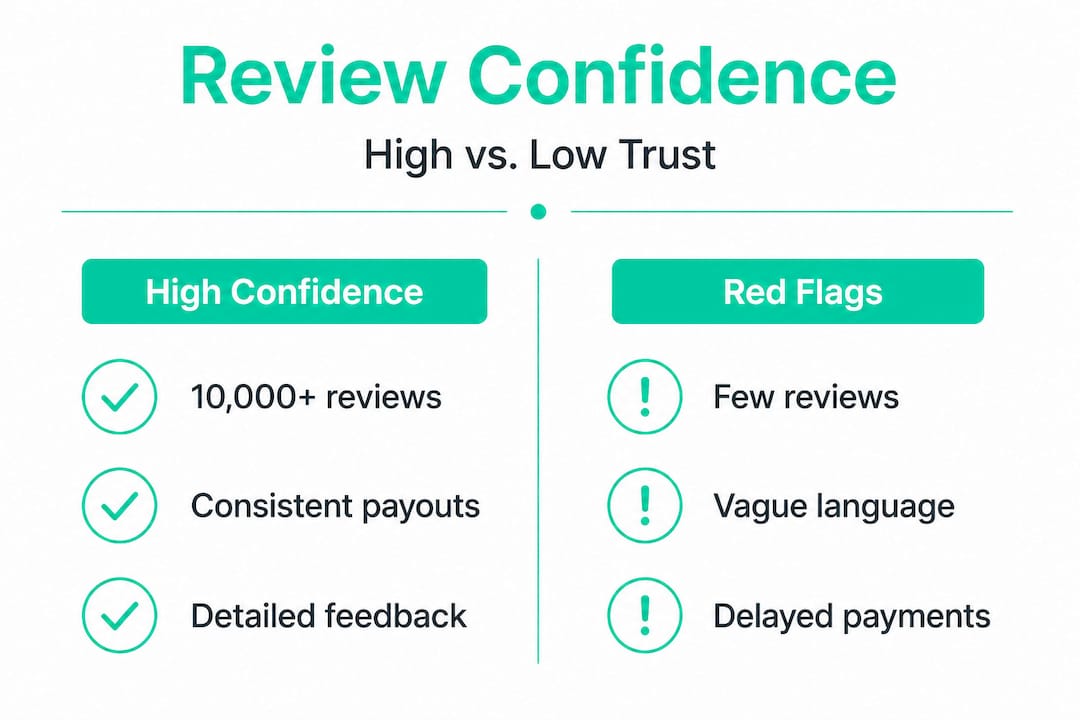
The following comparison illustrates the difference between high-confidence and low-confidence review profiles:
| Characteristic | High-confidence profile | Low-confidence profile |
|---|---|---|
| Review volume | 10,000+ | Under 500 |
| Rating consistency | Stable over 12+ months | Sharp recent spike |
| Review specificity | Detailed, experience-based | Generic, vague language |
| Negative review ratio | 5 to 15 percent | Near zero or over 40 percent |
| Firm response pattern | Constructive, timely | Absent or defensive |
Using established firm ranking criteria as a framework helps you apply these standards systematically rather than relying on intuition alone. Independent platforms that cross-reference Trustpilot data with Discord and Reddit communities offer substantially better signal quality than relying on a single review source.
Pro Tip: Always verify reviews across at least three platforms. Trustpilot, Reddit trading communities, and dedicated prop firm forums each attract different trader profiles. A firm that looks credible on one platform but draws consistent complaints on another has a credibility gap worth investigating before you invest challenge fees.
Using reviews to tailor your trading strategy
Reviews are not just a firm vetting tool. They are a strategic resource. Traders who read reviews with their own trading approach in mind extract significantly more value than those scanning for a simple positive or negative verdict.

Different trading strategies create different friction points with prop firm structures. A scalper who holds positions for seconds needs to know whether a firm’s platform allows that behavior or restricts it. A swing trader holding positions overnight needs clarity on overnight holding policies and news event restrictions. Reviews from traders using your strategy are the most directly relevant information you can find.
To build a review-informed selection framework:
- Filter for your strategy type. Search reviews alongside terms like “swing trading,” “scalping,” or “news trading” to surface experiences relevant to your approach.
- Identify rule application patterns. If multiple traders using your strategy report unexpected account breaches due to rule interpretations, that is a material risk for you specifically.
- Assess drawdown rule fit. Some firms use trailing drawdown, meaning the maximum loss limit adjusts upward as your account grows. Others use static drawdown. Reviews often clarify how these rules behave under real trading conditions.
- Look for strategy-specific payout confirmation. A firm may pay quickly for standard equity traders but experience delays for traders using specific instruments. Reviews with instrument-level detail matter.
- Map support quality to your risk tolerance. If you anticipate needing support during volatile market conditions, reviews about support responsiveness during high-activity periods are especially valuable.
Best prop firms consistently earn that designation not just because of their payout totals but because their rule structures accommodate a range of trading styles without creating unnecessary breach risk. Reviews make that reality visible in a way that firm documentation often does not.
Understanding how scoring systems work on independent review platforms gives you additional context for weighting the data you find. A six-point scoring model covering trustworthiness, payout reliability, rule fairness, customer support, value, and overall merit produces more actionable insight than a single aggregate star rating.
The industry benchmarks established by firms like FTMO, FundedNext, and FundingPips serve as a useful comparative baseline. When you evaluate a firm against those benchmarks using the lens of your own strategy, you move from passive consumer to informed decision-maker.
Pro Tip: Focus specifically on detailed, multi-paragraph reviews from traders who describe their strategy, account size, and the specific challenge phase they completed. Those reviews contain the most transferable insight and the least noise.
What most traders miss about reviews
The most common mistake traders make with reviews is treating the aggregate score as the complete answer. A 4.6 out of 5 rating tells you sentiment but not causality. It does not tell you why traders are satisfied or what specific conditions produced that satisfaction. The real value sits in the written content below the stars.
Seasoned traders approach reviews as a data analysis exercise. They look for repeated patterns in negative feedback to identify structural weaknesses. They note whether complaints cluster around specific account sizes, specific instruments, or specific payout thresholds. That kind of pattern recognition requires reading dozens of reviews, not scanning a summary dashboard.
There is an important principle here: “Combining payout statistics with granular feedback shows you which firms actually deliver long-term.” That observation holds up in practice. The best forex prop firms share a common characteristic: their review profiles contain specific, verifiable detail that aligns with independently reported payout data. The narrative and the numbers tell the same story.
The traders who consistently find the right firm are not the ones who pick the highest-rated option on the first platform they visit. They are the ones who map review patterns to their own risk profile, cross-reference across multiple sources, and treat the review research phase as seriously as they treat their technical analysis. Reviews are evidence. Use them that way.
Unlock trusted prop trading insights with Responsible Trading
Applying these review analysis principles requires access to reliable, structured data, and that is exactly what Responsible Trading provides. The platform conducts real-world testing by purchasing and evaluating actual trading challenges, then cross-referencing payout data across Discord, Reddit, Trustpilot, and direct trader submissions.
Whether you are evaluating your first funded account or reassessing your current firm, Responsible Trading’s resources help you move from uncertainty to informed action. Explore funded success concepts to sharpen your understanding of how the industry works, then use the platform’s structured evaluations to identify top-rated prop firms that align with your strategy and risk tolerance. Every ranking and review on the site reflects independent analysis, not affiliate-driven rankings.
Frequently asked questions
What review metric matters most when choosing a prop trading firm?
The combination of verified review volume and payout reliability is most important, as it signals both trust and consistent performance. Firms like FTMO with 41,000+ reviews and over $450 million in documented payouts set the credibility standard.
How can I spot manipulated or fake reviews in prop trading?
Look for sudden rating spikes, overly generic language, and reviewer accounts with no prior history. Cross-referencing across multiple platforms, including Reddit and Discord, is the most reliable way to identify manipulation patterns because community-driven forums are harder to game than isolated review sites.
Do high review scores always mean higher payouts?
Not necessarily. Consistent payout data and detailed review analysis offer more reliable insight than scores alone. A firm with a slightly lower aggregate rating but 62,000+ verified reviews like FundedNext may represent a more credible payout track record than a newer firm with a perfect but low-volume score.
How should reviews influence my trading strategy selection?
Reviews reveal firm strengths, weaknesses, and payout patterns specific to different trading approaches, helping you match your strategy to the right opportunity. Filtering reviews by strategy type, account size, and instrument gives you the most directly applicable evidence for your own trading decisions.
Recommended
- Prop firm scoring systems: how to evaluate and succeed (2026) | Responsible Trading
- Prop firm reputation: Why it matters most for traders (2026) | Responsible Trading
- Trading rules checklist for prop firm success (2026) | Responsible Trading
- How prop firms rank traders: criteria & evidence (2026) | Responsible Trading