
Knowing how to manage prop firm drawdowns is what separates traders who collect payouts from those who burn through funded accounts and restart from scratch. Over 70% of prop firm participants fail to reach payout largely due to drawdown violations, not poor trading strategies. The rules are unforgiving: breach your daily or maximum drawdown limit by even a fraction, and your account is gone regardless of how profitable you were before that moment. This guide breaks down exactly how drawdown rules work, how to build a framework around them, and how to execute trades without crossing those critical lines.
Table of Contents
- Understanding prop firm drawdowns and their impact
- Preparing to trade: setting up your drawdown management framework
- Executing trades while managing drawdowns effectively
- Common drawdown management pitfalls and how to avoid them
- Verifying and adapting your drawdown management for sustained success
- Why mastering drawdown management is the true test of funded trading success
- How Responsible Trading supports your prop firm drawdown management
- Frequently asked questions
Understanding prop firm drawdowns and their impact
Before you place a single trade on a funded account, you need to understand the role of drawdown in prop firms and how it governs every decision you make. Drawdown is the reduction in your account equity from its peak, and in prop trading, it operates as a hard boundary with no tolerance for exceptions.
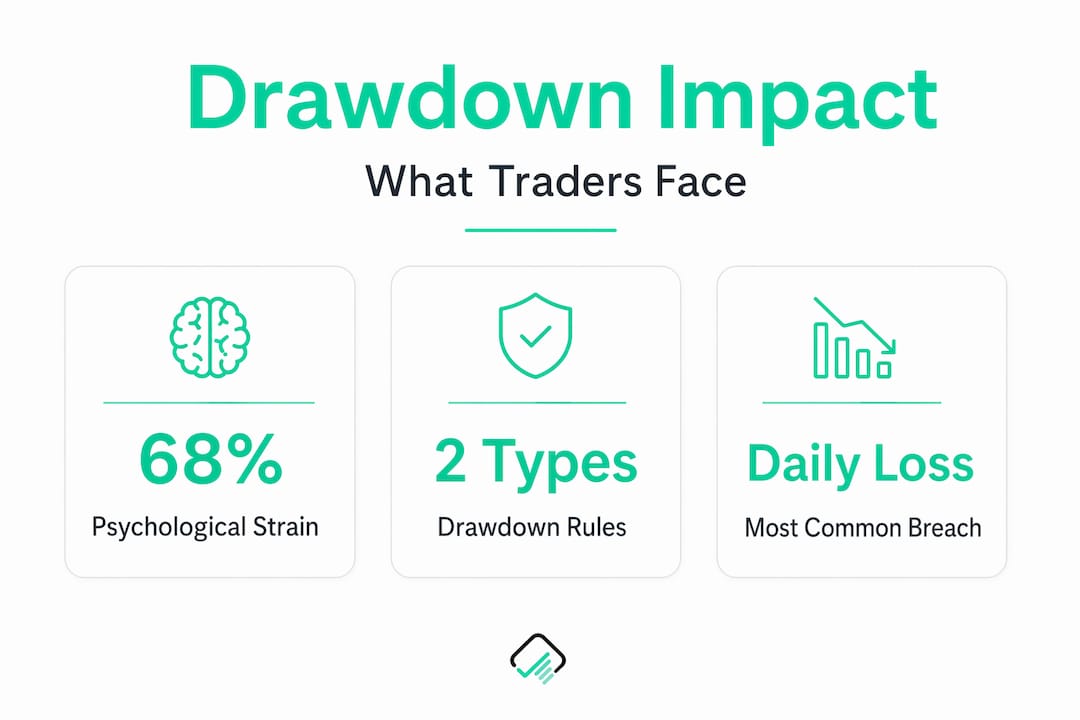
Most firms enforce two separate limits. Daily drawdown restricts how much you can lose within a single trading day, typically around 4-5% of account balance. Maximum drawdown caps total account losses across the account’s life, most commonly set at 10-12%. Breach either one and the account is closed immediately.
The type of drawdown your firm uses matters just as much as the percentages. Here is a quick comparison:
| Drawdown type | How it works | Risk level for trader |
|---|---|---|
| Static drawdown | Fixed loss limit from initial balance; never changes | Predictable, easier to plan around |
| Trailing drawdown | Moves up as equity peaks; tightens after profitable trades | More complex; winning can hurt your buffer |
| Balance-based | Calculated from account balance, excluding open P&L | More forgiving for swing traders |
| Equity-based | Includes unrealized losses on open trades | Tightest constraint; requires real-time monitoring |
The trailing drawdown model is where most traders get caught off guard. If you start a $100,000 account with a 10% trailing drawdown and run your equity up to $105,000, your drawdown floor rises to $95,000, not $90,000. A losing streak that follows now has less room to breathe.
Beyond the mechanics, 68% of traders cite psychological strain from rigid drawdown rules as the primary cause of failure, with only 22% achieving consistent profitability beyond three months. The pressure of watching every pip move against a hard limit changes how people trade, often for the worse.
Understanding these distinctions is the foundation of any serious approach to prop firm drawdown rules and forms the basis of everything that follows.
With the basics of drawdowns clear, let’s explore the essential preparations to trade within these rules effectively.
Preparing to trade: setting up your drawdown management framework
You cannot manage what you have not measured. Before opening any position, you need a complete picture of your firm’s specific rules and a plan that converts those rules into per-trade numbers.
Key preparation steps:
- Confirm whether your firm uses static or trailing drawdown, and whether calculations are balance-based or equity-based.
- Identify your exact daily drawdown percentage and maximum drawdown percentage.
- Divide your daily loss limit by your planned maximum number of losing trades to get a per-trade loss budget.
- Size each position so that your stop loss aligns with that per-trade budget, not the other way around.
- Set a personal daily stop loss at 70-80% of the firm’s limit to give yourself a safety buffer.
- Write out the rules for when you stop trading: after two consecutive losses, after reaching your personal stop, or after any trade that takes you within 1% of the firm’s daily limit.
Here is an example of how position sizing looks across different account sizes using a 5% daily drawdown limit and a plan of four losing trades maximum per day:
| Account size | Daily limit (5%) | Per-trade max loss | Example stop loss | Lot size (approx.) |
|---|---|---|---|---|
| $10,000 | $500 | $125 | 25 pips | 0.50 lots |
| $25,000 | $1,250 | $312 | 25 pips | 1.25 lots |
| $50,000 | $2,500 | $625 | 25 pips | 2.50 lots |
| $100,000 | $5,000 | $1,250 | 25 pips | 5.00 lots |
Allocating daily loss limits across your maximum expected losing trades and sizing positions accordingly is one of the most practical approaches to sustainable prop firm risk management.
Equally important: most firms calculate drawdown using equity, including open position P&L, not just closed trades. That means a floating loss on three open trades simultaneously counts against your daily limit right now, in real time.
Pro Tip: When you choose the right prop firm, prioritize firms with balance-based drawdown calculations if you are a swing trader or hold positions overnight. Equity-based calculations punish you for normal trade fluctuation, which increases the likelihood of an unintentional breach.
Reviewing a complete trading rules checklist before starting any challenge phase can help you confirm you have covered every rule-specific detail that varies between firms.
After preparing your drawdown framework, it is time to execute trades within those parameters using disciplined techniques.
Executing trades while managing drawdowns effectively
Preparation creates the structure. Execution is where discipline either holds or breaks down.
Step-by-step execution approach for managing drawdowns:
- Start each day with a written plan. Know your entry criteria, maximum position size, and your personal stop loss for the day before the market opens.
- Track equity in real time. Most platforms show floating P&L. Watch it relative to your daily limit, not just your closed trades.
- Reduce size after any loss. Successful funded traders cut position size by up to 50% immediately following a loss to protect their remaining buffer during the recovery phase.
- Treat trailing drawdown profits with caution. Trailing drawdown models update intraday as equity peaks, meaning a profitable trade can tighten your floor and leave you with less room than you started with. Size conservatively after gains.
- Set alerts on your platform. Configure notifications at 50% and 80% of your daily limit so you have time to react before hitting the ceiling.
- Stop trading once your personal daily limit is reached. Not the firm’s limit, yours. That 20-30% buffer is your protection against an unexpected spike.
Common execution pitfalls to avoid:
- Averaging down on a losing position to reduce your average entry price. This increases total exposure and accelerates drawdown.
- Entering a reversal trade immediately after a stop-out. Emotional trades placed in the minutes after a loss are rarely based on analysis.
- Trading during high-impact news without reducing size. Spreads widen, slippage increases, and moves can hit your stop before the market even reacts rationally.
Because firms measure drawdown continuously including floating losses, a sequence of three simultaneously open positions in a volatile market can breach your daily limit in seconds, not minutes.
Pro Tip: Use a separate spreadsheet or trade tracker that updates your remaining daily drawdown buffer as you open and close trades. Many traders use simple formulas that subtract floating losses from their daily limit in real time, which removes the guesswork during active trading sessions.

Reviewing a structured prop trading risk blueprint is one of the most direct ways to align your execution process with the exact constraints you are working within.
With disciplined execution strategies in place, you can now focus on avoiding the specific mistakes that cause premature account failures.
Common drawdown management pitfalls and how to avoid them
Even traders with solid strategies and good preparation make recurring mistakes when dealing with trading drawdowns. Most of them share one root cause: a gap between what traders assume the rules mean and what the rules actually say.
Mistakes that destroy funded accounts:
- Revenge trading. After a loss, the instinct to recover immediately pushes traders into oversized, poorly planned positions. 68% of traders who fail prop firm challenges cite this kind of psychological strain as the primary cause. The market does not owe you a recovery.
- Misreading firm-specific rules. Daily drawdown resets vary by firm: some reset at midnight server time, others at a specific hour in a different time zone. Trading near reset boundaries without knowing the exact rule is a blind spot that costs accounts.
- Confusing balance and equity drawdown. Ignoring floating losses and increasing position size after a partial loss is one of the most direct paths to account failure. If the firm calculates on equity, your open loss already counts.
- Holding correlated positions. Running long on EUR/USD and long on GBP/USD simultaneously doubles your effective directional exposure. If the dollar moves, both positions lose together and compound your drawdown instantly.
- Increasing size to recover faster. Doubling lot size to make back yesterday’s losses is a well-documented failure pattern. It compresses your buffer and removes the safety margin you built into your plan.
“The biggest mistake is treating a funded account like a demo account. Every decision needs to account for the hard boundary that exists on the other side of a drawdown breach.”
The most effective remedy for all of these pitfalls is consistent rule review before trading. Understanding prop firm rules in full and checking your common prop trading mistakes against a known list prevents the kind of errors that are 100% avoidable with preparation.
Understanding these pitfalls leads naturally into assessing your progress and adapting your approach for long-term funded account success.
Verifying and adapting your drawdown management for sustained success
Passing a prop firm challenge is not the final step. Maintaining a funded account over months requires ongoing review and honest self-assessment.
A structured review process:
- Log every session daily. Record opening equity, peak equity, lowest equity, closed P&L, and remaining drawdown buffer. Do not rely on memory or platform history alone.
- Review weekly. Look for patterns: Are you consistently using too much of your daily buffer on Mondays? Are you overtrading in the first hour of the session? Data reveals what intuition misses.
- Adjust position sizing quarterly. As your trading patterns evolve, your per-trade loss budget should reflect your current win rate and average risk-to-reward ratio, not the numbers you estimated when you started.
- Flag emotional sessions separately. If a session included a revenge trade, an impulsive entry, or a decision made under pressure, mark it. Review those sessions specifically to identify triggers and build a response protocol.
- Reassess after every drawdown event. Any session where you used more than 60% of your daily buffer should trigger a formal review, not just a mental note.
Most successful funded traders maintain detailed journals tracking daily losses and equity as a core practice, not an optional add-on. It is what separates traders who improve from those who repeat the same mistakes.
The professional mindset matters too. Treating a funded account as business capital focused on preservation and disciplined execution is what consistently profitable funded traders describe as the key shift in their approach.
Pro Tip: Use a trader evaluation checklist at the end of every week. Cross-reference your drawdown usage against your journal entries to identify whether your sizing, strategy, or psychology is the primary variable creating risk.
Your prop firm scoring approach can also help you evaluate whether the firm’s rules themselves match your trading style or whether a different structure would serve you better.
Having verified and adapted your drawdown strategy, let’s share a unique perspective on managing these challenges in today’s evolving prop firm landscape.
Why mastering drawdown management is the true test of funded trading success
Most traders approach a prop firm challenge as a profitability exercise. Reach the profit target, avoid the drawdown limit, collect the funded account. That framing is incomplete and it is why so many fail.
Drawdown rules are not an obstacle between you and profits. They are survival constraints. The moment you breach them, the account ends, regardless of your overall profitability up to that point. A trader who made 8% profit over 20 sessions and then lost 5% in one bad day with a 4% daily limit is finished. The prior 8% is irrelevant.
The phase that carries the most risk is not the initial trading period. It is the recovery phase after a significant loss. This is when most traders treat drawdown as a profit-target obstacle rather than a survival constraint, increasing size to recover faster and compressing the exact buffer they need to survive normal variance.
Trailing drawdowns make this worse. When your equity peaks and your floor rises with it, profitable trading narrows your loss tolerance. The firms that use trailing drawdown models are effectively requiring you to trade more carefully as you succeed, not less. That is the opposite of what most traders instinctively do.
The traders who maintain funded accounts long-term share one trait consistently: they prioritize capital preservation over any individual trade outcome. They reduce size when in doubt. They stop early on bad days. They do not treat the daily drawdown limit as a target to get close to. They treat it as a boundary that should never be approached at all.
Understanding the nuances of each firm’s rules and adapting your mindset accordingly is what produces lasting results. Reviewing a practical guide to avoiding prop trading mistakes is one of the most direct ways to identify where your current approach creates unnecessary risk.
How Responsible Trading supports your prop firm drawdown management
Managing drawdowns effectively starts with choosing the right firm and understanding its exact rules before you trade. Responsible Trading provides independent, data-backed resources specifically built for retail forex and CFD traders navigating prop firm challenges.

You can access a detailed risk management blueprint covering drawdown strategy and trader psychology, use a structured trader evaluation checklist to confirm your preparation before any challenge phase, and explore reviews of the best forex trading platforms suited to disciplined prop trading. Every resource on the platform is built around real-world testing and transparent evaluation criteria, so you can make informed decisions about which firms and tools align with your trading approach and drawdown tolerance.
Frequently asked questions
What is the difference between daily drawdown and maximum drawdown?
Daily drawdown limits the loss allowed within a single trading day, while maximum drawdown caps the total allowable loss over the account’s lifetime. Both limits operate independently, and breaching either one results in immediate account closure.
How does a trailing drawdown differ from a static drawdown?
A trailing drawdown rises with your highest equity, tightening your loss floor after profitable trades, while a static drawdown stays fixed to the starting balance. Trailing drawdown moves with equity peaks, so profitable sessions can reduce your remaining loss buffer.
Why do many traders fail prop firm challenges despite profitable trades?
Even profitable traders fail when they breach daily or maximum drawdown limits in a single session, which closes the account regardless of prior gains. Over 70% fail payout due to drawdown violations, with 68% citing psychological strain from rigid rules as the core driver.
How can traders effectively manage drawdowns during high-impact news events?
Reduce position sizes before scheduled news releases, avoid trading during firm-specific blackout windows, and widen stops to account for higher volatility and slippage. News-day risk management requires anticipating wider spreads and faster price moves that can breach limits before a rational response is possible.
What is the benefit of tracking real-time equity instead of just daily closing balance?
Real-time equity tracking includes unrealized P&L on open trades, which most firms count toward daily and maximum drawdown limits. Monitoring equity continuously prevents surprise breaches caused by floating losses that would not appear on a closed-trade-only balance view.
Recommended
- Prop Firm Drawdown Rules Explained: Trailing vs Static, Balance vs Equity (2026) | Responsible Trading
- Prop firm rules explained: Your guide to funding success (2026) | Responsible Trading
- How to Choose the Right Prop Firm for Your Trading Strategy (Step-by-Step Guide) (2026) | Responsible Trading
- How to Pass a Prop Firm Challenge — 7 Rules Every Trader Needs (2026) | Responsible Trading